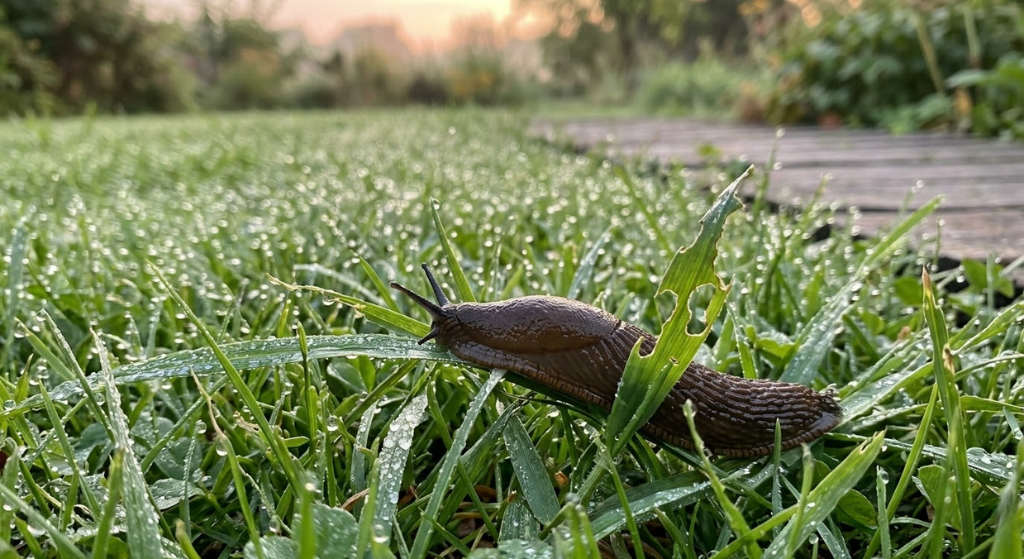
Few garden visitors divide opinion like the slug. Step outside on a dewy morning and you might see a dozen gleaming trails crossing your lawn, their authors long retreated beneath the thatch and soil surface. Step outside on a wet night and the grass can seem alive with them. But does any of this actually matter for your lawn’s health? Are slugs genuinely destroying your grass, or are they little more than a cosmetic inconvenience?
The answer turns out to be more nuanced than either the “slugs are harmless” or “slugs are devastating” camps suggest. This guide gives you the full picture — what slugs actually eat on a lawn, which conditions put your turf at genuine risk, how to tell real slug damage from other lawn problems, and the most effective ways to bring slug populations under control when they cross the damage threshold. We cover everything from the safest organic options to understanding the ecological role slugs play, and when doing nothing at all is the right call.
1. Are Slugs Actually Bad for Lawns? The Nuanced Truth
The question deserves a direct answer before diving into biology: slugs are a genuine problem for lawns under specific conditions and largely irrelevant under others. To understand which side of that line your lawn sits on, you need to know what slugs are actually doing when they’re out there at night.
Slugs are omnivorous detritivores — meaning they eat both living plant material and decomposing organic matter. On a lawn, this means they graze on grass blades (particularly the tender tips), consume fallen leaf debris and thatch, eat seedlings, and scavenge dead organic material in the soil. Not all of this is harmful. In fact, their role breaking down thatch and organic debris actually contributes to soil health in low numbers.
The damage threshold — the point where slugs shift from being background decomposers to actual lawn pests — depends on four factors:
- Population density — a few slugs per square meter cause negligible damage; dozens per square meter cause visible, persistent damage
- Grass maturity — established, actively growing turf recovers from slug grazing rapidly; newly seeded lawns and young seedlings can be killed entirely
- Moisture conditions — persistently wet lawns sustain larger slug populations than well-drained, properly irrigated ones
- Grass species — fine ornamental fescues and bentgrass are more susceptible than robust ryegrass or tall fescue
✅ When Slugs Are a Minor Issue
- Established, healthy lawn with dense turf
- Well-drained soil, proper irrigation timing
- Robust grass species (ryegrass, tall fescue)
- Moderate population — a few per square meter
- Warm, dry summer conditions
⚠️ When Slugs Become a Real Problem
- Newly seeded or overseeded lawn areas
- Fine ornamental or bowling green turf
- Persistent wet conditions, heavy clay soil
- Thick thatch layer providing ideal shelter
- Shaded areas with prolonged morning moisture
On most established residential lawns in average conditions, a realistic assessment is that slugs cause cosmetic ragged-edge damage to grass blades that the lawn grows out of within days. The turf looks slightly untidy if you look closely in the morning, but there is no permanent damage, no brown patches, and no threat to the lawn’s density or health. If this describes your situation, the most appropriate response is often to do nothing beyond addressing conditions that harbor excessive slug populations.
The calculus changes dramatically for newly seeded areas. Slug damage on new seed can mean losing an entire seeding investment overnight — slugs consume grass seedlings at the cotyledon stage before the plants have any resistance. This is where slug control becomes not optional but essential.
2. Slug Biology: Understanding What You’re Dealing With
Effective slug control is impossible without understanding how slugs live, reproduce, and behave. Their biology determines why standard pest control approaches that work on other lawn insects often fail on slugs entirely.
What Slugs Actually Are
Slugs are gastropod mollusks — more closely related to snails, clams, and octopuses than to any insect. They are not insects. This distinction matters enormously for control: insecticides kill insects by targeting insect-specific biological pathways. They have no effect on mollusks. A homeowner who applies a broad-spectrum lawn insecticide hoping to kill slugs will find it completely ineffective — slugs require molluscicides (compounds targeting mollusks specifically) or biological/physical control methods.
The UK is home to over 30 slug species. The US has fewer native species but several invasive European species have established widely. The most damaging species in both regions include:
- Gray field slug (Deroceras reticulatum) — the most common lawn pest; small, grey-brown, highly prolific
- Black slug (Arion ater) — large, conspicuous; less damaging to grass than garden beds
- Garden slug (Arion hortensis) — small, dark, extremely destructive to seedlings
- Keeled slug (Milax gagates) — lives almost entirely underground; rarely seen but damages roots
The Slug Lifecycle and Why It Matters
Adult slugs lay clusters of 20–40 transparent eggs in the soil, under debris, or in the thatch layer. A single slug can lay 200+ eggs per year. Eggs hatch in 2–4 weeks when conditions are moist and cool.
Newly hatched slugs are tiny (2–3mm) but immediately begin feeding. They are hardest to see and most numerous at this stage. Juvenile slugs are the primary grass seedling killers.
Adults reach full size in 2–6 months and live 12–18 months. They are hermaphroditic — every adult can lay eggs without a partner, though cross-fertilisation occurs. Adults are most damaging to established turf.
During drought or heat, slugs burrow deep into soil or debris and become dormant — sometimes for weeks. This is why slug activity seems to disappear in midsummer and reappears dramatically after autumn rains.
Only a fraction of your lawn’s slug population is ever visible on the surface at night. Research suggests that 90% or more of slugs may be underground or in the thatch layer at any given time. When you treat the surface only, you’re affecting a small minority of the actual population — which is why comprehensive habitat modification (addressing the thatch and moisture conditions that harbor underground slugs) is more effective than surface treatments alone.
Why Slugs Love Lawns: The Habitat Perspective
From a slug’s perspective, a typical poorly managed lawn is prime real estate. The thatch layer provides a moist, sheltered microhabitat with moderate temperatures and abundant food (organic matter, fungi, and grass). Overhead irrigation keeps the surface damp through the night. Dense grass provides cover from predators. And the lawn’s proximity to garden beds, log piles, and compost heaps means a rich, connected habitat network.
Understanding this helps explain why the most effective long-term slug management is always habitat modification — making the lawn inhospitable to large populations — rather than relying solely on baits or other control measures that address symptoms without addressing causes.
3. Identifying Slug Damage on a Lawn: What to Look For
Many lawn problems cause symptoms that superficially resemble each other. Correctly attributing brown patches, ragged grass, or thin areas to slugs (rather than drought, disease, or other pests) is essential before committing to any slug-specific treatment.
Characteristic Signs of Slug Activity
🔍 Slug Damage Diagnostic Checklist
- Silvery slime trails — the most reliable indicator; visible on grass blades, soil surface, and paths in the morning before they dry. Shimmering, translucent mucus trails crossing the lawn surface confirm active slug movement.
- Ragged, irregular grass blade tips — slugs rasp away at grass blades with their radula (a file-like feeding organ), producing a distinctive shredded, uneven edge rather than the clean cut of mowing or the uniform browning of drought or disease.
- Missing seedlings — in overseeded or newly seeded areas, bare patches appearing overnight or over several days where seedlings were previously visible are a classic slug damage symptom. The seedlings are eaten entirely, leaving bare soil.
- Irregular pale or brown patches in moist/shaded areas — concentrated in areas with persistent moisture: near irrigation heads, under trees, along fence lines. Unlike drought damage which follows sun exposure patterns, slug damage concentrates in cool, damp microhabitats.
- Slugs visible at night — go out with a torch 1–2 hours after sunset on a mild, damp night and count slugs per square meter. More than 5–10 per square meter in an established lawn, or any slugs in a newly seeded area, warrants treatment consideration.
- Slime under lifted thatch or debris — if you pull back a piece of wood, a heavy leaf layer, or a thick section of thatch, the presence of slug eggs (small, white, spherical clusters) or slugs sheltering there confirms a local population.
Distinguishing Slug Damage from Other Lawn Problems
| Symptom | Slug Damage | Drought Stress | Fungal Disease | Insect Damage |
|---|---|---|---|---|
| Pattern of damage | Irregular; moist/shaded areas | Follows sun exposure; uniform | Circular patches; specific shapes | Spreading from infestation point |
| Slime trails visible? | ✓ Yes | ✗ No | ✗ No | ✗ No |
| Grass blade appearance | Ragged, shredded edges | Uniformly brown/blue-grey tint | Discoloured, rotting at crown | Chewed, missing, or sucked-dry blades |
| Responds to watering? | Gets worse (more slugs active) | Recovers | May worsen | No change |
| Time of damage | Overnight/damp conditions | Progressive, daytime | Progressive over days/weeks | Progressive or sudden |
| Turf lifts like carpet? | ✗ No | ✗ No | ✗ No | ✓ Grubs: Yes |
The most important diagnostic step is the night visit with a torch. If you can see slugs actively feeding on the lawn surface, you have confirmed the pest. If the lawn shows damage but no slime trails are ever visible and no slugs appear at night, look elsewhere — the symptoms are almost certainly caused by another problem. Understanding your lawn’s full picture is part of comprehensive lawn problem diagnosis and solutions, which covers the full range of damage patterns and their causes.
4. What Conditions Attract Slugs to Your Lawn?
Slug populations don’t appear from nowhere. If your lawn has a serious slug problem, it’s because specific conditions are creating ideal slug habitat. Identify and address those conditions and you solve the slug problem at its root — more effectively and more permanently than any bait programme alone.
The Five Conditions That Drive Slug Populations
1. Excess Moisture and Poor Drainage
Slugs are roughly 90% water by body weight and desiccate rapidly in dry conditions. Lawns that stay wet — whether from overwatering, poor drainage, heavy clay soil, or shade — sustain far larger slug populations than well-drained turf. Evening irrigation is particularly problematic: watering in the afternoon or evening creates moist surface conditions that persist through the night, exactly when slugs are active. Switching to morning irrigation allows the surface to dry before slugs become active and is one of the single most effective slug management measures available — with no cost and no product required. For guidance on proper watering schedules, our resource on the best watering schedule for lawns covers optimal timing and depth for all grass types.
2. Thick Thatch Layers
A thatch layer exceeding half an inch creates a near-perfect slug habitat: moist, protected from temperature extremes, rich in decomposing organic matter, and shielded from most predators and surface treatments. Slugs shelter and lay eggs in dense thatch during the day and emerge to feed at night. Dethatching annually to keep the thatch layer below half an inch removes a major component of slug habitat. The improvement in slug control from regular dethatching is often more dramatic than from bait applications.
3. Debris, Leaf Litter, and Shelter
Wood piles, flat stones, fallen logs, leaf accumulations, dense ground cover, and low-hanging shrubs adjacent to the lawn all serve as daytime slug refuges. A lawn surrounded by rich slug habitat around its perimeter will constantly be invaded from these source areas regardless of any surface treatments. Removing debris from the lawn edge, keeping hedgerow bases clear, and eliminating flat objects resting on the soil all reduce the shelter available to slug populations.
4. Overly Long Grass
Grass maintained at excessive heights creates a dense, humid microenvironment at the soil surface that slugs exploit as cover. Maintaining grass at the recommended cutting height for your species — and mowing consistently — reduces surface humidity and shelter. Conversely, scalping the lawn to try to “expose” slugs causes more damage through grass stress than it prevents through slug exposure. Regular, proper-height mowing is the goal.
5. Overuse of Nitrogen Fertiliser
Excessive nitrogen produces soft, lush, highly palatable grass tissue that slugs prefer to feed on over tougher, more fibrous grass. Balanced fertilisation — providing adequate but not excessive nitrogen alongside potassium, which produces tougher cell walls — reduces the attractiveness of the turf as slug food. For guidance on getting fertiliser ratios right, our guide on how to fertilise your lawn for optimal growth and root health covers nutrient balance in detail.
5. Which Lawn Types and Situations Are Most Vulnerable to Slug Damage?
Not every lawn faces the same slug risk. Understanding your specific vulnerability helps you calibrate the urgency and intensity of your response.
Vulnerability by Situation
| Lawn Situation | Slug Damage Risk | Primary Concern | Recommended Action |
|---|---|---|---|
| Newly seeded lawn | 🔴 Very High | Seedling loss before establishment | Immediate iron phosphate bait treatment |
| Recently overseeded patches | 🔴 High | New grass killed before rooting | Apply bait before seeding in slug-prone areas |
| Fine ornamental / bowling green turf | 🟡 Moderate–High | Cosmetic perfection; fine-leaved grasses less robust | Regular monitoring; bait at first sign of damage |
| Shaded lawn, heavy clay soil | 🟡 Moderate | Persistent moisture sustains large populations | Habitat modification first; bait if necessary |
| Established ryegrass / tall fescue lawn | 🟢 Low | Cosmetic ragged-blade damage only | Monitor; act only if damage is visually significant |
| Established lawn in well-drained, sunny garden | 🟢 Very Low | Negligible; slugs prefer moister habitats | No action typically required |
Regional Vulnerability
Geography dramatically affects slug pressure. The UK — particularly Wales, Scotland, and the wetter parts of England — has among the highest slug densities in the world due to its cool, persistently damp climate. Homeowners in these regions dealing with slugs is essentially universal. The Pacific Northwest of the US faces similar conditions and similarly persistent slug problems year-round.
By contrast, lawns in arid climates (American Southwest, Mediterranean Europe) rarely face slug problems at all — the dry conditions are simply incompatible with viable slug populations at pest levels. In the humid Southeast US, slugs are present but typically less damaging to established lawns than in cooler, moister climates.
6. How Bad Can Slug Damage Actually Get? A Severity Assessment
It helps to put slug damage in perspective relative to other lawn threats. Here’s an honest comparison of slug damage severity against other common lawn pest problems:
This comparison makes the situation clear: slugs on an established home lawn rank among the lower-severity lawn pests. They are primarily a seedling and fine-turf problem. The alarm most homeowners feel when they see dozens of slugs on their lawn at night is often disproportionate to the actual damage being done to a mature, healthy grass sward.
The severity calculation changes entirely for newly seeded lawns. A high slug population encountering fresh seed and newly germinated seedlings can eliminate an entire seeding effort within days. If you’re establishing a new lawn or doing significant overseeding in an area with known slug populations, treat proactively with iron phosphate bait before and during the germination period. This is the one scenario where aggressive slug management is non-negotiable.

Sluggo Slug & Snail Killer (Iron Phosphate)
The gold standard for safe, effective slug control. Iron phosphate formula kills slugs within 3–6 days, breaks down into soil nutrients, and is OMRI listed as safe for pets, wildlife, vegetables, and organic gardening.
🛒 View on Amazon7. The 6 Most Effective Slug Control Methods for Lawns
Slug control falls into six distinct categories, each with different modes of action, safety profiles, and appropriate situations. The most effective programmes combine methods from multiple categories rather than relying on a single approach.
Molluscicide Baits
Iron phosphate or metaldehyde pellets that slugs eat and die from. Fastest direct kill, widely available. Iron phosphate preferred for safety.
Nematode Biocontrol
Phasmarhabditis hermaphrodita nematodes seek out and parasitise slugs underground. Organic, pet-safe, long-lasting when conditions suit.
Natural Predators
Hedgehogs, ground beetles, thrushes, toads, and slow worms are natural slug predators. Encouraging them provides free, ongoing biological control.
Cultural Controls
Morning watering, dethatching, debris removal, and mowing height management. Removes slug habitat — the most sustainable long-term approach.
Trapping
Beer traps and damp boards used as shelter traps. Useful for monitoring and population estimation; not sufficient as sole control for large areas.
8. Iron Phosphate Bait: The Best First-Line Slug Control for Lawns
Iron phosphate-based slug bait (sold as Sluggo, Escar-Go, Slug Magic, and various own-brand equivalents) is the clear first choice for lawn slug control in 2026. It effectively kills slugs, degrades into iron and phosphate that benefit the soil, is certified organic (OMRI listed), and is safe for pets, birds, hedgehogs, earthworms, and all beneficial garden organisms.
How Iron Phosphate Works
Slugs are attracted to the bait pellets, consume them, and within 3–6 days stop feeding and die underground. Because the affected slugs retreat beneath the soil to die, you rarely see a dramatic “kill event” on the surface — instead you simply notice fewer slugs and trails over the following week. The iron phosphate that isn’t consumed breaks down into ferric oxide (a form of iron) and phosphate, both of which contribute to soil nutrition rather than persisting as toxins.
How to Apply Slug Bait on a Lawn
- Apply in the evening — scatter bait pellets across the lawn at dusk when slugs are becoming active. Application timing dramatically affects efficacy; slugs encounter bait most readily during their night feeding period.
- Use the correct rate — most iron phosphate products recommend 1 teaspoon per square yard (roughly 1 lb per 100 sq ft). Do not over-apply thinking more is better — too many pellets in one spot is less effective than an even scatter.
- Target problem areas and borders — focus on areas of visible damage, the perimeter where lawn meets garden beds, and any areas with heavy debris or shade where slug populations are highest.
- Reapply after heavy rain — iron phosphate pellets dissolve in persistent rain. Reapply within 1–2 weeks after significant rainfall during active slug seasons.
- Apply before overseeding or seeding — in slug-prone areas, scatter bait 3–5 days before seeding to reduce the resident population before vulnerable seedlings emerge.
- Continue through spring and autumn — apply every 4–6 weeks during peak slug activity seasons (spring and autumn), not just during a single treatment event. Slug populations recover quickly if control lapses.
Iron Phosphate vs. Metaldehyde: Why It Matters
| Feature | Iron Phosphate (Sluggo) | Metaldehyde (traditional pellets) |
|---|---|---|
| Pet Safety | ✓ Safe | ✗ Highly toxic to dogs & cats |
| Wildlife Safety | ✓ Safe for hedgehogs, birds | ✗ Can kill hedgehogs via secondary poisoning |
| Kill Speed | 3–6 days | 1–3 days |
| Effectiveness | Very good | Slightly faster but similar overall |
| Organic Certified | ✓ OMRI Listed | ✗ Not organic |
| Soil Residue | Breaks down to iron + phosphate | Persists; potential leaching |
| Legal Status (UK) | Approved | Banned for amateur use from 2022 |
| Recommendation | ✓ First choice | ✗ Not recommended for home lawns |
As of March 2022, metaldehyde slug pellets are no longer legal for amateur garden and lawn use in the UK due to risks to wildlife and water sources. Iron phosphate products are the legal, safe, and genuinely effective alternative. In the US, metaldehyde remains available but should be avoided in any household with pets — even small ingested amounts can cause seizures and death in dogs and cats.
9. Biological Controls and Natural Predators
Biological slug control works by enlisting living organisms to reduce slug populations — either through direct predation or parasitism. These methods are slower-acting than chemical baits but provide more sustainable, self-renewing control over time.
Phasmarhabditis hermaphrodita Nematodes: The Most Targeted Option
Phasmarhabditis hermaphrodita (Ph) are microscopic roundworms that specifically parasitise slugs. Unlike the Steinernema and Heterorhabditis nematodes used for grub control, Ph nematodes are specialist slug parasites — they enter slugs through natural openings, release bacteria that kill the slug from the inside, and reproduce within the slug’s body before seeking new hosts.
They are entirely safe for pets, children, birds, hedgehogs, earthworms, and all non-slug organisms. Applied as a liquid drench to moist soil (soil temperature must be above 40°F / 5°C), they provide 6 weeks of effective control per application. Sold in the UK as Nemaslug and in the US through specialist biological control suppliers. The main limitations are cost and the requirement for moist soil conditions — they die quickly in dry soil.
Encouraging Natural Predators
The most sustainable slug control over the long term comes from building a garden ecosystem that includes effective natural slug predators. The key species to encourage:
- Ground beetles (Carabidae) — perhaps the most important natural slug predators in lawns. These fast-moving beetles hunt slugs at night. They thrive in undisturbed soil with some leaf litter at the garden edge. Reducing insecticide use dramatically increases ground beetle populations.
- Hedgehogs — can eat dozens of slugs per night and are highly effective at keeping garden slug populations in check. Provide log piles, hedgehog houses, and gaps in boundary fences to encourage these animals.
- Song thrushes and blackbirds — both species actively feed on slugs, particularly during and after rain. Bird feeders, bird baths, and undisturbed planting areas near the lawn encourage foraging birds.
- Toads and frogs — highly effective slug predators that will establish naturally if suitable water features (even a small garden pond) are provided nearby.
- Slow worms — legless lizards that prey extensively on slugs and are completely harmless to humans and garden plants. Provide flat stones or corrugated metal sheets as basking and shelter sites.
A garden with an established hedgehog territory, healthy ground beetle populations, and regular thrush and toad activity will maintain slug populations at sub-damaging levels indefinitely — with no products, no cost, and no effort beyond providing the habitat these predators need. Invest in biodiversity around your lawn perimeter and reduce chemical inputs, and slug control largely takes care of itself within 2–3 seasons.

Nemaslug Biological Slug Killer (Phasmarhabditis hermaphrodita)
The specialist slug-parasite nematode that targets only slugs — completely safe for pets, hedgehogs, birds, earthworms, and all beneficial organisms. Provides 6 weeks of underground slug control per application. Available in multiple pack sizes.
🛒 View on Amazon10. Cultural Control: Making Your Lawn Inhospitable to Slugs
Cultural control means modifying how you manage your lawn and garden to reduce the conditions that support large slug populations. These changes are free, sustainable, have no safety concerns, and often deliver better long-term slug reduction than any product-based approach.
Switch to Morning Irrigation
This is the single highest-impact cultural change for slug management. Evening or nighttime irrigation creates a wet surface that remains moist through the night — exactly when slugs are active and feeding. Morning irrigation gives the surface 12+ hours to dry before slugs become active at dusk. The surface moisture the slugs would have exploited is gone. Make this change and many homeowners notice a significant reduction in visible slug activity within a week, with no other intervention required.
Dethatch Annually
A thick thatch layer is slug real estate: moist, protected, full of food, and impenetrable to most predators and treatments. Keeping thatch below half an inch through annual dethatching removes the primary daytime habitat for your lawn’s slug population. This also improves lawn health, drainage, and fertiliser efficiency — making it a high-value maintenance task regardless of the slug management benefit.
Improve Drainage
If your lawn consistently stays wet due to poor drainage, clay soil, or compaction, you’re providing permanent slug habitat regardless of any treatment you apply. Addressing the drainage issue — through core aeration, topdressing with gritty material, or more significant grading corrections — changes the fundamental character of the habitat. For lawns with serious drainage problems, our guide on how to improve lawn drainage covers the range of solutions from simple to comprehensive.
Remove Debris and Shelter
Conduct a perimeter audit: look for log piles, flat stones, dense low-growing plants, board sections, compost heaps, and any other shelter within 5–10 metres of the lawn edge. Each one is a potential slug refuge that is feeding populations into your lawn every night. You don’t need to remove all habitat features (many of them support beneficial wildlife too), but concentrating dense slug shelter directly adjacent to lawn edges dramatically increases slug invasion pressure.
Mow at the Right Height and Frequency
Overly long grass creates a humid canopy at soil level that suits slugs. Maintaining the correct cutting height for your grass species — consistent with the recommendations in our lawn grass cutting height chart — keeps the sward open, drier, and less hospitable. Regular mowing also prevents the accumulation of grass debris that adds to the organic matter slugs feed on.
11. Physical Barriers and DIY Slug Deterrents: What Works and What Doesn’t
A wide range of physical barrier and deterrent methods are promoted for slug control. The honest assessment: most work to varying degrees in specific situations but none are practical or effective enough to control slugs across an entire lawn. They are best employed to protect specific vulnerable areas — a newly seeded patch, a seedling area, or a defined border.
What Works (With Caveats)
Copper Tape and Copper Mesh
Copper creates a mild electrical reaction with slug mucus that deters (but doesn’t kill) slugs. Effective as a barrier around raised seedbeds, containers, or specific vulnerable patches. Completely impractical as a lawn-wide measure. Also loses effectiveness in heavy rain and must be kept clear of soil contact. Best used to create a protective ring around a newly seeded patch while it establishes.
Gritty Barriers (Crushed Eggshells, Sharp Sand, Diatomaceous Earth)
The theory: abrasive particles cut slug undersides and desiccate them. The practice: these materials only work when completely dry, lose all effect when wet, and a single rainy night renders them ineffective. They require constant replenishment to maintain any barrier effect. Useful as a temporary deterrent in dry weather; not reliable as a primary control method.
Beer Traps
Slugs are attracted to the yeast in beer. Shallow containers sunk to soil level and half-filled with cheap beer (or a sugar-water-yeast mix) trap and drown slugs overnight. These genuinely work but require daily emptying and refilling, attract slugs from beyond the trap radius (potentially drawing in more slugs than you trap), and are impractical across a whole lawn. Best used for monitoring population levels or providing targeted protection around small vulnerable areas.
What Doesn’t Work Well Enough to Be Worth It
Salt
Salt kills slugs by osmotic dehydration on contact. It is also devastatingly harmful to grass, soil microorganisms, earthworms, and the soil’s long-term structure. Never use salt anywhere near a lawn. A slug problem treated with salt becomes a grass problem, a soil problem, and a long-term recovery project.
Vinegar
Direct application of vinegar kills slugs on contact but simultaneously acidifies soil, harms grass, and kills beneficial soil organisms. Like salt, the collateral damage vastly exceeds the slug control benefit on a lawn.
Wool Pellets
Compressed wool pellets are marketed as a slug deterrent. They absorb moisture and swell to form a wool mat that is supposed to irritate slugs. Results in practice are inconsistent and the deterrent effect diminishes quickly once the wool becomes fully saturated. Not reliable or cost-effective for lawn use.
Place damp boards, cardboard sections, or overturned roof tiles on the lawn surface the evening before you intend to treat. Slugs shelter under these overnight. In the morning, lift each board and destroy the sheltering slugs by dropping them in salty water (off the lawn), cutting them, or bagging them. This is time-intensive but extremely effective for monitoring actual population density and for targeted removal in key areas without any chemical products.
12. Mistakes That Make Slug Problems Worse
Watering in the Evening
The most common and impactful mistake. Evening irrigation creates the moist surface conditions that activate and sustain slug feeding through the entire night. Switching to morning watering is free, requires no products, and often makes a dramatic difference to visible slug activity within days. If you use an automatic irrigation system, this is one setting change that pays for itself in improved slug management immediately. Our guidance on optimal lawn watering schedules explains both the slug management and grass health reasons to irrigate in the morning.
Using Insecticides Against Slugs
Slugs are mollusks, not insects. No insecticide has any molluscicidal action. Homeowners who spray broad-spectrum insecticides on slug-infested lawns not only fail to control the slugs — they kill ground beetles, which are among the most effective natural slug predators. This results in both wasted product and a reduced natural predator population, making the slug problem worse in subsequent seasons.
Applying Slug Bait in the Morning
Slugs are nocturnal. Bait pellets scattered in the morning sit on the surface all day in UV light and dry conditions, degrading before slugs become active in the evening. Always apply bait at dusk — this maximises the fresh bait available during peak slug activity and minimises daytime degradation losses.
Treating Once and Stopping
A single bait application kills the slugs currently present but does nothing to prevent the next generation from hatching and maturing within 4–8 weeks. Effective slug programmes require repeated applications through the active seasons (spring and autumn), spaced 4–6 weeks apart. Homeowners who treat once, see improvement, and then stop often find their slug problem fully returned by the following season.
Neglecting the Thatch Layer
Applying bait to the surface of a heavily thatched lawn treats a symptom while leaving the primary slug habitat untouched. The thatch layer shelters far more slugs than the surface bait can reach. Dethatching before or alongside bait treatment dramatically improves efficacy by reducing the harbour where 90% of the slug population lives during the day.
Over-Watering New Seed to Compensate for Slug Damage
A common reactive cycle: homeowners seed a lawn, slugs attack the seedlings, they water more to compensate for poor germination, the extra moisture attracts more slugs, more seedlings die. If you’re seeding in slug-prone conditions, the correct response is to apply iron phosphate bait and water in the morning only — not to increase irrigation frequency.
13. Seasonal Slug Activity Calendar for Lawns
Knowing when slugs are most active allows you to time control measures for maximum impact, rather than reacting to damage after it has already occurred.
| Season / Month | Slug Activity Level | Primary Concern | Recommended Actions |
|---|---|---|---|
| Early Spring (Mar–Apr) | 🟡 High | Overwintered eggs hatching; adults active after winter dormancy | First iron phosphate bait application of the year; dethatch if needed |
| Late Spring (May–Jun) | 🟡 Moderate | Juveniles growing; spring seeding vulnerable | Bait any overseeded areas; switch to morning irrigation |
| Summer (Jul–Aug) | 🟢 Low | Heat and drought drive slugs underground | Minimal action needed; monitor after any rain events |
| Early Autumn (Sep–Oct) | 🔴 Very High | Peak egg-laying season; autumn overseeding vulnerable; major adult activity | Second bait application; treat before fall overseeding; debris clearance |
| Late Autumn (Nov) | 🟡 Moderate | Final adult feeding before cold; eggs in soil overwinter | Final bait if temperatures above 40°F; clear leaf litter |
| Winter (Dec–Feb) | 🟢 Very Low | Slugs dormant underground; eggs overwintering in soil | No treatment needed; plan spring programme |
The two peak treatment windows are early spring and early autumn. Spring treatment reduces the active adult population before it breeds. Autumn treatment — particularly important around fall overseeding — reduces both adult damage and egg-laying that will fuel the following year’s population. Missing either window means the slug population has a full breeding cycle to rebuild before you next treat.
For the complete lawn care calendar that integrates slug management with all other seasonal tasks, our month-by-month guide at the complete lawn care calendar provides the full year in sequence.

Garden Safe Brand Slug & Snail Bait
Iron phosphate formula safe for use around pets, wildlife, and edible plants. Effective against all common UK and US slug species. Weather-resistant pellets remain effective through light rain. Covers up to 2,000 sq ft per bag.
🛒 View on AmazonFrequently Asked Questions About Slugs and Lawns
Slugs can damage lawns but are rarely a severe threat to established grass. In large numbers on a newly seeded lawn, fine ornamental turf, or in persistently wet, shaded conditions, they cause visible shredding of grass blades, irregular patches, and significant seedling loss. On a mature, healthy lawn with robust grass species, low to moderate slug populations generally cause only cosmetic damage that the grass recovers from quickly. The severity depends far more on the situation than on slugs as a category.
Slug damage on grass shows as irregular, ragged shredding of leaf blade tips — the distinctive result of slugs rasping at the grass with their radula feeding organ. Silvery slime trails visible on grass and soil surfaces in the morning are the most reliable indicator. In severe cases, bare patches appear where seedlings have been consumed entirely. The damage concentrates in moist, shaded areas and looks quite different from drought browning (which is uniform and follows sun exposure) or fungal disease (which forms specific patch shapes).
Slugs are drawn to lawns primarily by moisture, shelter, and food. Overwatered lawns, thick thatch layers, evening irrigation, dense ground cover, leaf debris, wood piles, and shaded areas all create ideal slug conditions. Soft, nitrogen-rich grass tissue is also more palatable to slugs than tougher, well-balanced turf. Reducing these attractants — particularly switching to morning irrigation and dethatching annually — is the most effective long-term slug management approach.
Slugs are nocturnal, most active 1–3 hours after sunset and through the night until sunrise. They peak seasonally in spring (March–May) and autumn (September–November) when temperatures are cool and moisture is highest. During hot, dry summer periods they retreat underground or into debris and become largely dormant. In the UK and Pacific Northwest US, cool moist conditions can sustain year-round activity with only brief summer slowdowns.
The fastest safe and effective method is iron phosphate bait (Sluggo, Escar-Go, Garden Safe) applied in the evening at the recommended rate. Slugs consume the pellets within 1–2 nights and die underground within 3–6 days. You won’t see a dramatic surface die-off — instead you’ll notice progressively fewer trails and slugs over 5–7 days. Reapply after heavy rain and repeat every 4–6 weeks during active seasons for sustained control.
Iron phosphate-based baits (Sluggo, Escar-Go, Garden Safe) are considered safe for pets and are OMRI certified as organic. The iron phosphate breaks down into plant nutrients and poses negligible risk to mammals. Metaldehyde-based baits are a completely different matter — they are highly toxic to dogs and cats, and even small amounts can cause severe neurological symptoms and death. Always check the active ingredient before using any slug product around pets. If the bag says “metaldehyde,” do not use it around animals.
Coffee grounds have a limited and temporary repellent effect on slugs. Caffeine is toxic to slugs at higher concentrations, and the abrasive texture of dry grounds acts as a mild barrier. However, the effect is short-lived, requires heavy application and constant renewal, loses all effectiveness when wet, and is not reliable enough for controlling established slug populations. Coffee grounds work better as a garden bed perimeter barrier than as a lawn-wide measure. For serious slug problems, iron phosphate bait is far more effective.
Yes, and this is the highest-risk slug scenario for lawns. Slugs readily eat grass seedlings at the cotyledon (seed leaf) stage, before the plants have developed any size or root anchorage. A high slug population can eliminate an entire new lawn seeding effort within days, leaving bare patches that require reseeding. In slug-prone areas, apply iron phosphate bait 3–5 days before seeding to reduce the resident population, and reapply during the germination period. Also switch to morning irrigation only to avoid activating slugs during the vulnerable establishment window.
Yes — slugs play a genuine ecological role as decomposers, breaking down organic matter, thatch, fungi, and debris in the soil. This contributes to nutrient cycling and soil health at low population densities. They also serve as important food for many beneficial predators: ground beetles, hedgehogs, thrushes, blackbirds, toads, slow worms, and predatory nematodes all depend on slugs as part of their diet. In a healthy, diverse garden ecosystem, slugs are part of the food web rather than simply a pest. The goal is management to sub-damaging levels, not eradication.
Prevention focuses on removing the conditions that sustain large slug populations: switch to morning irrigation so the surface dries before slugs become active; dethatch annually to eliminate the moist thatch habitat; clear debris and shelter from the lawn perimeter; mow at the correct height consistently; and encourage natural predators — ground beetles, hedgehogs, and thrushes — by providing habitat and reducing chemical inputs. These habitat changes are far more effective at preventing slug population recovery than repeated bait treatments alone.
Salt kills slugs on contact by drawing water out of their bodies through osmosis. However, salt applied to a lawn simultaneously kills grass, severely damages soil structure, harms earthworms and soil microorganisms, and creates a salinized zone that prevents plant growth for extended periods. The collateral damage from using salt on lawns is vastly greater than the slug damage it prevents. Never use salt as a slug treatment on any lawn area — use iron phosphate bait instead, which is both more effective and safe for the lawn.
The most effective natural slug predators for lawns include ground beetles (Carabidae) — which are perhaps the most impactful slug hunters in temperate gardens — hedgehogs, song thrushes and blackbirds, toads and frogs, slow worms, and the specialist parasitic nematode Phasmarhabditis hermaphrodita. Encouraging these predators through habitat provision (log piles, ponds, bird feeders, undisturbed border areas) and reducing broad-spectrum insecticide use creates a self-sustaining biological control system that keeps slug populations in check long-term without any ongoing product cost.
Conclusion: Slugs in Perspective — When to Act and When to Relax
Slugs are a fact of life for most garden lawns, particularly in cooler, moister climates. But the degree to which they are actually bad for your specific lawn depends on three things: what type of grass you have, whether you’re establishing new seed, and how wet and sheltered your lawn conditions are.
For most mature, established home lawns with robust grass species, slugs cause cosmetic damage at most — ragged blade tips that grow out within days and slime trails that dry up by mid-morning. This level of activity warrants habitat management (morning watering, dethatching, debris clearance) but not necessarily chemical treatment.
For newly seeded lawns, overseeded patches, fine ornamental turf, or heavily slug-populated gardens in persistently wet climates, slugs are a genuine management priority. In these situations, a programme combining iron phosphate bait applied at dusk, habitat modification to reduce shelter and moisture, and natural predator encouragement provides safe, effective, and sustainable control.
The most important takeaways: never use insecticides against slugs (they are mollusks, not insects, and you’ll just kill your slug predators); choose iron phosphate over metaldehyde for safety; time your bait applications to dusk in spring and autumn; and invest in the habitat and cultural changes that make your lawn fundamentally less attractive to large slug populations. Get those fundamentals right, and slug damage becomes a minor inconvenience rather than a recurring crisis.
🐛 Full Lawn Pest Control Guide →