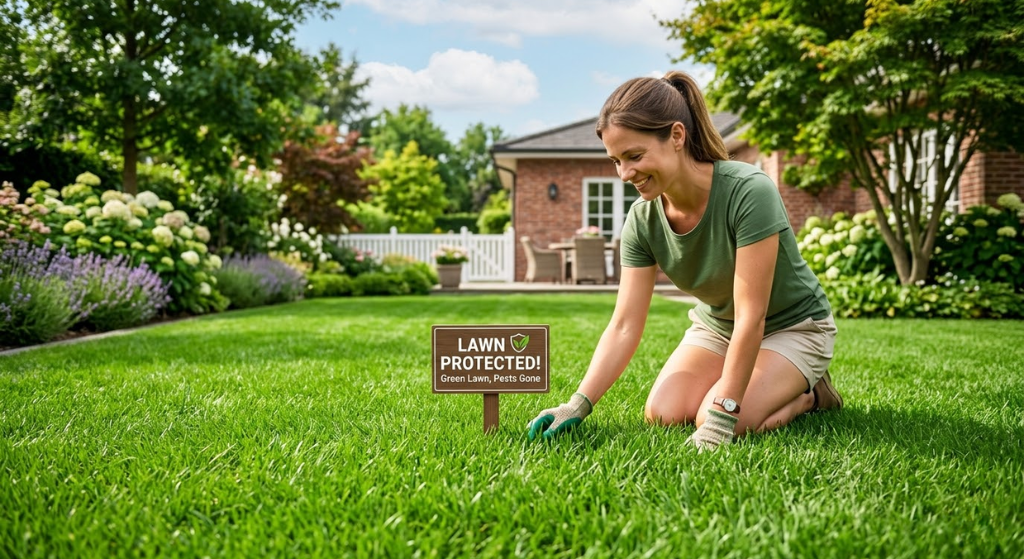
A lawn that looks like it’s dying of drought — despite regular watering — is often the victim of something far more insidious happening just below the surface. White grubs silently consume root systems from underneath. Chinch bugs suck the sap from individual grass plants in summer heat. Sod webworms chew through leaf blades overnight. Fire ants build fortress mounds that deflect mowers and sting bare feet. Mosquitoes turn your backyard into an uninhabitable zone from dusk to dawn.
Each of these problems requires a different solution. The most expensive, broadly-marketed insect killers aren’t always the most effective ones — and applying the wrong product wastes money while leaving the actual pest population untouched. This guide walks through every major lawn insect pest, the products that genuinely control each one, and the application techniques that determine whether an insecticide actually works or just sits in a bag in the garage.
1. Quick Picks: Best Lawn Insect Killers at a Glance
BioAdvanced Complete Insect Killer
Surface + subsurface · All grass types · Granular
Scotts GrubEx Season-Long
Preventive grub control · Up to 4 months
Ortho BugClear Lawn Insect Killer
Chinch bugs, sod webworms, armyworms
NaturesGood Guys Nematodes
Grubs, mole crickets · Pet & bee safe
Ortho Fire Ant Killer Mound Treatment
Fire ants, black ants · Fast-acting
Spectracide Triazicide Insect Killer
Mosquitoes, ticks, fleas · Hose-end spray
2. Know Your Lawn Pest Before Buying Anything
The single biggest mistake homeowners make with lawn insecticides is buying a product before confirming what pest they have. Treating a grub problem with a surface insecticide accomplishes nothing — the active ingredients never reach 3–4 inches underground where grubs live. Treating chinch bugs with a grub preventive is equally futile. Identification first, product second.
The Six Most Destructive Lawn Insects
White Grubs
C-shaped larvae 1–2″ deep. Brown patches, turf lifts like carpet. Peak damage: late summer.
Chinch Bugs
Tiny black/red bugs at soil surface. Yellow-brown patches in hot, dry areas. Summer.
Fire & Black Ants
Visible mounds. Sting risk. Don’t directly damage turf but disrupt soil and mowing.
Mosquitoes & Ticks
Rest in grass and shrubbery. Health risk. Peak activity: warm humid months.
Sod Webworms
Caterpillar larvae chew blades at night. Brown patches with silky tunnels in thatch.
Mole Crickets
Tunnel through soil, uprooting grass. Spongy feel underfoot. Southern lawns primarily.
How to Diagnose Your Lawn Pest
🔍 Quick Diagnosis Guide
- Turf peels back like carpet, increased bird/mole activity: White grubs (dig 2–4″ to confirm C-shaped larvae)
- Yellow/brown patches spreading from dry or sunny areas in midsummer: Chinch bugs (float test — see FAQ)
- Small brown patches appearing overnight, birds pecking grass: Sod webworms (look for silky tunnels in thatch layer)
- Visible mounds, stinging insects, disturbed soil: Ants (species ID determines product choice)
- Spongy, lifted soil channels; irregular bare patches especially in South: Mole crickets (soap flush — pour soapy water, watch for insects emerging)
- Human biting insects present after sunset, resting in grass and shrubs: Mosquitoes / ticks
Correct diagnosis is the foundation of effective pest control. For comprehensive lawn pest identification, diagnosis flowcharts, and treatment matching, our full guide on lawn pest control methods, identification, and treatment covers every major lawn insect in depth with photos and treatment protocols.
Mix 2 tablespoons of liquid dish soap in 1 gallon of water and pour it over a 1-square-foot patch of lawn at the edge of a damaged area. Watch for 60–90 seconds. Chinch bugs, sod webworms, billbugs, and other surface insects will emerge from the soil. This is the most reliable DIY pest confirmation technique available.
3. How We Evaluated These Insect Killer Products
Each product was assessed across six criteria weighted to reflect homeowner priorities:
- Pest control efficacy (35%) — breadth of species targeted, speed of kill, and duration of protection based on independent university extension research and verified product testing
- Safety profile (25%) — toxicity to mammals, beneficial insects (bees, earthworms), and pets; re-entry interval; environmental persistence
- Ease of application (15%) — product form, equipment required, and coverage per package
- Timing flexibility (10%) — window in which the product is effective; preventive vs. curative capability
- Value per square foot (10%) — cost per 1,000 sq ft at MSRP
- Grass type compatibility (5%) — any restrictions on specific turf species
4. Best Overall: BioAdvanced Complete Insect Killer for Soil & Turf

BioAdvanced Complete Insect Killer earns its “best overall” designation by being the only widely available granular product that simultaneously targets both soil-dwelling insects (grubs, mole crickets) and surface feeders (chinch bugs, sod webworms, armyworms, billbugs) in a single application. The dual active ingredient system does the heavy lifting: imidacloprid moves into the soil profile to target subsurface larvae, while beta-cyfluthrin works as a contact and residual killer on the turf surface.
In practice, this means one bag handles the most common pest scenarios a homeowner encounters across an entire season. Applied in late spring or early summer, the imidacloprid moves into the root zone and provides 3 months of grub prevention while the cyfluthrin component handles any surface insects present at time of application. The granular format requires a broadcast spreader and watering in — a 0.5-inch irrigation pass within 24 hours is essential for the subsurface component to activate.
The notable limitation is the safety profile for pollinators: beta-cyfluthrin is toxic to bees until it fully dries and is watered in. Apply in the evening, water in immediately, and keep pets off the lawn for 24 hours. The product should not be applied near flowering weeds or adjacent garden beds where pollinators are active — mow any flowering weeds before application.
✅ Pros
- Targets both surface and subsurface insects
- Single application covers the whole pest spectrum
- 3-month residual protection
- Works on 30+ species including grubs, chinch bugs, ants
- Available at most major home improvement retailers
❌ Cons
- Toxic to bees and aquatic invertebrates until absorbed
- Not as effective at grub prevention as dedicated GrubEx
- Requires watering in for subsurface activation
- Restricted near waterways in some states
5. Best for Grubs: Scotts GrubEx Season-Long Grub Killer

Scotts GrubEx is the most effective preventive grub control product on the residential market, with an active ingredient — chlorantraniliprole — that represents a generational leap over older neonicotinoid-based products in both efficacy and environmental safety. Chlorantraniliprole works by targeting insect muscle receptors, causing paralysis and death in larval grubs when they contact or ingest treated soil. It has significantly lower toxicity to mammals, birds, earthworms, and bees compared to imidacloprid and clothianidin.
The key to GrubEx success is timing. Apply between May and July — the window when adult beetles are laying eggs and newly hatched grubs are in their young, most vulnerable larval stage near the soil surface. Applied correctly and watered in (0.5 inch of irrigation within 24 hours), GrubEx creates a soil barrier that kills grubs before they grow large enough to cause visible turf damage. A single spring application provides protection through the entire grub season.
The critical caveat: GrubEx is preventive only. It does not effectively kill large, established grubs already causing visible damage in late summer. If your lawn is actively being damaged by grubs right now (August–September), you need a curative product like trichlorfon (Dylox). If you’re treating proactively in May–July, GrubEx is by far the best choice. Our detailed resource on lawn pest control and treatment timing explains exactly when to switch from preventive to curative approaches.
GrubEx (chlorantraniliprole) = preventive. Apply May–July before eggs hatch. Won’t fix existing damage. Dylox (trichlorfon) = curative. Apply August–September when large grubs are actively feeding. Use the right tool for the right timing.
✅ Pros
- Best-in-class preventive grub efficacy
- Up to 4 months of protection from a single application
- Safer for earthworms, bees, and mammals than neonicotinoids
- Works on Japanese beetle, European chafer, and masked chafer grubs
- One of the most studied residential grub control ingredients
❌ Cons
- Preventive only — ineffective on established large grubs
- Must be applied and watered in before grub eggs hatch
- Does not control surface-feeding insects at all
- Imidacloprid-based products may outperform in certain grub species scenarios

Scotts GrubEx — Apply Before Grubs Hatch
One application in spring covers up to 14,285 sq ft for the entire grub season. Chlorantraniliprole formula is safer for earthworms and pollinators than older grub killers. Available in multiple bag sizes.
🛒 View on Amazon6. Best for Surface Insects: Ortho BugClear Lawn Insect Killer

When chinch bugs are destroying your St. Augustine or bermudagrass in the middle of summer, or when sod webworm moths are fluttering over the lawn at dusk and you can see the larval damage spreading by the day, Ortho BugClear delivers the fast, decisive surface kill you need. Bifenthrin — the active ingredient — is a synthetic pyrethroid that kills on contact and provides 1–3 months of residual protection on the turf surface.
The critical application difference from grub products: for surface-contact insecticides, do NOT water in immediately after application. The bifenthrin needs to remain on the surface and in the upper thatch layer to contact crawling insects. Allow 24–48 hours before irrigation. This is the opposite of grub products and a major source of application errors.
Ortho BugClear is available in both granular (spreader-applied) and ready-to-spray liquid (hose-end) formats. The liquid format provides faster activation and more even coverage on irregular lawn shapes. The granular is better for scheduled preventive applications across large areas. Both formulations use the same active ingredient at similar efficacy.
✅ Pros
- Kills chinch bugs, sod webworms, and armyworms within minutes
- Available in granular and liquid formulations
- 1–3 months residual surface protection
- Works on 100+ insect species at surface level
❌ Cons
- Limited sub-surface reach for grub control
- Toxic to bees and aquatic insects — apply in evening
- Do not water in for 24–48 hours (common mistake)
- Less effective in very thick thatch layers
7. Best Organic: NaturesGood Guys Live Beneficial Nematodes
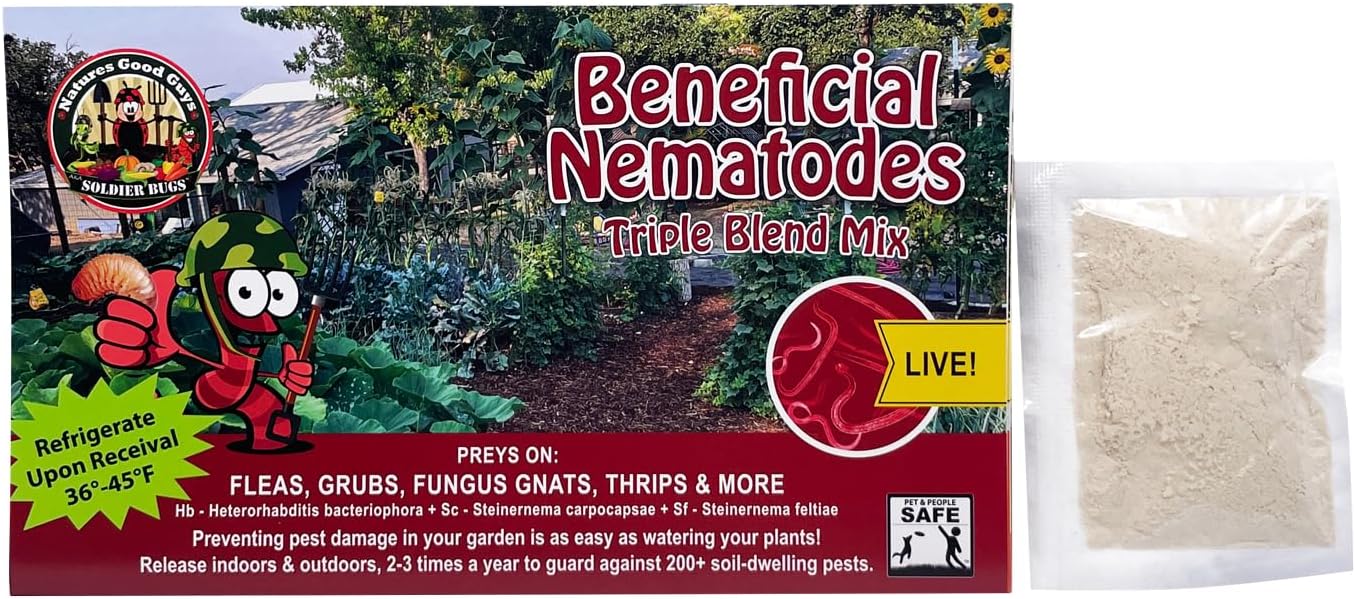
Beneficial nematodes are microscopic roundworms that occur naturally in healthy soils. The species used for lawn pest control — primarily Heterorhabditis bacteriophora (Hb) for grubs and Steinernema carpocapsae (Sc) for surface insects — are entirely harmless to mammals, birds, bees, earthworms, and plants. They work by entering the bodies of target insects, releasing symbiotic bacteria that kill the host from the inside, then reproducing and searching for the next host.
The results are genuinely impressive when conditions are right: moist soil at 55–85°F, applied in the morning or evening (nematodes die in UV light), and watered in immediately. Under these conditions, grub populations can be reduced by 50–80% within 2–4 weeks — competitive with chemical preventives in ideal conditions. The multi-species pack (Hb + Sc + Sf) covers the broadest pest range, targeting grubs, mole crickets, fleas, sod webworms, and cutworms simultaneously.
The trade-offs are real: nematodes cost more per square foot than synthetic alternatives, require refrigerated storage, have a limited shelf life (use within 2 weeks of purchase), and are far more sensitive to application conditions. They won’t work in dry soil, won’t work when soil temperature is outside the 55–85°F window, and lose viability quickly if applied in direct sun. For households where chemical avoidance is a priority — especially with children and pets — the investment and care are absolutely worth it.
✅ Pros
- 100% safe for pets, children, bees, earthworms
- Effective on grubs, mole crickets, sod webworms, fleas
- Establishes in soil and self-replicates if conditions remain favorable
- No waterway, re-entry, or application restrictions
❌ Cons
- More expensive per sq ft than synthetic options
- Requires refrigerated storage and careful handling
- Highly sensitive to soil moisture, temperature, and UV
- Results take 2–4 weeks vs. hours for synthetic
8. Best for Ants: Ortho Orthene Fire Ant Killer

Fire ant mounds are a genuine hazard — not just inconvenient bumps that interfere with mowing, but real stinging threats that can cause serious allergic reactions. Ortho Orthene uses acephate, a systemic organophosphate that is carried through the mound by worker ants as a contact toxicant, eventually reaching and killing the queen. No queen means no colony regeneration — it’s the most reliable mound-elimination method on the residential market.
Application is remarkably simple: sprinkle one level teaspoon of the granular dust directly onto each mound without disturbing it first (agitation causes ants to scatter and retreat, reducing product contact). Do not water in — the product works as a dry contact toxicant and needs to remain on the mound surface and in the tunnels. Effects are typically visible within 24 hours; complete colony death takes 1–2 weeks.
For broad lawn ant control beyond individual mound treatments, pairing Orthene mound treatment with a perimeter broadcast application of a bifenthrin-based product covers both active mounds and prevents new ones from establishing. Our dedicated guide on ant control in lawns covers every ant species and treatment approach in detail.
✅ Pros
- Kills the queen — eliminates colony permanently
- One teaspoon per mound — extremely economical
- Fast-acting: visible results within 24 hours
- Works on both fire ants and common black ants
❌ Cons
- Acephate is toxic to bees and aquatic organisms
- Strong odor during application
- Mound-specific only — not for broadcast lawn application
- Pets must stay off treated area for 24+ hours
9. Best for Mosquitoes & Ticks: Spectracide Triazicide Insect Killer

Mosquitoes and ticks don’t live in your soil — they rest in grass blades, leaf litter, dense ground cover, and low shrubs. This makes them susceptible to surface contact insecticides applied as a fine spray across the turf and lower vegetation. Spectracide Triazicide uses lambda-cyhalothrin, a synthetic pyrethroid that kills on contact and provides 6–8 weeks of residual protection on treated surfaces.
The hose-end format makes application genuinely easy: attach to any garden hose, set the dial, and walk across the lawn at a steady pace. Coverage extends to 10,000 square feet per bottle, making it one of the best value-per-sq-ft options in its category. For maximum mosquito impact, treat not just the lawn but also the lower 3–4 feet of surrounding shrubs, fence lines, and shaded ground cover areas where mosquitoes rest during daylight hours.
For comprehensive mosquito management, combine Triazicide lawn treatment with elimination of standing water sources (the only place mosquitoes breed) and consider adding Bacillus thuringiensis israelensis (BTi) dunks to any unavoidable standing water features. Our guide on mosquito control in lawns covers the full integrated management approach.
✅ Pros
- Kills mosquitoes, ticks, and fleas on contact
- Hose-end spray — no special equipment required
- 6–8 weeks residual protection
- Excellent coverage at competitive price per sq ft
❌ Cons
- Highly toxic to fish — avoid near water features
- Toxic to bees during application and while drying
- Apply in evening when bees are inactive
- Temporary solution — does not address breeding sites

NaturesGood Guys Beneficial Nematodes — Chemical-Free Grub Control
Multi-species nematode pack (Hb + Sc + Sf) covers grubs, mole crickets, fleas, and sod webworms. 100% safe for pets, children, bees, and earthworms. Refrigerate on arrival and apply within 2 weeks.
🛒 View on Amazon10. Full Lawn Insect Killer Comparison Table
| Product | Active Ingredient | Target Pests | Form | Grubs? | Surface? | Pet Safe? | Coverage | Score |
|---|---|---|---|---|---|---|---|---|
| BioAdvanced Complete | Imidacloprid + Beta-Cyfluthrin | Grubs + 30 surface pests | Granular | ✓ | ✓ | ~ After dry | 5,000–10,000 sq ft | 8.9 |
| Scotts GrubEx | Chlorantraniliprole | Grubs only (preventive) | Granular | ✓✓ | ✗ | ✓ Safer | 5,000–14,285 sq ft | 9.2 |
| Ortho BugClear | Bifenthrin | 100+ surface insects | Granular / Liquid | ✗ | ✓✓ | ~ After dry | 5,000–10,000 sq ft | 8.6 |
| Beneficial Nematodes | Hb + Sc + Sf nematodes | Grubs, mole crickets, fleas | Liquid (spray) | ✓ | ~ Limited | ✓✓ Yes | 2,000–3,000 sq ft/pack | 7.8 |
| Ortho Orthene Fire Ant | Acephate | Fire ants, black ants | Granular dust | ✗ | ~ Mound only | ~ 24 hrs | 162 mounds/bag | 8.7 |
| Spectracide Triazicide | Lambda-cyhalothrin | Mosquitoes, ticks, fleas + 260 insects | Hose-end liquid | ✗ | ✓✓ | ~ After dry | Up to 10,000 sq ft | 8.5 |
11. Lawn Insecticide Active Ingredients: What They Are and How They Work
Understanding the active ingredients in lawn insecticides helps you compare products beyond marketing claims and choose the right one for your pest and safety requirements.
| Active Ingredient | Chemical Class | Best For | Bee Safety | Earthworm Safety | Duration |
|---|---|---|---|---|---|
| Chlorantraniliprole | Diamide (IRAC 28) | Grub prevention (best-in-class) | ✓ Safer | ✓ Safe | Up to 4 months |
| Imidacloprid | Neonicotinoid (IRAC 4A) | Grubs + subsurface insects | ✗ Toxic | ~ Moderate risk | 60–90 days |
| Bifenthrin | Pyrethroid (IRAC 3) | Surface insects, chinch bugs | ✗ Toxic until dry | ✓ Low risk | 1–3 months |
| Lambda-cyhalothrin | Pyrethroid (IRAC 3) | Mosquitoes, ticks, fleas | ✗ Toxic until dry | ✓ Low risk | 6–8 weeks |
| Acephate | Organophosphate (IRAC 1B) | Ants (systemic, queen kill) | ✗ Toxic | ~ Moderate | 2–4 weeks |
| Trichlorfon | Organophosphate (IRAC 1B) | Curative grub kill (large grubs) | ✗ Toxic | ✗ Toxic | 1–2 weeks |
| Beneficial Nematodes | Biological (Hb/Sc/Sf) | Grubs, mole crickets, fleas | ✓✓ Safe | ✓✓ Safe | Ongoing if conditions suit |
| Bacillus thuringiensis (BT) | Biological bacterium | Sod webworms, caterpillars | ✓✓ Safe | ✓✓ Safe | 3–7 days |
Rotating between different chemical classes (IRAC groups) in consecutive seasons reduces the risk of insect populations developing resistance. If you use a pyrethroid (IRAC 3) this season, consider switching to a diamide (IRAC 28) or biological option next season for the same pest category.
12. Lawn Insect Killer Buying Guide: How to Choose the Right Product
Step 1: Identify the Pest Precisely
Use the diagnosis guide in Section 2 and the soap flush test to confirm which pest you’re dealing with before purchasing. No amount of product research substitutes for correct pest identification. If you’re uncertain, your local cooperative extension office (or university extension website) offers free or low-cost pest ID services and regionally specific treatment recommendations.
Step 2: Choose Preventive or Curative
For grubs, this decision is made by timing: if it’s spring or early summer and you want to prevent damage, choose a preventive (GrubEx). If it’s late summer and you can already see damage, you need a curative product (trichlorfon/Dylox). For surface insects, there’s no preventive option — treat when you see confirmed pest activity.
Step 3: Assess Your Safety Requirements
Homes with young children, pets that eat grass, beehives nearby, or proximity to water features should prioritize products with the safest profiles. Chlorantraniliprole (GrubEx) and beneficial nematodes sit at the top of the safety hierarchy. Organophosphates (acephate, trichlorfon) sit at the bottom. Pyrethroids fall in the middle — significant bee risk during application but break down relatively quickly.
Step 4: Match Application Form to Your Equipment
Granular products require a broadcast or drop spreader. Liquid hose-end products require only a garden hose with adequate pressure. Liquid concentrates require a pump sprayer. Choose the format that matches the equipment you have or are willing to acquire. For large lawns (over 10,000 sq ft), granular products are generally more cost-effective. For irregular lawns with many beds and obstacles, liquid hose-end spray gives you more control.
Step 5: Calculate Coverage and Cost
Measure your lawn area before buying. Most bags state coverage in square feet — buy slightly more than your measured area to allow for edge passes and imperfect spreader patterns. Underapplication (stretching a bag over more area than labeled) is one of the most common causes of poor insecticide results.
| Situation | Recommended Product | Timing |
|---|---|---|
| Grub prevention, spring or early summer | Scotts GrubEx (chlorantraniliprole) | May–July, water in within 24 hrs |
| Active grub damage (late summer) | Dylox (trichlorfon) — curative | Aug–Sept, water in immediately |
| Chinch bugs or sod webworms active | Ortho BugClear (bifenthrin) | When damage is first noticed; do NOT water in |
| Full-spectrum prevention, one product | BioAdvanced Complete Insect Killer | Late spring, water in within 24 hrs |
| Fire ant mounds | Ortho Orthene (acephate) | Any time mounds are active; do NOT water in |
| Mosquitoes / ticks in backyard | Spectracide Triazicide (lambda-cyhalothrin) | Apply evening, treat lawn + shrubs |
| Organic / pet-safe household | Beneficial nematodes (Hb+Sc+Sf) | Spring or fall, soil 55–85°F, moist |
13. How to Apply Lawn Insecticide: Step-by-Step for Best Results
Proper application technique separates effective pest control from wasted product. The key variables — whether to water in or not, timing relative to heat and sun, spreader settings, and coverage patterns — differ by product type and target pest. Here’s the consolidated guidance.
For Granular Grub Killers (GrubEx, BioAdvanced Complete)
- Time your application correctly — for preventive products, apply between May and July. For BioAdvanced, any time pests are active is appropriate.
- Calibrate your spreader — use the setting specified on the product label for your exact spreader model. Wrong settings are the #1 cause of under- or over-application.
- Apply in overlapping passes — walk steady straight lines, overlapping each pass by 2–3 inches for consistent coverage.
- Water in within 24 hours — apply 0.5 inches of irrigation immediately or within 24 hours to carry active ingredients into the soil profile where grubs live. This step is non-negotiable for grub products.
- Keep pets off until dry — once the product has been fully watered in and the lawn is dry, the risk to pets is minimal. Typically 24–48 hours.
For Surface Contact Insecticides (Ortho BugClear, bifenthrin-based products)
- Confirm active pest presence first — use the soap flush test or direct visual observation to confirm the pest is active before treating.
- Apply in the evening — bees return to hives at dusk; evening application dramatically reduces pollinator exposure and the product is still fully effective.
- Apply to a dry lawn — surface contact works best when granules or spray can adhere to dry foliage and the thatch surface.
- Do NOT water in for 24–48 hours — the active ingredient needs to remain at the surface to contact crawling insects. This is the opposite of grub products and a very common mistake.
- Focus on active damage areas and borders — treat the edge zone between healthy and damaged turf where the active pest population is highest, plus the surrounding healthy turf buffer.
For Liquid Hose-End Sprays (Triazicide, BugClear liquid)
- Shake/mix well and check the dial setting — hose-end sprayers dilute the concentrate automatically; confirm the dial is set to the product-specified dilution ratio.
- Walk at a consistent pace — coverage evenness is controlled by walking speed. Too fast means underapplication; too slow means overapplication.
- Treat lawn plus lower shrubs and fence lines for mosquito/tick control — these pests rest in vegetation, not just grass. Treating only the lawn misses a significant portion of the resting population.
- Allow to dry before re-entry — typically 2–4 hours for liquid products; longer if heavy application.
For the complete lawn care picture — including how pest control fits into the annual maintenance calendar — our lawn care 101 guide provides the full seasonal schedule from spring green-up through winter preparation.
BioAdvanced Complete Insect Killer — One Product, Full Protection
The only widely available granular that kills both grubs underground and surface insects simultaneously. Apply in late spring for season-long coverage against 30+ insect species.
🛒 View on Amazon14. Common Lawn Insecticide Mistakes That Ruin Results
Mistake 1: Treating Without Confirming the Pest
Brown patches in summer can mean drought stress, fungal disease, fertilizer burn, or insect damage — and each has a completely different treatment. Applying an insecticide to a fungus-damaged lawn wastes money and delays the correct treatment. Always confirm pest presence with the soap flush test, visual inspection, or soil sampling before purchasing any product.
Mistake 2: Using a Preventive Product on Active Damage
GrubEx and other chlorantraniliprole products are preventive — they must be in the soil before grub eggs hatch to be effective. If you can already see grub damage (brown turf lifting like a carpet in August), a preventive product will not help. You need a fast-acting curative product like trichlorfon. Matching prevention/cure to timing is the single most important application decision for grub control.
Mistake 3: Not Watering In Soil Insecticides
Grub killers left on the lawn surface without irrigation simply don’t work. The active ingredients need moisture to move through the thatch layer and into the 1–3 inch soil depth where young grubs feed. A bag of GrubEx sitting dry on the surface for a week after application is effectively wasted. Always water in within 24 hours — use a rain gauge or smart sprinkler timer to apply a measured 0.5 inch.
Mistake 4: Watering In Surface Contact Insecticides
The opposite mistake: immediately irrigating after applying a surface contact insecticide like bifenthrin washes the active ingredient off the thatch surface and into the soil before it contacts the surface-feeding insects you’re targeting. Allow 24–48 hours of dry conditions before any irrigation. Check the forecast before application and plan accordingly.
Mistake 5: Applying in the Heat of the Day
Applying any insecticide during peak sun and heat (10 AM–4 PM) is counterproductive for multiple reasons: pyrethroids break down faster in UV light, heat increases volatilization losses, and pollinator exposure is maximized. Apply in the early morning or evening for both efficacy and environmental safety. This single timing change can meaningfully improve results with no additional cost.
Mistake 6: Stretching Coverage to Save Money
The label rate on any insecticide product is established by the minimum effective dose for the target pest under normal conditions. Applying at half the label rate because you want to cover twice the area produces half the pest control — or less, because many insecticides have minimum threshold concentrations below which they’re ineffective. Buy the correct quantity for your lawn area and apply at full label rate.
Mistake 7: Ignoring the Thatch Layer
Lawns with more than half an inch of thatch act as a physical barrier that traps granular insecticides above the soil and intercepts liquid applications before they reach surface-feeding insects at the soil-thatch interface. If your lawn has significant thatch buildup, dethatch before treating to improve product penetration. Our resources on lawn problems and solutions cover thatch management as part of the complete lawn health picture.
Frequently Asked Questions About Lawn Insect Killers
For broad-spectrum coverage, BioAdvanced Complete Insect Killer handles both sub-surface grubs and surface pests in one application. For targeted grub prevention specifically, Scotts GrubEx with chlorantraniliprole is the top performer. For organic households, NaturesGood Guys Beneficial Nematodes are the most effective chemical-free option. The best choice depends on which pest you’re dealing with, the timing of your treatment, and your household’s safety requirements.
Timing is pest-specific. For grub prevention, apply in May–July before beetle eggs hatch. For surface insects like chinch bugs and sod webworms, apply when damage and pest activity are first confirmed — typically June through August. For ants, treat when mounds are active. For mosquitoes and ticks, apply in spring and repeat every 6–8 weeks through the active season. Evening application is preferred for all products to reduce pollinator exposure.
Classic grub damage signs: irregular brown patches that don’t recover after watering, turf that peels back like a loose carpet (roots have been consumed), increased bird, raccoon, or mole digging activity in the lawn, and a spongy feel when walking on affected areas. Confirm by cutting a 1-square-foot section of sod and peeling it back to inspect the top 2–4 inches of soil. Finding 5 or more white C-shaped grubs per square foot is the typical treatment threshold.
Most synthetic lawn insecticides are unsafe for pets during and immediately after application — until the product has been watered in and the lawn is completely dry, typically 24–48 hours. Check the specific product’s re-entry interval on the label. Beneficial nematodes and BT (Bacillus thuringiensis) products pose essentially no risk to pets and mammals. If your dog frequently eats grass, consider organic options regardless of label claims on synthetic products.
Yes — most broad-spectrum synthetic insecticides are toxic to bees and other pollinators during and shortly after application. Pyrethroids (bifenthrin, lambda-cyhalothrin) are highly toxic to bees while wet but break down within hours once dry. Neonicotinoids (imidacloprid) can have longer-lasting impacts on bee health. To minimize pollinator risk: apply in the evening, mow flowering weeds before treatment, avoid treating areas adjacent to flowering plants, and prefer chlorantraniliprole or biological options where pollinators are a priority concern.
Preventive grub control (chlorantraniliprole, imidacloprid) is applied before grub eggs hatch (May–July) and kills young larvae before they cause visible damage. It doesn’t kill large, established grubs. Curative grub control (trichlorfon/Dylox) is applied to lawns that already show grub damage (August–September) when large grubs are feeding near the surface. Preventive products generally achieve higher efficacy in controlled trials, but timing determines which is appropriate — using a preventive product in August on actively damaged turf wastes money and time.
First confirm presence with the float test: push both ends off a coffee can, press it 2 inches into the soil at the edge of a damaged/healthy area border, fill with water, and watch for 10 minutes. Chinch bugs (tiny black/red insects) will float to the surface. Treat confirmed infestations with a bifenthrin-based granular or spray (Ortho BugClear) focused on the active damage border and surrounding healthy turf. Do not water in immediately — allow 24–48 hours for contact kill. Repeat in 3–4 weeks if damage continues spreading.
Some do. Carbaryl (Sevin) and trichlorfon are most toxic to earthworms and should be avoided when earthworm populations are high. Chlorantraniliprole (GrubEx) has very low toxicity to earthworms and is the preferred choice for grub control in lawns where earthworm activity is valued. Beneficial nematodes are entirely safe for earthworms. Pyrethroids have low earthworm toxicity at label application rates. If you want to maintain healthy soil biology, choose your active ingredients with earthworm safety in mind.
Duration varies significantly by active ingredient. Chlorantraniliprole (GrubEx) provides up to 4 months of grub control. Imidacloprid lasts 60–90 days. Bifenthrin gives 1–3 months of surface insect control. Lambda-cyhalothrin persists 6–8 weeks. Organic options like nematodes remain active as long as soil conditions stay favorable; pyrethrin sprays break down within days in sunlight. Always check the product label for the specific residual claim.
It depends entirely on the product type and target pest. Soil-targeting grub killers (GrubEx, BioAdvanced Complete) require 0.5 inches of irrigation within 24 hours to carry active ingredients to root depth — watering in is essential. Surface contact insecticides targeting chinch bugs or ants (Ortho BugClear, Orthene) should NOT be watered in for 24–48 hours — they need to remain on the surface for contact kill. Always read the specific product label for its watering instructions, as this varies by formulation.
Yes. Combination insect-plus-fertilizer products are available (like Scotts GrubEx Season Long with Lawn Fertilizer or BioAdvanced Insect Killer with Fertilizer). You can also apply granular insecticide and granular fertilizer in separate passes on the same day without any reduction in efficacy. The active ingredients don’t interact negatively. Just ensure both products are appropriate for your grass type and the season, and water in appropriately for the insecticide component’s requirements.
Broad-spectrum lawn insect killers like BioAdvanced Complete typically cover white grubs (Japanese beetle, European chafer, masked chafer), chinch bugs, sod webworms, armyworms, billbugs, mole crickets, cutworms, and ants. Products claiming 30+ species or 100+ species on the label are marketing both surface and soil insects in one count. Specific pests like fire ants, mosquitoes, and ticks respond better to products formulated specifically for those categories than to generic broad-spectrum treatments.
Conclusion: Match the Product to the Pest and the Timing
The best insect killer for your lawn is the one matched precisely to your pest, your timing window, and your household’s safety requirements. For most homeowners dealing with the most common problems: apply Scotts GrubEx in May through July to prevent grub damage before it happens. Use Ortho BugClear when chinch bugs or sod webworms are actively confirmed in summer. Reach for Spectracide Triazicide when mosquitoes and ticks are making your backyard unusable. And consider Beneficial Nematodes when chemical exposure is a concern — they work surprisingly well under the right conditions.
The single most important habit you can build around lawn insect control is diagnosis before treatment. The soap flush test takes three minutes and can save you from buying an entire bag of the wrong product. Once you know what you have, the right product is obvious. Once you know the timing, the application is straightforward. And once the pests are gone, a properly fertilized, well-watered, regularly mowed lawn is your best long-term defense against reinfestation.
Build your pest management into a complete lawn health program. A thriving, dense turf is inherently more pest-resistant than thin, stressed grass — and the best pest prevention is a lawn that doesn’t give insects easy access to vulnerable soil and weak roots in the first place. Our complete lawn care 101 guide covers the full picture.
🐛 Full Lawn Pest ID & Treatment Guide →