Ask any experienced turf manager what separates lawns that explode into thick, lush green in March from those that limp out of winter thin and patchy, and the answer is almost always the same: what you do in the fall. Winterizing your lawn isn’t just about one bag of fertilizer — it’s a coordinated series of tasks that prepares your grass’s root system, carbohydrate reserves, and soil structure for months of cold, frost, and dormancy.
Get the timing right, execute the tasks in the correct sequence, and your lawn will emerge from winter ahead of every neighbor’s on the block. Get it wrong — apply winterizer too early, mow too tall into dormancy, skip aeration, or neglect a final watering — and you’ll spend the entire spring playing catch-up. This guide covers every element of the process in depth, with specific timing guidance for different grass types, climate regions, and soil conditions.
1. What Is Lawn Winterization and What Does It Actually Accomplish?
Lawn winterization is the collective name for a set of late-fall lawn care tasks designed to prepare your turf for winter dormancy and set it up for a strong spring recovery. It’s not a single action but a sequence — typically spanning 6 to 8 weeks in the fall — that transitions your lawn from the active growing season into a protected dormant state.
The core objectives of winterization are:
- Maximize carbohydrate storage — grass crowns and roots stockpile sugars and starches over fall that fuel spring green-up
- Strengthen cell walls against freezing — potassium hardens cell membranes, reducing cellular damage from ice crystal formation
- Deepen root systems — deep roots survive winter cold better and access moisture earlier in spring
- Reduce disease risk — proper height, thatch management, and final clean-up minimize the conditions that trigger snow mold and other winter diseases
- Give new overseeded areas time to establish — fall-seeded grass needs to reach sufficient root depth before freeze-up
- Prepare equipment and irrigation systems — winterizing sprinkler lines prevents freeze damage worth hundreds of dollars in repairs
Think of winterization as a long-term investment: the time and cost you spend in October and November pays dividends every week from March through June as your lawn outperforms turf that wasn’t properly prepared.
2. Why Winterizing Your Lawn Matters: The Science Behind Cold-Season Turf Prep
To understand why winterization timing is so critical, it helps to understand what’s actually happening inside your grass plants as temperatures drop in fall.
The Hardening-Off Process
As day length shortens and temperatures drop below about 50°F (10°C), cool-season grasses begin a biological process called “cold hardening” — a gradual physiological shift that prepares cells for freezing temperatures. The plant slows top growth, redirects energy to roots and crown tissue, and accumulates cryoprotectants (natural antifreeze compounds, primarily sugars) within its cells.
This hardening process takes 4 to 6 weeks and cannot be rushed. It’s one reason winterization timing matters so much: applying the right nutrients during this window — when the plant is actively hardening — delivers maximum benefit. Too early and the plant uses the nutrients for top growth instead. Too late and the plant can no longer absorb and utilize them before freeze-up.
Root Growth in Fall: Your Hidden Advantage
Here’s the counterintuitive truth about fall lawn care: while top growth slows and eventually stops, root growth continues actively until the soil temperature drops below about 40°F (4°C) at 4-inch depth. This means your grass is still building its root system long after the lawn looks like it’s done for the year.
Fall fertilization, aeration, and deep watering all capitalize on this extended root growth window. A lawn that enters winter with a deep, well-nourished root system has dramatically better cold hardiness, spring green-up speed, and resistance to spring diseases than one that was neglected in fall.
What Happens Without Winterization
✅ Properly Winterized Lawn
- Rapid, even spring green-up
- Dense, thick turf from the first mow
- Fewer bare spots and winter kill areas
- Lower spring weed pressure
- Reduced snow mold susceptibility
- Less fertilizer needed in spring to recover
❌ Neglected Lawn
- Slow, patchy spring emergence
- Thin, stressed turf needing extensive repair
- Higher snow mold and disease incidence
- Significant bare areas from winter kill
- Explosive spring weed germination
- Greater cost and effort to restore in spring
3. The Best Time to Winterize Your Lawn: Precise Timing Guidelines
The single most important timing rule for lawn winterization is this: apply winterizer fertilizer when the grass has slowed its top growth but the soil is still warm enough for root absorption. This is the narrow window that makes winterization effective rather than wasteful.
The Key Timing Indicators
Rather than relying solely on calendar dates (which vary enormously by region and year), use these observable conditions as your triggers:
- Nighttime temperatures consistently below 50°F (10°C) — the primary biological trigger for cold hardening and reduced top growth
- Mowing frequency has dropped — if you’ve gone from weekly mows to every 10–14 days or longer, the grass has slowed its growth cycle
- Grass has a slight bluish-green tint — cool-season grasses often shift slightly in color as temperatures drop, indicating active cold hardening
- Soil temperature at 4-inch depth is between 40–55°F — roots are still actively absorbing nutrients but top growth has slowed
- First hard frost has occurred or is 1–2 weeks away — ideal to complete the main fertilizer application just before or immediately after the first light frost
Inexpensive soil thermometers (under $15 on Amazon) give you the most accurate winterization trigger. Insert the probe 4 inches deep in the morning. When readings are consistently 40–52°F, you’re in the ideal fertilizer application window. Below 40°F, nutrient uptake drops sharply.
The Two-Phase Timing Approach
For best results, think of fall lawn care in two distinct phases:
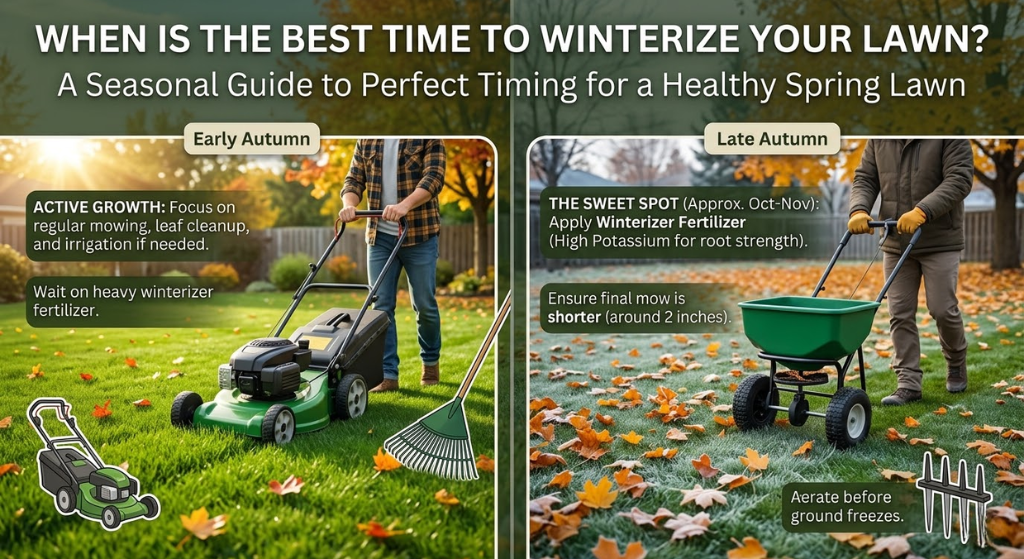
Phase 1 — Early Fall (6–8 weeks before first frost): Core aeration, overseeding, and starter/balanced fertilizer application. This phase capitalizes on warm soil temperatures to establish new grass and deepen root systems.
Phase 2 — Late Fall (2–4 weeks before ground freeze): Winterizer fertilizer application, final mowing at winter height, last deep watering, leaf cleanup, and equipment winterization. This is the true “winterization” window most homeowners refer to.
Many homeowners skip Phase 1 entirely and only do Phase 2, which is better than nothing — but the combination of both phases produces dramatically superior results. If you can only do one thing in fall, make it Phase 2: the late-fall winterizer fertilizer application is the single highest-impact action you can take for your lawn’s winter and spring performance.

Scotts Turf Builder WinterGuard Fall Lawn Food
The #1 selling winterizer fertilizer in the US. High-potassium formula builds deep roots, strengthens grass against cold, and fuels fast spring green-up. Covers 5,000 sq ft.
🛒 View on Amazon4. Lawn Winterization Timing by Region
Calendar-based timing for winterization varies significantly by climate zone. Here’s a region-by-region breakdown of optimal winterization windows, using the Phase 1 / Phase 2 framework.
Northern US / Canada
Phase 1: Aug–Sept
Phase 2: Oct–early Nov
Ground freeze: Nov–Dec
Midwest / Great Plains
Phase 1: Sept
Phase 2: Oct–Nov
Ground freeze: Nov–Jan
Southern US
Phase 1: Oct–Nov
Phase 2: Nov–Dec
Ground freeze: Jan (if at all)
Pacific Northwest
Phase 1: Sept–Oct
Phase 2: Oct–Nov
Ground freeze: Rarely, varies
UK / Northern Europe
Phase 1: Sept
Phase 2: Oct–early Nov
Ground freeze: Dec–Feb
| Region / Climate | Grass Types | Phase 1 Window | Phase 2 (Winterizer) Window | Deadline |
|---|---|---|---|---|
| Northern US (Zones 4–5) | Kentucky Bluegrass, Fescue, Ryegrass | Aug 20 – Sept 20 | Oct 1 – Nov 1 | Before hard ground freeze |
| Midwest (Zones 5–6) | Bluegrass, Tall Fescue, Ryegrass | Sept 1 – Sept 30 | Oct 10 – Nov 10 | Before first hard frost |
| Mid-Atlantic / Northeast | Tall Fescue, Bluegrass, Ryegrass | Sept 1 – Oct 1 | Oct 15 – Nov 15 | Nov 15 typically |
| Southeast (Zones 7–8) | Bermuda, Zoysia, Centipede, Fescue | Sept 15 – Oct 15 | Nov 1 – Dec 1 | Before turf goes fully dormant |
| Deep South (Zone 9+) | St. Augustine, Bermuda, Centipede | Oct – Nov | Nov – Dec | Jan in coastal areas |
| Pacific Northwest | Fescue, Bluegrass, Ryegrass | Sept – Oct | Oct – Nov | Before extended wet season |
| UK / Northern Europe | Ryegrass, Fescue, Bent | Sept | Oct – early Nov | Before ground freeze |
The USDA’s Plant Hardiness Zone map and the Old Farmer’s Almanac both offer free frost date lookup tools by zip code. Your Phase 2 fertilizer window should close no later than 2–3 weeks before your average first hard frost date.
5. Winterization Timing and Approach by Grass Type
Cool-season and warm-season grasses have entirely different growth cycles and respond to fall conditions in opposite ways. Their winterization protocols differ accordingly.
Cool-Season Grasses: The Classic Winterization Candidates
Cool-season grasses (Kentucky bluegrass, tall fescue, perennial ryegrass, fine fescue) experience their second growth peak in fall, after the summer slowdown. This fall flush of growth is the ideal time to apply fertilizer because the plant is actively photosynthesizing and absorbing nutrients, but top growth is moderate and root development is the primary beneficiary.
For cool-season grasses, the full Phase 1 + Phase 2 approach yields the best results. The fall growing period is your most productive window for any improvement you want to make — overseeding, aeration, fertilizing — and the relative cool and moisture of fall creates ideal conditions for grass establishment and root deepening.
Warm-Season Grasses: A Different Approach
Warm-season grasses (bermudagrass, St. Augustine, zoysia, centipede, buffalo grass) enter dormancy as temperatures drop and require a modified winterization approach:
- Stop nitrogen fertilization 6–8 weeks before the first expected frost — late nitrogen application on warm-season grasses causes tender, frost-susceptible top growth
- A light potassium application (0-0-50 or similar) in early fall can improve cold hardiness without stimulating growth
- Allow the lawn to harden off naturally — don’t fight the dormancy process with irrigation or fertilizer
- Final mow at the recommended height and leave the dormant turf alone through winter
| Grass Type | Category | Last Nitrogen Date | Winterizer Suitable? | Key Fall Priority |
|---|---|---|---|---|
| Kentucky Bluegrass | Cool | Up to 2 wks before freeze | ✓ Yes | Deep root development |
| Tall Fescue | Cool | Up to 2 wks before freeze | ✓ Yes | Aeration + overseed |
| Perennial Ryegrass | Cool | Up to 2 wks before freeze | ✓ Yes | Disease prevention |
| Fine Fescue | Cool | Up to 3 wks before freeze | ✓ Yes | Low input; light winterizer |
| Bermudagrass | Warm | 6–8 wks before frost | ~ K only | Allow natural dormancy |
| Zoysia | Warm | 6–8 wks before frost | ~ K only | Final mow + cleanup |
| St. Augustine | Warm | 8 wks before frost | ✗ No N | Protect from freeze damage |
| Centipede | Warm | 8–10 wks before frost | ✗ No N | Potassium only; very low input |
Understanding your grass type is foundational to getting everything else right. For a comprehensive overview of grass species, growth habits, and climate zones, our guide on types of grass for lawns covers every major species in depth.
6. Winterizer Fertilizer: What to Apply, When, and How Much
Winterizer fertilizer is the centerpiece of the entire winterization process. Get this right and everything else falls into place. Get it wrong — apply too early, too late, or with the wrong formula — and you’ve wasted both money and a critical window.
What Makes a Winterizer Different from Regular Fertilizer?
A true winterizer fertilizer is distinguished by its NPK ratio — specifically, a higher potassium (K) content relative to nitrogen (N) and often zero or low phosphorus (P). Common winterizer NPK ratios include 24-0-12, 32-0-8, 13-0-46, and 0-0-50 (straight potassium sulfate).
Why high potassium? Potassium drives three critical winter-prep processes in grass plants:
- Cell wall strengthening — potassium regulates the movement of water in and out of cells, reducing the damage caused by ice crystal formation inside plant tissues
- Carbohydrate synthesis and storage — potassium activates enzymes that convert sugars to starches for winter storage, fueling spring regrowth
- Disease resistance — adequate potassium levels correlate strongly with reduced incidence of snow mold, dollar spot, and other turf diseases
Winterizer Application Rates by Grass Type
| Grass Type | Nitrogen Rate (lbs N/1,000 sq ft) | Potassium Rate (lbs K/1,000 sq ft) | Product Example |
|---|---|---|---|
| Kentucky Bluegrass | 0.75 – 1.5 | 0.5 – 1.0 | 32-0-8 or 24-0-12 |
| Tall Fescue | 0.5 – 1.0 | 0.5 – 1.0 | 24-0-12 or 13-25-12 |
| Perennial Ryegrass | 0.75 – 1.25 | 0.5 – 0.75 | 24-0-12 |
| Fine Fescue | 0.25 – 0.5 | 0.25 – 0.5 | 13-0-46 (diluted) or 10-0-20 |
| Bermudagrass | 0 (no N in fall) | 0.5 – 1.0 | 0-0-50 Potassium Sulfate |
| Zoysia | 0 (no N in fall) | 0.5 – 0.75 | 0-0-50 or Milorganite (low N) |
Granular vs. Liquid Winterizer
The vast majority of winterizer products are granular, and for good reason: granular fertilizers release slowly as they dissolve with moisture, providing a sustained nutrient supply over several weeks — exactly what you want as the soil cools. Liquid fertilizers are absorbed more quickly but offer less control over the release timing in cooling temperatures.
For most homeowners, a quality granular winterizer applied with a broadcast or drop spreader is the right choice. For details on spreader calibration and coverage patterns, our comparison of drop vs. broadcast spreaders explains the trade-offs between each type for precision fertilizer application.
Excessive nitrogen in late fall — especially for warm-season grasses or in mild-winter regions — causes lush, soft top growth that is highly susceptible to frost damage and snow mold. Stay within the recommended nitrogen rates for your grass type. When in doubt, err on the side of less nitrogen and more potassium.
Organic Winterizer Options
Organic fertilizers like Milorganite (6-4-0) are sometimes used as part of a fall program, particularly for homeowners with pets or children. However, most organic products are lower in potassium than synthetic winterizers, so you may need to supplement with a separate potassium source (potassium sulfate or potassium chloride) to achieve full winterization benefits.
For a detailed breakdown of fertilizer types and nutrient release mechanisms, our guide on slow-release vs. quick-release lawn fertilizers covers the key differences and when each type is appropriate.

Jonathan Green Winter Survival Fall Fertilizer
High-potassium formula (10-0-20) specifically engineered for fall root development and cold hardiness. Slow-release nitrogen for even feeding without flush growth. 15,000 sq ft bag.
🛒 View on Amazon7. Final Mowing for Winter: Height, Timing, and Technique
How you mow your lawn in the last weeks of the growing season has a direct impact on how well it survives winter and recovers in spring. The transition to winter height should be gradual, not sudden — a common mistake is letting the lawn grow long all fall and then cutting it short in one pass just before the first freeze. This shocks the grass and creates exactly the conditions that promote snow mold.
The Right Winter Mowing Height
| Grass Type | Normal Summer Height | Winter / Final Height | Notes |
|---|---|---|---|
| Kentucky Bluegrass | 2.5 – 3.5 in | 2 – 2.5 in | Lower reduces snow mold risk |
| Tall Fescue | 3 – 4 in | 2.5 – 3 in | Don’t go below 2.5 in |
| Perennial Ryegrass | 2 – 3 in | 2 – 2.5 in | Good snow mold resistance at 2 in |
| Fine Fescue | 2 – 3 in | 2 – 2.5 in | Tolerates low mowing well |
| Bermudagrass | 0.5 – 1.5 in | 1 – 1.5 in | Clean mow; remove debris |
| Zoysia | 1 – 2 in | 1 – 1.5 in | Final mow before dormancy |
| St. Augustine | 3 – 4 in | 3 – 3.5 in | Keep higher; protects crown |
The Gradual Height Reduction Approach
Over the last 3–4 mowing sessions of the season, gradually lower your cutting height by a quarter to half an inch with each mow. This allows the grass to acclimate to the reduced leaf surface rather than experiencing the stress of a sudden drastic cut. It also encourages the plant to redirect energy from top tissue to the crown and root zone.
Never remove more than one-third of the grass blade in a single mow — even in fall when trying to reach winter height. The one-third rule prevents physiological stress that weakens the plant entering dormancy. If you need to drop height significantly, do it over two or three mows spaced a week apart.
The Last Mow of the Season
Your final mow of the year should occur after the grass has visibly stopped growing but before the first hard freeze. A few nuances for the final cut:
- Ensure your mower blades are sharp — a clean cut heals faster than a torn cut, reducing disease entry points
- Mulch the clippings if possible — they add organic matter and a small nutrient return to the soil
- Remove any large leaf accumulations that could mat down and smother the grass over winter
- Do not mow when the ground is frozen or when frost is present on the blades — foot traffic and mowing on frozen grass causes physical damage to brittle, frozen leaf tissue
Keeping your mower blades sharp for clean late-season cuts matters year-round, not just in fall. Our guide on how to sharpen lawn mower blades walks through blade sharpening in full detail, including the signs that tell you a blade needs attention.
8. Fall Aeration and Overseeding: The Phase 1 Power Combination
Core aeration and overseeding in early fall represent the highest-value lawn improvement investment of the entire year. Together, they directly address the two most common causes of thin, struggling turf: soil compaction and reduced grass plant density.
Why Fall Is the Best Time to Aerate
For cool-season grasses, fall aeration is superior to spring aeration for several reasons:
- Warm soil temperatures in early fall (still 55–65°F at depth) allow faster soil plug breakdown and hole closing
- Fall rains naturally fill and soften the aeration channels, maximizing their benefit
- The fall root growth period directly benefits from the improved air, water, and nutrient access that aeration creates
- Aeration opens channels that make winterizer fertilizer significantly more effective — nutrients penetrate to the root zone rather than sitting on the surface
- Weed pressure is lower in fall, so the disturbed soil from aeration is less likely to trigger weed germination
Combining Aeration, Overseeding, and Fertilizing
The optimal fall lawn improvement sequence is: Aerate → Overseed → Fertilize with starter fertilizer → Water. This sequence exploits the open aeration channels as seed receptacles, improving germination rates dramatically over broadcasting seed onto an un-aerated surface.
Timing within this sequence matters. Aeration, overseeding, and starter fertilizer should all happen in the Phase 1 window — at least 6 weeks before the first hard frost. This gives new seedlings time to germinate, establish, and reach sufficient root depth before freeze-up. Seedlings that are too young when frost arrives will not survive winter.
Pre-emergent herbicides prevent seed germination — all seed, including grass seed. If you’re overseeding in fall, skip pre-emergent weed control until the new grass has been through at least 2–3 mowing cycles. Plan your weed control around your overseeding timeline.
Overseeding Varieties for Winter Hardiness
If you’re overseeding to improve a lawn’s overall composition, fall is the time to introduce improved grass varieties. Modern turf grass breeding has produced cultivars with significantly better cold hardiness, disease resistance, and drought tolerance than the varieties in older established lawns. Seek out named cultivars of Kentucky bluegrass or tall fescue with proven cold-climate performance records from NTEP (National Turfgrass Evaluation Program) trials for your region.

Yard Butler Lawn Coring Aerator
Heavy-duty manual core aerator that pulls 3-inch plugs on every pass. Ideal for small to medium lawns before overseeding and winterizer application. No engine required.
🛒 View on Amazon9. Fall Watering, Weed Control, and Leaf Management
Fall Watering: Tapering Down Correctly
Fall watering is a balancing act: your lawn still needs consistent moisture for root development and nutrient uptake right up until the ground freezes, but you should be gradually reducing irrigation frequency as temperatures drop and evapotranspiration rates fall.
The general guideline: continue irrigating as needed to maintain 1 inch of water per week (from rain plus irrigation combined) through October, then reduce to every 10–14 days if the weather remains dry into November. The last deep watering of the season — often called “winterizing” the irrigation cycle — should happen about 2 weeks before the first hard freeze, and is distinct from draining and blowing out your irrigation system.
One of the most common fall lawn care mistakes is stopping irrigation too early in October when warm dry spells can leave the lawn drought-stressed going into its critical hardening period. Stressed grass hardens off poorly, storing fewer carbohydrates and entering winter in a weakened state.
Fall Weed Control: Targeting Winter Annuals
Fall is actually one of the most effective seasons for weed control, particularly for broadleaf weeds. Weeds are actively moving carbohydrates into their root systems in fall — the same mechanism that makes them absorb herbicides so efficiently at this time of year. A fall application of a selective broadleaf herbicide (products containing 2,4-D, MCPP, or dicamba) reaches the weed’s root system and kills it more completely than the same application in spring.
Winter annual weeds (annual bluegrass, henbit, chickweed) germinate in fall and overwinter as seedlings, erupting aggressively in early spring. A pre-emergent application in very early fall (when soil temperatures drop below 70°F) prevents these winter annual seeds from germinating. This requires early timing — late August to mid-September in most Northern regions. For a complete guide to weed management strategies, see our resource on how to get rid of weeds without killing grass.
Leaf Management: Don’t Ignore the Canopy
Fallen leaves left on the lawn through winter create multiple problems: they smother grass by blocking light and trapping moisture, create ideal conditions for snow mold fungi, and can mat into a wet layer that physically prevents spring green-up. Effective leaf management is a non-negotiable part of fall lawn care.
Options in order of preference:
- Mulch-mow thin leaf layers — a mulching mower shreds light leaf coverage into fine pieces that decompose quickly and add organic matter
- Rake or blow and compost — heavy leaf accumulations should be physically removed and composted or bagged
- Bag while mowing — for mixed leaf-grass debris in late fall, bagging during mowing handles both leaf removal and clipping collection efficiently
The goal is to ensure no large patches of matted leaves remain on the lawn when snow falls or when the grass goes fully dormant.
10. The Complete Fall Lawn Winterization Checklist
Here’s the full winterization process organized as a practical checklist, sequenced from early fall through to final equipment storage. Work through these tasks in order for the best results.
Phase 1: Early Fall (6–8 Weeks Before First Frost)
- Mow lawn at normal summer height; assess lawn for thin areas, bare spots, and compaction
- Perform soil test to determine pH and nutrient levels (guides fertilizer choices)
- Core aerate the entire lawn (especially important on clay soils or compacted areas)
- Overseed thin or bare areas with appropriate grass seed for your region
- Apply starter fertilizer (higher phosphorus) after overseeding for root establishment
- Begin watering newly seeded areas lightly 2–3 times daily until germination
- Apply pre-emergent herbicide for winter annual weeds (if NOT overseeding)
- Apply broadleaf herbicide for active weed control if needed
Phase 2: Late Fall (2–4 Weeks Before Ground Freeze)
- Begin gradual mowing height reduction — lower blade by ¼ inch per mow over 3–4 sessions
- Conduct soil temperature check — confirm 40–55°F range before applying winterizer
- Apply winterizer fertilizer (high potassium, moderate-to-low nitrogen) at label rate
- Water lightly after fertilizer application to activate granules (0.25–0.5 inch)
- Clear all fallen leaf accumulations — mulch-mow light layers, rake or blow heavy ones
- Perform final deep watering before ground freeze (1 inch of water)
- Complete final mow of the season at winter height
- Remove, clean, and properly store lawn furniture and decorations
Equipment Winterization
- Drain and blow out irrigation system lines to prevent freeze damage
- Drain and fog lawn mower engine; sharpen blades for spring readiness
- Empty gas-powered equipment fuel or add fuel stabilizer for storage
- Clean, dry, and hang or store hand tools to prevent rust
- Bring in or properly winterize any outdoor water features or hose bibs
A complete month-by-month breakdown of every seasonal lawn care task — including the full fall and winter sequences — is available in our complete month-by-month lawn care calendar.
11. Common Winterization Mistakes (And How to Avoid Every One)
Mistake 1: Applying Winterizer Too Early
The most common timing error — applying winterizer fertilizer in September while the grass is still growing vigorously. Too-early application stimulates excessive top growth going into fall, depletes carbohydrate reserves through unwanted leaf production, and increases susceptibility to fall diseases like dollar spot and brown patch. Wait for the biological triggers: slowed growth, 40–50°F nights, reduced mowing frequency.
Mistake 2: Applying Winterizer Too Late
Applying winterizer after the soil temperature has dropped below 40°F at 4-inch depth is equally problematic. The grass can no longer take up nutrients efficiently, the granules sit on the soil surface through winter and risk runoff into waterways, and the plant gets no benefit from the application. Monitor your soil temperature and set a firm cutoff date based on your region’s typical freeze timeline.
Mistake 3: Skipping Aeration
Homeowners who fertilize religiously but never aerate are leaving significant value on the table. Without aeration, a significant percentage of applied fertilizer never reaches the root zone — it stays in the thatch layer or runs off. Core aeration in early fall transforms the effectiveness of every other fall lawn care action by opening the soil profile. This is especially important on lawns that have been rolled earlier in the year — our lawn aeration guide explains exactly what to expect from a fall aeration session.
Mistake 4: Leaving Leaves on the Lawn
Homeowners in leafy climates often procrastinate on leaf removal until it becomes overwhelming. A layer of unmanaged leaves through winter provides a habitat for snow mold fungi, physically smothers grass, and prevents spring growth. Start leaf management as soon as accumulations begin in early fall — it’s far easier to manage incrementally than to deal with a deep, wet mat in late November.
Mistake 5: Mowing Too Long Going Into Winter
Tall grass going into winter creates conditions favorable for snow mold — especially in regions with consistent snow cover. The matted, tall leaf blades trap moisture and create the humid microenvironment that snow mold thrives in. Gradually reducing to winter height over the last 3–4 mows of the season is one of the simplest, most effective disease prevention measures available.
Mistake 6: Ignoring the Irrigation System
A single freeze cycle through water-filled irrigation lines can cause burst pipes, cracked fittings, and head damage costing hundreds to thousands of dollars to repair. Blowing out or draining the irrigation system before the first hard freeze is non-negotiable in any climate where ground freeze occurs. Schedule this 2–3 weeks before your average first freeze date.
Mistake 7: Applying High Nitrogen to Warm-Season Grasses in Fall
This mistake is particularly damaging. Nitrogen applied to bermudagrass, St. Augustine, or zoysia in fall forces tender new growth that has no time to harden before frost. This soft tissue is the most frost-susceptible part of the plant and can suffer severe crown damage or outright kill patches. For warm-season grasses, switch to potassium-only products in fall and stop all fertilization 6–8 weeks before the first expected frost.
12. Bridging Fall Prep to Spring: What Winter-Prepared Lawns Need When They Wake Up
The payoff for a well-executed fall winterization program arrives in March and April — but only if the spring transition is handled correctly. Here’s how to carry the momentum from fall preparation into an explosive spring recovery.
Reading Your Lawn in Early Spring
As the snow melts and temperatures rise above 40°F, take a diagnostic walk across your lawn before doing anything else. Look for:
- Snow mold patches — circular areas of matted, straw-colored grass (gray or pink tinge) that develop under snow. Light raking breaks up the mat and allows recovery; severe cases may need fungicide or reseeding.
- Frost heave — bumps and lifted soil areas from freeze-thaw cycling. Address with a light roller pass once soil moisture is ideal (see our lawn rolling guide)
- Winter kill areas — brown patches that don’t green up within 2–3 weeks of surrounding turf. These need reseeding
- Ice damage — crown hydration damage from ice sheets sitting on the lawn. Recovery is often slower than from snow mold but usually happens naturally
The Spring Transition Timeline
A properly winterized lawn needs only modest spring inputs to perform at its best:
- Late February – March: Soil temperature monitoring — begin checking when daily highs consistently reach 50°F+
- When soil reaches 45–50°F: First light fertilizer application (balanced, lower N) to support green-up without forcing excessive growth
- After first 1–2 mows: Apply pre-emergent crabgrass preventer before soil temperatures reach 55°F at 2-inch depth
- After ground thaw and soil is at field capacity: Light rolling if frost heave correction is needed
- 4–6 weeks after green-up: Main spring fertilizer application; core aerate if needed; address bare spots with overseeding
The difference between a properly winterized lawn and a neglected one becomes starkly apparent in early spring. A well-prepared lawn is dense, even, and green by the time its neighbors are still patchy and yellow. All of that advantage traces directly back to what you did — or didn’t do — in October and November.
For the complete spring prep roadmap, our guide on what to do with your lawn in spring covers every task from first thaw to full growing season in sequential detail.
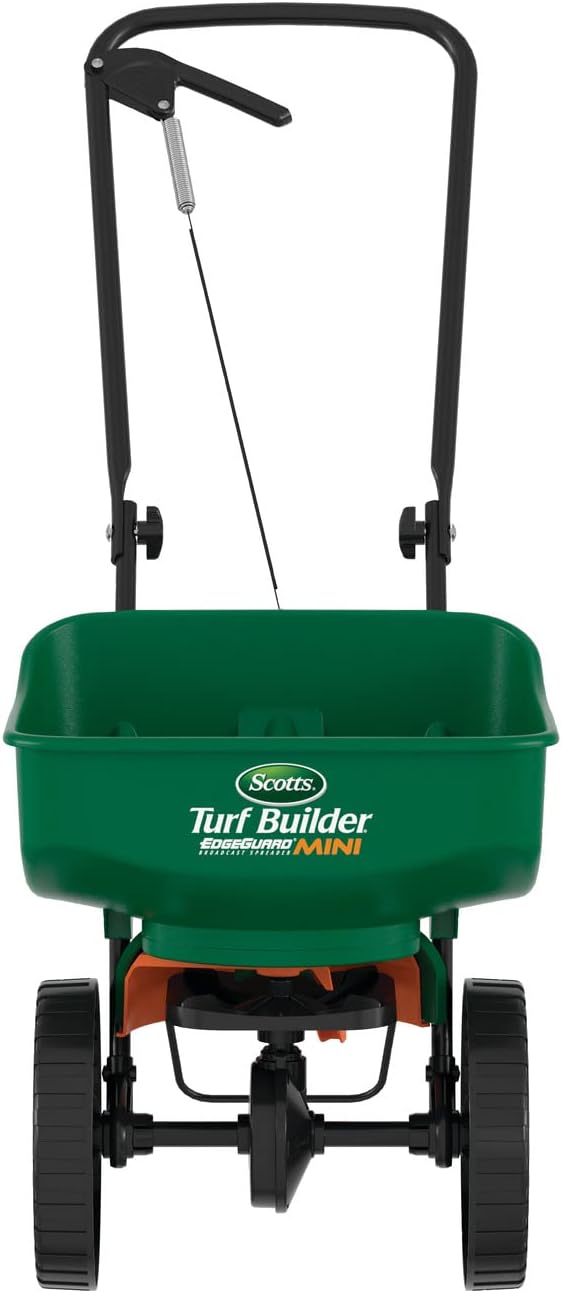
Scotts Spreader EdgeGuard Mini Broadcast Spreader
The go-to spreader for applying winterizer fertilizer with precision and edge control. Holds up to 5,000 sq ft of product per fill, with an EdgeGuard feature that keeps fertilizer off driveways and beds.
🛒 View on AmazonFrequently Asked Questions About Lawn Winterization
The best time to winterize your lawn is in late fall — typically 2 to 4 weeks before the ground freezes hard. For most Northern US lawns, that’s October into early November. Apply winterizer fertilizer when nighttime temperatures are consistently in the 40–50°F range and the grass’s top growth has visibly slowed. Soil temperature at 4 inches should be between 40–55°F for effective nutrient uptake.
For most of the Northern US and Canada, October is the ideal month for winterizer application. In the Mid-Atlantic and Midwest, October 1 through November 10 is a reliable window. In the Southern US, November or even early December works depending on your frost dates. The trigger to watch is when nighttime temperatures consistently drop below 50°F and growth rate slows — not simply a calendar date.
Yes, and it’s a very common mistake. Applying winterizer fertilizer while the grass is still actively growing in early fall redirects nutrients into top growth rather than root storage. This produces a lush fall flush that’s susceptible to disease and depletes carbohydrate reserves. Wait until mowing frequency drops and nighttime temperatures are consistently below 50°F before applying.
Yes. Begin lowering your mowing height gradually over the last 3–4 mows of the season, targeting winter height (typically 2–2.5 inches for cool-season grasses). Mowing before the final fertilizer application ensures the fertilizer reaches the soil surface directly. Your last mow of the season should occur after the grass has stopped growing but before the first hard freeze.
Warm-season grasses require a different approach. Stop all nitrogen fertilization 6–8 weeks before the first expected frost to prevent tender growth that’s prone to frost damage. A light potassium-only application (like 0-0-50 potassium sulfate) in early fall can improve cold hardiness without stimulating growth. Allow the grass to harden off and go dormant naturally — don’t fight the process with late-season irrigation or fertilizer.
Winterizer fertilizer is formulated with a high potassium (K) ratio relative to nitrogen (N) — common NPK ratios include 24-0-12, 32-0-8, and 13-0-46. Potassium strengthens cell walls against freeze damage, activates carbohydrate storage enzymes, and improves disease resistance. This is fundamentally different from spring or summer fertilizers that emphasize nitrogen for top growth. Using a standard high-nitrogen fertilizer in fall won’t give you the cold-hardiness benefits of a true winterizer.
Absolutely — fall core aeration is one of the highest-value pre-winterization steps you can take. Aerate in early fall (September for most Northern US lawns), then follow with overseeding and starter fertilizer in that same Phase 1 window. Aeration opens channels that dramatically improve the effectiveness of winterizer fertilizer applied 4–6 weeks later in Phase 2, getting nutrients directly to the root zone rather than leaving them on the surface.
Once the soil temperature at 4-inch depth drops below 40°F, nutrient uptake becomes very inefficient. Below 32°F at 2-inch depth (frozen ground), it stops entirely. Any winterizer applied to frozen ground sits on the surface all winter and risks nutrient runoff into waterways in spring. Set a firm cutoff: stop winterizer applications when consistent soil temperatures at 4 inches fall below 40°F.
Yes — a light irrigation pass of 0.25 to 0.5 inches after applying granular winterizer dissolves the granules and carries the nutrients into the soil, activating the product and ensuring it reaches the root zone before temperatures drop. If rain is expected within 24–48 hours, you can skip manual watering. Avoid heavy watering that runs off without absorbing.
Not in the same application. Overseeding belongs in Phase 1 (early fall, 6–8 weeks before first frost) with starter fertilizer. Winterizer fertilizer comes in Phase 2 (late fall, 2–4 weeks before freeze). Applying winterizer when you overseed gives the wrong nutrient profile at the wrong time — starter fertilizer’s higher phosphorus better supports seedling root establishment, while winterizer’s high potassium is for the hardening-off mature plant.
Yes — returning clippings during fall mowing adds nitrogen, organic matter, and micronutrients back to the soil as they decompose. The caveat: avoid leaving thick clumps of clippings that mat down and smother the turf. Use a mulching mower setting to shred clippings finely, or avoid bagging on normal-growth mowing days. During the leaf season, mulching both leaves and clippings together is very beneficial.
Skipping winterization leaves your grass entering the most stressful period of the year with depleted carbohydrate reserves, shallow roots, and no potassium buffer against freeze damage. The results are visible in spring: patchy green-up, winter kill areas, higher disease incidence (especially snow mold), explosive weed germination into thin turf, and an overall lawn that needs far more spring intervention to recover. Over multiple years of skipped winterization, turf quality degrades progressively.
Conclusion: Give Your Lawn the Winter It Deserves
Winterizing your lawn is one of the most high-leverage investments in lawn care — a few hours of work in October and November that pays back every week from March through June. The timing window is specific but not difficult to hit: apply winterizer fertilizer when nighttime temperatures are consistently in the 40–50°F range and growth has slowed, which for most Northern US lawns means October into early November.
But timing is only part of the equation. The full winterization program — early fall aeration and overseeding in Phase 1, followed by winterizer fertilizer, final mowing at winter height, leaf cleanup, and deep watering in Phase 2 — is what separates truly great-looking lawns from average ones. Each task in the sequence reinforces the others, and the cumulative effect on spring green-up speed, turf density, and disease resistance is substantial.
Whether you’re working with a cool-season fescue lawn in the Midwest, a bermudagrass turf in Georgia, or a mixed-species lawn in the UK, the principles are the same: prepare the roots, build the carbohydrate reserves, protect the crown, and give the grass everything it needs to survive winter and explode into spring growth. Your lawn will thank you — loudly, greenly, and for the entire growing season ahead.
❄️ Full Winter Preparation Guide →