Can Milorganite Burn Your Lawn? The Full Truth About This Organic Fertilizer
Everything you need to know about burn risk, safe application rates, timing, and why yellow patches still appear — even with organic fertilizers.
The Quick Answer — Does Milorganite Burn Grass?
If you’ve searched “can Milorganite burn your lawn,” you’ve likely spotted a yellow patch after fertilizing and started wondering if your organic fertilizer is to blame. The short answer is: almost certainly not. Milorganite is one of the safest fertilizers on the market precisely because of how it’s formulated, and burn risk is extraordinarily low when used correctly.
That said, “almost impossible” doesn’t mean “completely impossible.” Certain edge-case scenarios — like applying a double rate on a parched lawn in 95°F heat — could contribute to stress-induced discoloration. But the mechanism is entirely different from chemical burn caused by synthetic nitrogen salt. Understanding that difference is key to diagnosing your lawn correctly and taking the right corrective action.
This guide unpacks the full science, walks you through every scenario where Milorganite could conceivably cause discoloration, gives you exact safe application rates, and helps you figure out what’s actually wrong when your turf turns yellow after fertilizing.
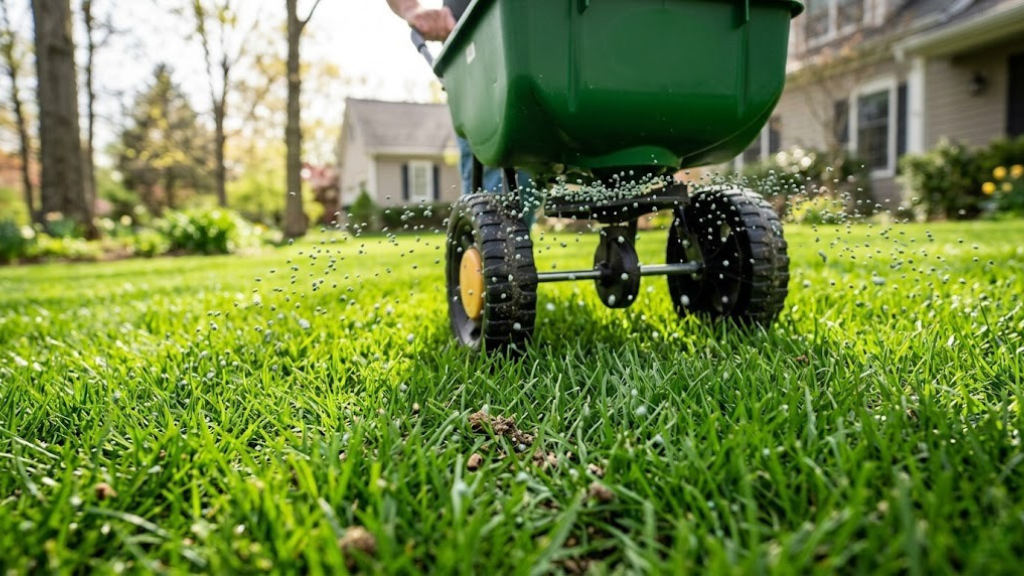
Milorganite is a granular organic fertilizer with an unusually low burn risk profile compared to synthetic alternatives.
What Is Milorganite and How Is It Made?
Milorganite has been around since 1926, originally developed by the Milwaukee Metropolitan Sewerage District (MMSD) as a way to recycle nutrient-rich biosolids from wastewater treatment. The name itself is a portmanteau of Milwaukee Organic Nitrogen. Today it’s one of the most widely used organic fertilizers in North America, and it’s sold under a trusted brand that turfgrass professionals have used for generations.
The manufacturing process is elaborate: microorganisms in the wastewater treatment process consume the organic matter in sewage, then those microbe-rich solids are harvested, kiln-dried at very high temperatures to eliminate pathogens, and pelletized. What remains is a granular product rich in slow-release organic nitrogen, iron, and other micronutrients.
Its NPK ratio is approximately 6-4-0 — meaning 6% nitrogen, 4% phosphorus, and 0% potassium added. This is a deliberately moderate profile, especially for nitrogen. But what sets Milorganite apart from synthetic fertilizers is that the nitrogen exists in an organic, protein-bound form that soil microbes must break down before grass roots can access it. This slow-release mechanism is exactly why burn risk is so low.
Key Nutrient Composition
| Nutrient | Amount | Form | Release Speed |
|---|---|---|---|
| Nitrogen (N) | 6% | Organic, protein-bound | Slow (4–8 weeks) |
| Phosphorus (P) | 4% | Organic | Moderate |
| Potassium (K) | 0% | — | — |
| Iron (Fe) | ~6% | Chelated organic | Moderate |
| Calcium (Ca) | ~3% | Organic | Slow |
| Magnesium (Mg) | ~0.5% | Organic | Slow |
The iron content deserves special attention. While iron won’t burn your lawn, it can cause the sidewalk, driveway, or pavers to stain a rust-orange color if granules land on hard surfaces and get wet. Always sweep hard surfaces after application. For more fertilizer science, check out this excellent guide on how to fertilize your lawn for optimal growth and root health.

Milorganite All-Purpose Organic Nitrogen Fertilizer
The classic 32 lb bag covers 2,500 sq ft. Virtually zero burn risk, releases slowly, feeds for weeks.
🛒 Check Price on AmazonThe Science: Why Organic Nitrogen Doesn’t Burn
To understand why Milorganite is so much safer than synthetic fertilizers, you need to understand what actually causes fertilizer burn in the first place. It’s not the nutrients themselves — it’s the salt concentration.
When synthetic nitrogen fertilizers like urea, ammonium nitrate, or ammonium sulfate dissolve in soil water, they release ions that create a high-osmotic-pressure environment around the root zone. This is the same principle as osmosis: water moves from areas of low solute concentration to high. When soil water becomes more concentrated than the fluid inside root cells, water is actually pulled out of the roots rather than in. Roots desiccate, grass yellows and dies — classic fertilizer burn.
Milorganite’s nitrogen is locked in organic molecules. It cannot dissolve into ions until soil microbes physically decompose the pellets. Even then, the process releases nitrogen slowly — in small, steady amounts that the root zone and grass plants can absorb before osmotic pressure builds. There are virtually no soluble salts introduced suddenly. This is the core reason Milorganite has an extremely low — though not technically zero — burn potential.
Osmotic Pressure Explained Visually
Nitrogen Release Speed: Milorganite vs Common Synthetic Fertilizers
Burn Risk Comparison: Milorganite vs Other Fertilizers
Not all fertilizers carry the same fire risk for your lawn. Understanding the spectrum — from zero-burn organic options to high-risk quick-release synthetics — helps you make smarter decisions for your turf’s long-term health.
Side-by-Side Burn Risk Score
Fertilizer Burn Risk by Type — Filterable Table
| Fertilizer | Type | Burn Risk | Salt Index | Release |
|---|---|---|---|---|
| Milorganite | Organic Biosolid | Very Low | ~0 | Slow (4–8 wks) |
| Compost | Organic | Negligible | ~0 | Very Slow |
| Blood Meal | Organic | Low–Medium | Low | Moderate |
| Fish Emulsion | Organic Liquid | Low | Low | Fast |
| Urea (46-0-0) | Synthetic | High | 75 | Fast |
| Ammonium Nitrate | Synthetic | Very High | 105 | Fast |
| Ammonium Sulfate | Synthetic | High | 69 | Fast |
| Scotts Turf Builder | Synthetic + Polymer-Coated | Medium | Moderate | Moderate |
| Slow-Release Urea (PSCU) | Coated Synthetic | Low–Medium | Low | Slow |
When comparing fertilizer options, it’s worth reading up on how slow-release and quick-release fertilizers differ in nutrient release and burn risk. The difference is significant, especially for homeowners who don’t want to carefully measure and water in their fertilizer immediately.

Scotts Turf Builder EdgeGuard Mini Broadcast Spreader
Precise, even distribution prevents hot spots when applying Milorganite — eliminates any minor overlap burn risk.
🛒 Check Price on AmazonWhat Actually Causes Yellow Patches After Milorganite?
If Milorganite doesn’t burn, why does your lawn look patchy or yellow after application? This is one of the most common points of confusion. The answer is almost always something else entirely — and correctly diagnosing it means you can actually fix the problem rather than blaming the wrong product.
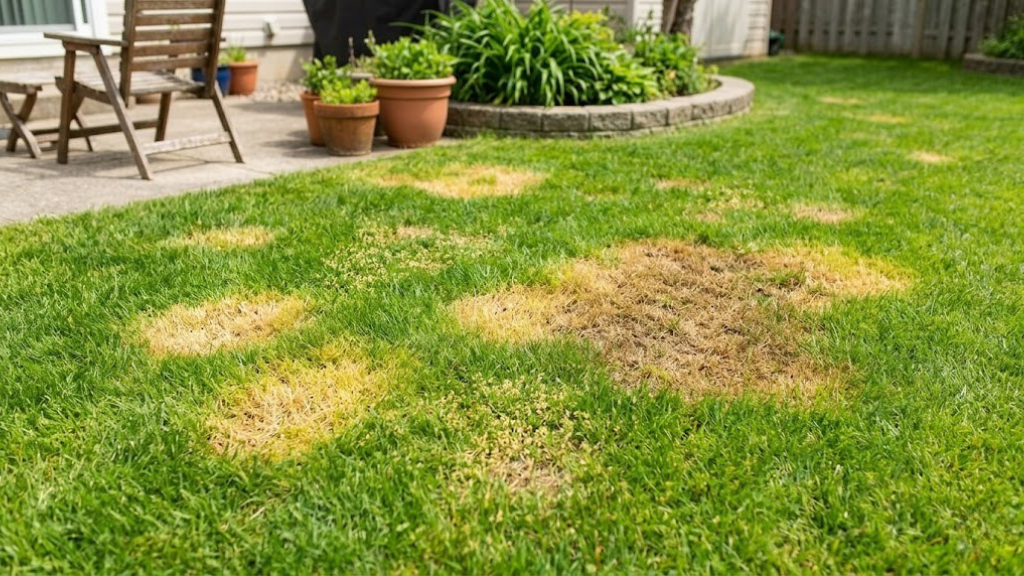
Yellow patches after fertilizing are almost never caused by Milorganite burn — heat stress, drought, fungus, and uneven spreading are the usual culprits.
Common Causes of Post-Application Yellowing — Click to Expand
Safe Application Rates — How Much Is Too Much?
One of Milorganite’s greatest advantages is its wide safety margin. Even at double the recommended rate, turf scientists have found negligible burn effects. However, staying within recommended ranges ensures your lawn gets the right balance of nutrients without tipping into excess — and it makes your bag go further.
Standard Recommended Rates
| Lawn Size | Amount Needed | Frequency | Notes |
|---|---|---|---|
| 1,000 sq ft | ~13 lbs | Every 8–10 weeks | Standard half-bag for small yards |
| 2,500 sq ft | ~32 lbs (1 bag) | Every 8–10 weeks | One standard 32 lb bag |
| 5,000 sq ft | ~64 lbs (2 bags) | Every 8–10 weeks | Two bags; use broadcast spreader |
| 10,000 sq ft | ~128 lbs (4 bags) | Every 8–10 weeks | Walk in two perpendicular directions |
Annual Application Schedule — Nitrogen Budget
Milorganite delivers approximately 0.78 lbs of nitrogen per 1,000 sq ft per application at the standard 32 lbs rate. General turf guidelines suggest 2–4 lbs of nitrogen per 1,000 sq ft per year for cool-season grasses and 3–6 lbs for warm-season grasses. That means you can safely apply Milorganite 3–6 times per year without approaching nitrogen excess thresholds.
Maximum Safe Rate Before Any Risk
Research and Milorganite’s own technical guidance suggest that up to 2× the recommended rate (roughly 26 lbs per 1,000 sq ft) applied at once on well-watered turf poses no burn risk. Beyond that, the excess iron may cause temporary darkening or slight phytotoxicity on very sensitive turf in hot weather. These effects are reversible with irrigation.
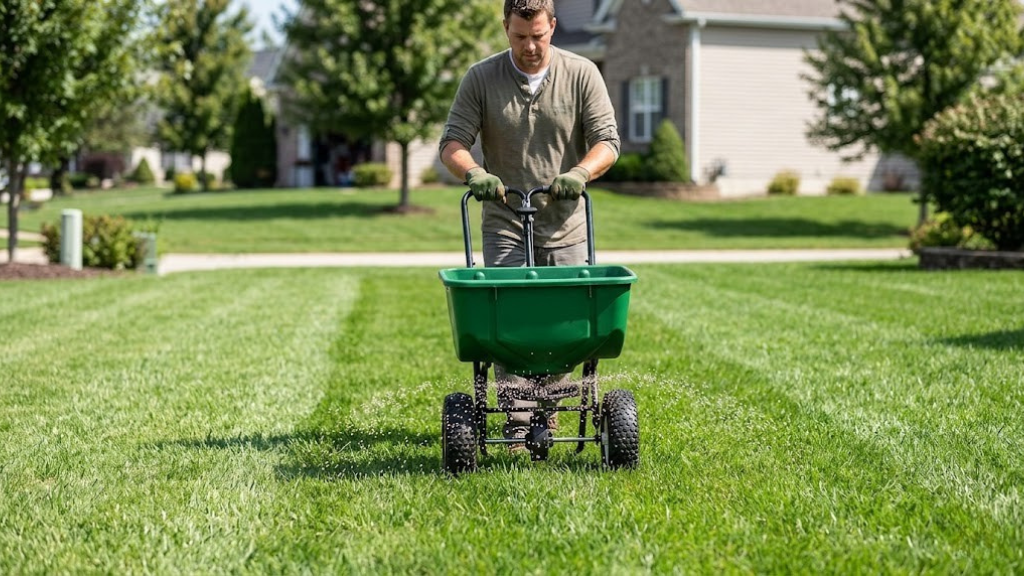
A calibrated broadcast spreader is the best tool for even distribution of Milorganite, preventing any localized over-application.

Professional Digital Soil pH & Moisture Tester
Test soil pH before applying Milorganite. Optimal pH (6.0–7.0) maximizes nutrient uptake and ensures even greening.
🛒 Check Price on AmazonBest Timing and Conditions for Zero-Risk Application
Even though Milorganite has a very low burn risk by nature, applying it under ideal conditions guarantees the best results and the healthiest turf possible. Timing matters not just for burn risk but for nutrient uptake efficiency, runoff prevention, and long-term soil health.
Ideal Conditions for Milorganite Application
- Temperature: Apply when air temperatures are consistently between 50°F and 85°F. Soil microbes are most active in this range, which accelerates nutrient release.
- Soil Moisture: Soil should be moist but not soggy. If it hasn’t rained in 5+ days, water first to activate microbial activity.
- Weather Forecast: Ideal timing is the day before rain, so granules get watered in naturally. Avoid applying before heavy downpours (risk of runoff) or during drought stress.
- Time of Day: Early morning or evening applications reduce evaporation. Avoid midday summer applications on stressed turf.
- Grass Condition: Only apply to actively growing grass. Dormant cool-season grass in mid-summer heat won’t benefit — wait for recovery.
Milorganite Application Rating by Season
Safety & Effectiveness Score — Animated Meters
Fall is arguably the best time to apply Milorganite, especially for cool-season turf. The grass is actively recovering from summer stress, microbes are still active, and cooler temperatures eliminate any remote heat-related stress concern. For a full seasonal plan, see our month-by-month lawn care calendar for step-by-step guidance year-round.
Milorganite Pros & Cons — Click Each for Details
No product is perfect for every situation. Here’s a thorough, balanced breakdown of Milorganite’s advantages and drawbacks — click each item to expand the explanation.
For more fertilizer review context, our full Milorganite fertilizer review covering nutrient profile and real-world results goes deep on long-term performance data across grass types and climates.
Milorganite vs Synthetic Fertilizer — Full Head-to-Head
If you’re trying to choose between Milorganite and a synthetic option like Scotts Turf Builder or a straight urea product, here’s a comprehensive comparison covering every relevant dimension.
| Attribute | Milorganite | Scotts Turf Builder | Straight Urea (46-0-0) |
|---|---|---|---|
| Nitrogen Form | Organic (slow) | Synthetic + slow-coat | Synthetic (fast) |
| Burn Risk | Very Low | Medium | High |
| NPK | 6-4-0 | 32-0-8 | 46-0-0 |
| Cost per lb N | $$–$$$ | $$ | $ |
| Green-Up Speed | 1–3 weeks | 3–7 days | 3–5 days |
| Feed Duration | 4–8 weeks | 4–6 weeks | 2–4 weeks |
| Soil Health Benefit | High (feeds microbes) | Low | Very Low |
| Pet Safety | ✅ High | ⚠️ Moderate | ❌ Low |
| Phosphorus | 4% included | 0% (varies) | 0% |
| Iron Content | ~6% | Low | 0% |
Nitrogen Burn Risk by Fertilizer Type
This comparison makes it clear why lawn care professionals often recommend Milorganite for homeowners who don’t want to carefully monitor watering schedules after every fertilizer application. The forgiveness factor is real and significant, especially when summer travel or irregular watering is a concern. If your lawn also needs proper aeration to accept nutrients effectively, reading about lawn aeration benefits will help you build a complete care system.
Milorganite Burn Risk by Grass Type
Different grass species have different tolerances for nitrogen, iron, and organic material. While Milorganite is broadly safe for all common turf species, some nuances are worth knowing before you apply.
| Grass Type | Season | Burn Risk | Best Application Window | Notes |
|---|---|---|---|---|
| Kentucky Bluegrass | Cool | Very Low | April–May, Sept–Oct | Responds exceptionally to iron content; deep blue-green color |
| Tall Fescue | Cool | Very Low | April–May, Aug–Oct | Drought-tolerant; Milorganite pairs well with deep watering |
| Bermuda Grass | Warm | Very Low | May–August | Loves summer heat; Milorganite won’t push excessive thatch as synthetics can |
| Zoysia Grass | Warm | Very Low | May–July | Low N requirements; don’t over-apply — 1× rate is sufficient |
| St. Augustine | Warm | Low | April–August | Sensitive to phosphorus buildup; soil test before multiple season use |
| Centipede Grass | Warm | Low–Medium | May–June | Very low N requirements — apply at ½ standard rate to avoid push overgrowth |
| Fine Fescue | Cool | Very Low | Sept–Oct primarily | Low fertility needs; once-annual fall application often sufficient |
Understanding which grass type you have is fundamental to any lawn care decision. For a comprehensive look at grass variety characteristics, see our guide on types of grass for lawns — it covers heat tolerance, maintenance requirements, and ideal fertilizer approaches by variety.
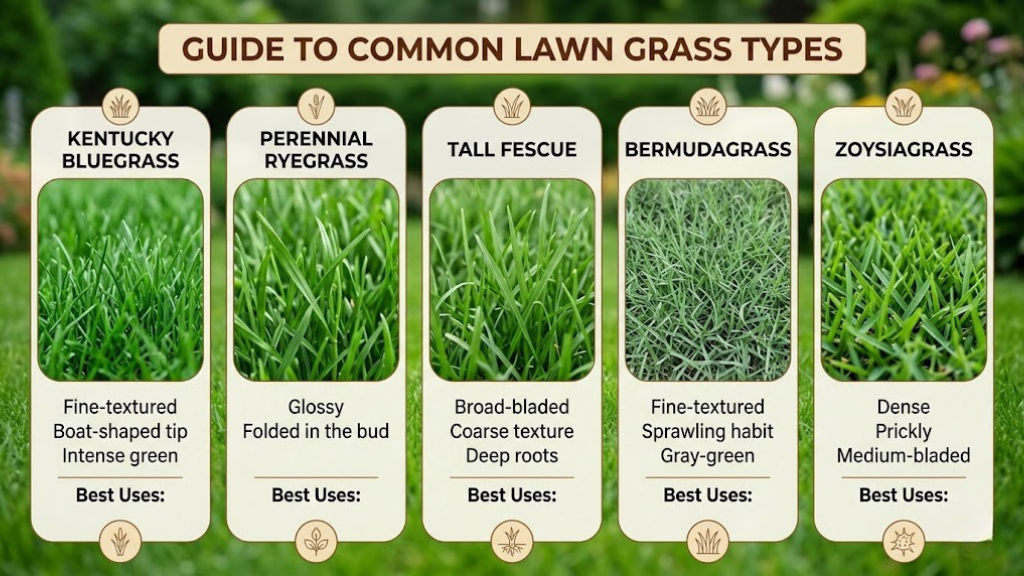
Milorganite is safe for virtually all common turf species, though centipede grass owners should apply at half the standard rate.
Troubleshooting: What to Do If Your Lawn Yellows After Milorganite
Even when you’ve done everything right, lawn problems happen. If you notice yellowing, discoloration, or patchy growth after a Milorganite application, here’s a step-by-step diagnostic process to correctly identify and resolve the issue.
Step-by-Step Diagnosis
- Assess the pattern: Uniform yellowing suggests a systemic issue (heat, drought, disease); irregular patches suggest localized causes (dog urine, fungal disease, spread error).
- Check recent weather: Was there a heat spike? Extended dry period? Heavy rain that may have washed granules off slopes?
- Inspect patch edges: Defined, sharp edges = likely dog urine or spreader error. Fuzzy, smoke-ring-style edges = likely fungal disease.
- Water deeply: Apply 1 inch of water to the affected area. If the problem is nutrient localization or salt concentration (very unlikely with Milorganite), this dilutes the issue.
- Test soil pH: Use a soil test kit or digital meter. pH outside 6.0–7.0 causes nutrient lockout regardless of how much you fertilize.
- Check thatch depth: More than ½ inch of thatch can trap granules. Dethatch if needed before the next application.
- Look for disease signs: If you see mycelium (white thread-like strands), spore bodies, or irregular dark rings, treat with an appropriate fungicide before reapplying fertilizer.
- Consider soil compaction: Compacted soil restricts root growth and nutrient absorption. If affected areas also drain poorly, schedule core aeration.
When It Really Might Be Milorganite (Rare Edge Cases)
Genuinely attributed Milorganite “burn” is extremely rare, but in the interest of completeness, these conditions could theoretically contribute to turf stress:
- Applying 3× or more the recommended rate on a lawn that’s already heat-stressed and unwatered
- Granules sitting on dry grass crowns for extended periods in intense sun without being watered in
- Applying to centipede or bahia grass at full synthetic-fertilizer rates (these are low-nitrogen grasses)
- Combining Milorganite with other high-nitrogen products in the same application window
In all these scenarios, the remedy is deep watering to dilute and carry nutrients into the soil. Recovery is typically complete within 2–3 weeks.
If you’ve recently revived a damaged lawn and are rebuilding turf health, our guide on how to revive a dead lawn through soil prep, watering, and reseeding covers the full recovery process step by step.
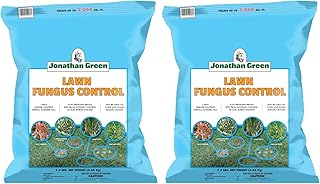
Scotts DiseaseEx Lawn Fungicide — Broad-Spectrum Treatment
If yellow patches after Milorganite application are actually fungal disease, this fast-acting fungicide treats 14+ common diseases including brown patch and dollar spot.
🛒 Check Fungicide Price on Amazon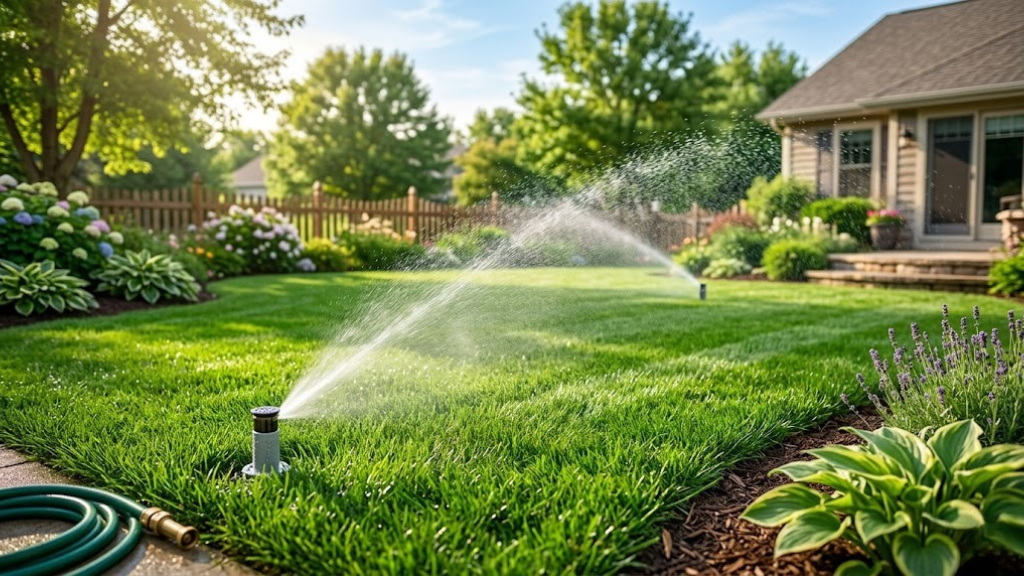
Deep watering after Milorganite application is the single most important step — it activates microbial breakdown and moves nutrients into the root zone where grass can access them.
Frequently Asked Questions
🌿 Conclusion: Milorganite Is Among the Safest Fertilizers You Can Use
After examining the science, the application data, and real-world outcomes, the answer to “can Milorganite burn your lawn?” is a resounding no — with negligible exceptions. Its slow-release organic nitrogen, near-zero soluble salt content, and wide application safety margin make it one of the most forgiving fertilizers available to home lawn care enthusiasts.
If you’re seeing yellowing after application, look elsewhere for the cause — heat stress, drought, fungal disease, dog urine, or soil problems are overwhelmingly more likely culprits. Correct diagnosis is everything in lawn care.
Apply at recommended rates (32 lbs per 2,500 sq ft), water in lightly after application, avoid applying to dormant or severely stressed turf, sweep granules off hard surfaces, and Milorganite will reward you with steady, deep-green growth for weeks. It’s the forgiving fertilizer that beginners and experts alike keep coming back to — and for very good reason.
🛒 Shop Milorganite on Amazon