Summer Lawn Aeration: The Complete Expert Guide
Everything you need to know about aerating your lawn in summer — timing, grass type, risks, and step-by-step techniques that actually work.
It’s the peak of summer, your lawn is stressed from heat, foot traffic, and sporadic watering — and you’re wondering whether now is the right time to break out the aerator. The short answer is: it depends on your grass type. The long answer — the one that will actually save your lawn — is what this guide is all about.
Aeration is one of the most transformative things you can do for a compacted, oxygen-starved lawn. Done at the right time, it unlocks root growth, improves drainage, and makes every drop of water and fertilizer count. Done at the wrong time, it can set your lawn back weeks or even cause lasting damage. Understanding the nuance between warm-season and cool-season grasses is the difference between a thriving summer lawn and a scorched recovery project.
Whether you’re dealing with Bermuda, Zoysia, St. Augustine, Kentucky Bluegrass, or Tall Fescue — this guide breaks down exactly what summer aeration means for your specific lawn, when it’s safe, when it’s risky, and how to do it right. We’ve also included step-by-step instructions, tool comparisons, and interactive visuals to make the process as clear as possible. Let’s dig in.
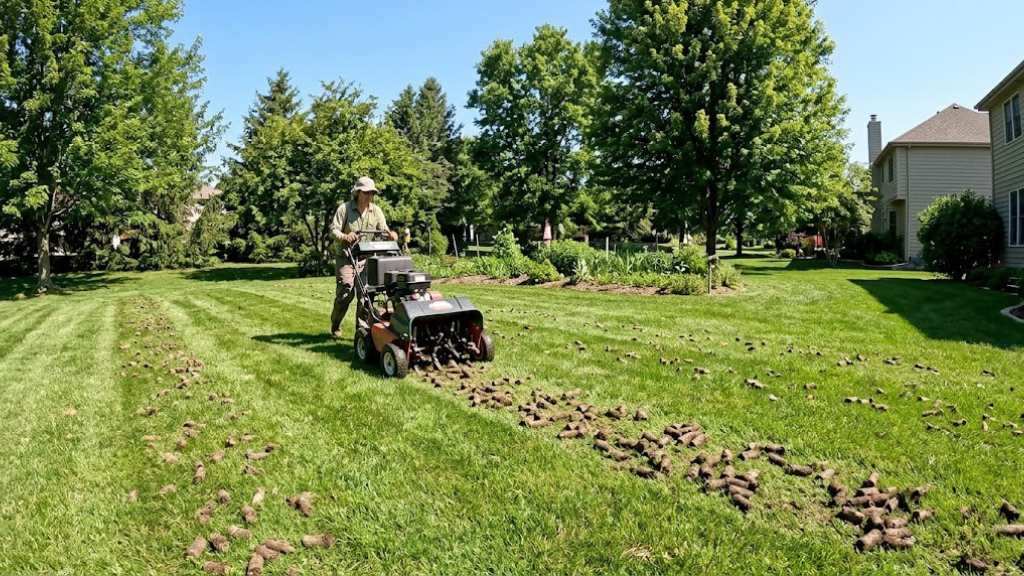
Core aeration removes plugs of soil, allowing air, water, and nutrients to penetrate the root zone.
What Is Lawn Aeration — and Why Does It Matter?
Lawn aeration is the process of perforating the soil with small holes to allow air, water, and nutrients to penetrate deep into the grass root zone. Over time, soil — especially clay-heavy soils — becomes compacted from foot traffic, mowing, rain, and the natural settling process. When soil compacts, the tiny pore spaces that hold oxygen and water collapse, essentially suffocating your grassroots.
Aeration is the remedy. By mechanically creating channels through the soil, you restore those pathways and give roots the resources they need to grow deeper, stronger, and more resilient. A lawn with a deep, robust root system handles drought, disease, heat, and weed competition dramatically better than a shallow-rooted one.
What Happens Underground When You Aerate?
The benefits of aeration are largely invisible — but they’re profound. Here’s what actually happens beneath the surface when you run an aerator over your lawn:
- Oxygen exchange improves: Roots respire, consuming oxygen and releasing carbon dioxide. Compacted soil traps CO₂ and blocks fresh oxygen. Aeration restores this gas exchange.
- Water infiltration increases: Instead of water pooling on the surface or running off, it now flows directly to the root zone where it belongs.
- Fertilizer becomes more effective: Nutrients from fertilizer applications reach the roots instead of washing away from the surface layer.
- Thatch breaks down faster: The soil cores deposited on your lawn after core aeration contain microorganisms that help decompose the thatch layer.
- Root growth deepens: Roots follow the path of least resistance. Open aeration channels encourage them to grow down rather than sideways near the surface.
According to university extension studies from institutions like Penn State and the University of Georgia, lawns that are regularly aerated show significantly better root depth, reduced weed pressure, and improved drought tolerance compared to unaerated counterparts. For those looking to build a comprehensive lawn maintenance plan, the Lawn Care 101 guide is an excellent foundation to start from.
Push a screwdriver or pencil into your lawn with moderate pressure. If it sinks easily 2–3 inches, your soil is fine. If it barely penetrates or requires significant force, your soil is compacted and aeration is overdue.
How Often Should You Aerate?
Most lawns benefit from aeration once a year. Heavily trafficked lawns — sports fields, backyard play areas, high-activity zones — may need aeration twice a year. Sandy soils compact less easily and may only need aeration every other year. Clay soils, on the other hand, are notorious compactors and may benefit from twice-annual aeration. The key is to read your lawn and respond to what it’s telling you.
Understanding when aeration is appropriate throughout the year — including in summer — requires knowing your grass. Let’s get into that now.
Can You Aerate Your Lawn in the Summer?
This is the central question — and the answer isn’t a simple yes or no. Whether summer aeration is appropriate depends entirely on what type of grass you have. Warm-season grasses actually thrive when aerated in summer. Cool-season grasses, however, are far more vulnerable to summer stress, and aerating them during the hottest months can cause serious harm.
Here’s the essential breakdown before we go deeper:
📌 The Core Rule
Warm-season grasses: Summer is the BEST time to aerate (May through August). Growth is active and recovery is rapid.
Cool-season grasses: Summer is generally the WORST time to aerate. These grasses are dormant or heat-stressed and have little ability to recover from the trauma of aeration.
The reasoning comes down to how each grass type grows. Warm-season grasses — Bermuda, Zoysia, Buffalo, Centipede, St. Augustine — are adapted to hot weather. Their growing season is summer. Aerate when they’re actively growing, and they’ll fill in the aeration holes quickly, recover fast, and show benefits within weeks.
Cool-season grasses — Kentucky Bluegrass, Tall Fescue, Fine Fescue, Perennial Ryegrass — peak in spring and fall. In summer, they either slow down dramatically or go dormant entirely. Aerating a dormant or heat-stressed cool-season lawn is like performing surgery on a weakened patient. The wounds don’t heal, weeds invade through the open holes, and moisture loss accelerates through the aeration channels.
There’s also a regional consideration. In the transition zone — a broad swath running through the middle of the United States from the Carolinas to California — both grass types sometimes coexist, and the timing window for aeration gets more complicated. If you’re in the transition zone, identifying your exact grass species before aerating in summer is critical.
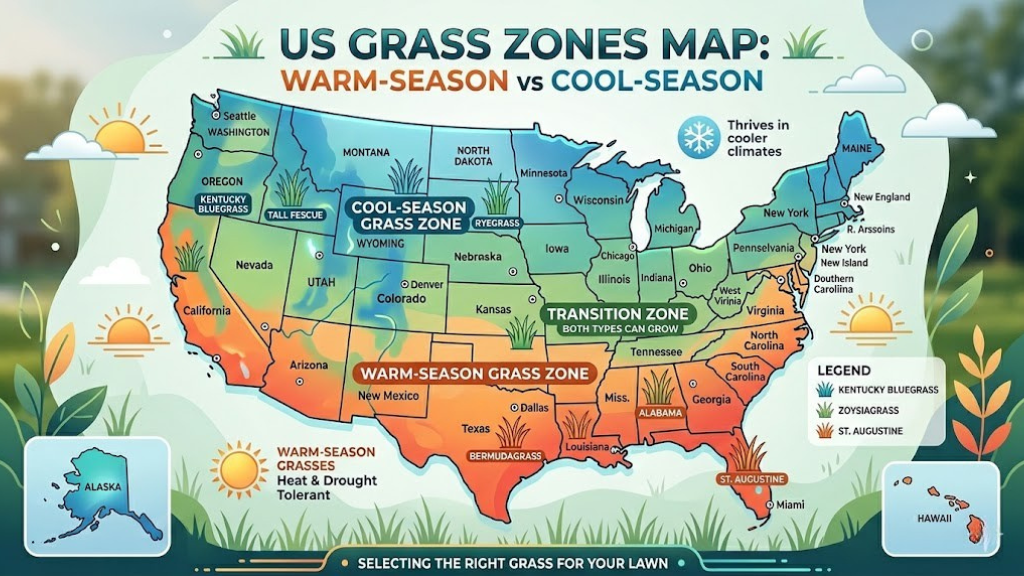
U.S. grass zones: warm-season grasses dominate the south and southwest, cool-season grasses cover the northern states.
There is one exception for cool-season lawns worth noting: if your cool-season lawn is severely compacted — to the point where water puddles and nothing grows — a very light aeration during a brief cool spell in early summer, followed by aggressive watering, can sometimes be justified. But this should be considered a rescue operation, not standard practice. For most homeowners with cool-season lawns, patience until fall will always produce better results.
Warm-Season vs. Cool-Season Grasses: The Fundamental Difference
Understanding how warm-season and cool-season grasses differ biologically is the foundation for smart aeration timing. These aren’t just categories of preference — they represent genuinely different metabolic strategies for surviving the year.
Warm-Season Grasses: Summer Is Their Prime
Warm-season grasses use what botanists call C4 photosynthesis — a more efficient method of converting sunlight to energy that works best at high temperatures (85–100°F). They actively grow in summer, slow dramatically in fall, and go dormant (often turning brown) in winter. Their root systems go deep, their stolons and rhizomes spread aggressively in warm conditions, and they recover quickly from physical disturbance.
Common warm-season grass species include Bermudagrass, Zoysiagrass, St. Augustinegrass, Centipedegrass, Bahiagrass, and Buffalo grass. These are the dominant grasses of the Southeast, Southwest, and Gulf Coast regions of the U.S., and they’re also common in tropical and subtropical climates worldwide.
Cool-Season Grasses: They Hate Summer Too
Cool-season grasses use C3 photosynthesis, which is optimal in cooler conditions (60–75°F). They grow actively in spring and fall, go semi-dormant or completely dormant in summer heat, and often stay green through mild winters. Their recovery mechanisms are at their weakest in the heat of summer, making summer aeration a serious risk.
Common cool-season species include Kentucky Bluegrass, Tall Fescue, Fine Fescue (Creeping Red, Chewings, Hard), Perennial Ryegrass, and Annual Ryegrass. These dominate northern lawns from New England through the Pacific Northwest and are common in higher-elevation areas even in southern states.
Side-by-Side: Warm-Season vs. Cool-Season for Summer Aeration
Best Timing for Summer Lawn Aeration
Timing is everything in lawn care, and summer aeration is no exception. Even for warm-season grasses where summer aeration is appropriate, there’s a sweet spot within the season that produces the best results. Getting this right ensures your lawn has maximum time to recover before stresses like drought or early-fall temperature drops arrive.
For Warm-Season Grasses: Timing Within Summer
The ideal window for aerating warm-season grasses begins once the grass has broken dormancy and is actively growing — typically when daytime temperatures are consistently above 70°F and soil temperatures exceed 65°F. In most southern states, this is late May to early June. The prime window runs through July, with late August being the last recommended period to allow adequate recovery before fall.
Avoid aerating during peak heat waves. If temperatures are above 100°F and drought stress is visible, give your lawn a few days of good watering first, then aerate when conditions moderate slightly. You want the grass actively growing — not barely surviving — when you aerate.
For Cool-Season Grasses: Summer Is Mostly Off-Limits
For cool-season grasses, the ideal aeration window is fall (late August through October in most northern regions). If spring aeration is needed, do it in March or April before temperatures climb above 80°F. The summer months — June through August — should generally be avoided entirely for cool-season lawns.
The one partial exception: early June in cooler northern climates (think Minnesota, Maine, or higher elevations in the Rockies) where summer temperatures rarely exceed 80°F. Even here, aerate only if needed, water immediately after, and skip fertilizing post-aeration until fall.
Aeration Effectiveness by Month (Warm-Season Grass)
The chart above shows the relative effectiveness of aeration for warm-season lawns across the calendar year. Notice how effectiveness peaks from June through August and drops sharply in winter dormancy. For a detailed breakdown of aeration timing for all grass types, see the guide on when to aerate your lawn.
- Grass is actively growing (not dormant or stressed)
- Soil is moist but not waterlogged (aerate 1–2 days after watering)
- No extreme heat forecast for the next 48 hours
- You have time to water immediately after aeration
- No new seeding was done in the past 6 weeks

Top Pick · Core Aerator
Agri-Fab 45-0299 Tow Behind Core Aerator
32-inch tow-behind design with 32 heat-treated, hollow steel tines. Perfect for warm-season summer aeration on medium to large lawns.
View on Amazon →Signs Your Lawn Needs Aeration Right Now
Your lawn communicates. If you know what to look for, it will tell you clearly when soil compaction is holding it back. These are the most reliable indicators that summer aeration is warranted — for warm-season grasses that are in their growing season.
Water Pooling
Water sits on the surface for 30+ minutes after rain or irrigation instead of absorbing within a few minutes. Classic compaction sign.
Spongy Thatch Layer
A thatch layer exceeding ½ inch acts as a barrier. Feel the grass near the soil — thick, bouncy matting indicates thatch buildup.
Thin, Patchy Growth
Despite adequate watering and fertilizing, certain areas remain thin or refuse to fill in. Compaction starves roots of oxygen.
Heavy Foot Traffic Areas
Pathways, sports areas, or zones where people regularly walk develop hardpan soil that resists root penetration.
Runoff on Slopes
Water runs downhill instead of soaking in. Even gentle slopes can shed water rapidly when soil is compacted.
Scalping Vulnerability
If your mower scalps small hills or bumps in the lawn easily, soil has likely settled unevenly due to compaction below.
The Screwdriver Test: Quick Field Assessment
The simplest compaction test requires nothing more than a regular screwdriver. Push it into the soil — with moderate, steady pressure (not a hammer blow) — in multiple spots across your lawn. A properly aerated, healthy soil should accept the full blade (4–6 inches) without extreme effort. If you’re hitting resistance within the first 1–2 inches, compaction is present and aeration is needed.
Repeat this test in different zones: near the house, in the center of the lawn, in high-traffic paths, and in garden borders. Compaction is rarely uniform — it often concentrates in specific areas. This tells you where to focus your aeration efforts most heavily.
For more insights into diagnosing what’s wrong with your lawn before taking action, the lawn problems and solutions guide covers the full spectrum of common issues and their remedies.
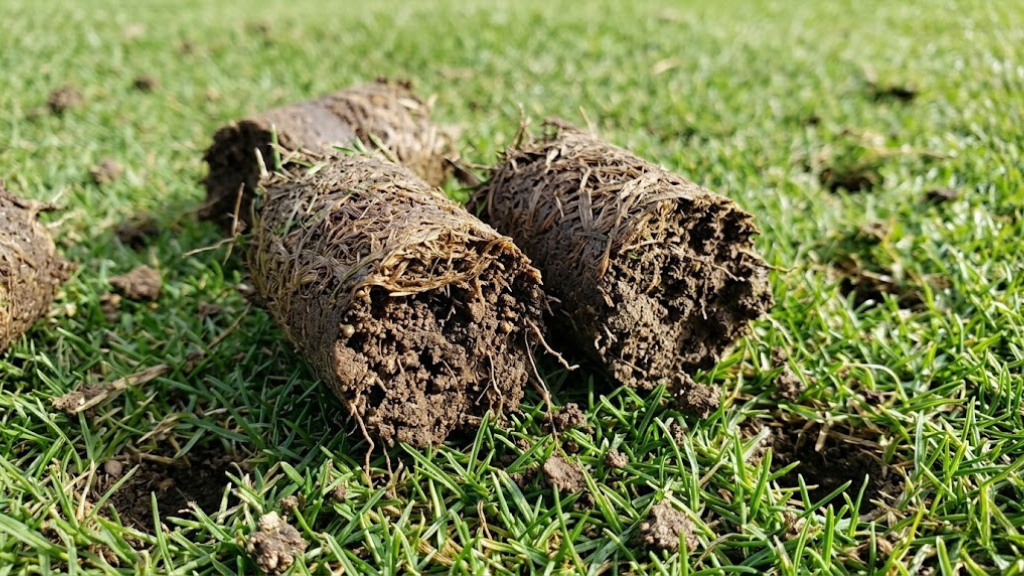
Soil cores extracted during aeration reveal the thatch layer and soil composition — a valuable diagnostic tool.
Risks of Summer Aeration & When to Completely Avoid It
Even for warm-season grasses where summer aeration is generally safe, there are specific conditions and scenarios where you should hold off. And for cool-season grasses, it’s important to understand exactly why summer aeration can be so damaging — so you’re not tempted to take the risk.
Risks for Cool-Season Lawns in Summer
When a cool-season lawn is heat-stressed or dormant, aerating it creates open wounds in the soil and grass that the plant has almost no ability to heal. Here’s what happens in practice:
- Accelerated moisture loss: Aeration holes increase evaporation from the soil. A dormant cool-season lawn that can barely maintain itself will lose critical moisture reserves it needs to survive the summer.
- Weed invasion: Crabgrass, goosegrass, spurge, and other summer annuals love bare soil. Aeration holes are prime germination sites, and with the turf unable to compete, weeds explode.
- Disease vulnerability: Open aeration channels in hot, humid conditions can invite fungal pathogens. Brown patch, dollar spot, and pythium blight thrive in exactly these conditions. For more on managing summer fungal issues, see the guide on brown patch fungus treatment.
- Slow or no recovery: Without active growth, the grass cannot fill in the holes created by aeration. The lawn may look worse for weeks — or longer — before improving.
- Heat stress amplification: The physical disruption of aeration during extreme heat can push already-stressed cool-season grass over the edge into actual dieback, not just dormancy.
Risks Even for Warm-Season Grasses
Summer aeration is generally safe for warm-season lawns, but there are still scenarios where you should postpone:
Core Aeration vs. Spike Aeration: Which Is Right for Summer?
When people talk about lawn aeration, they’re usually referring to one of two distinct methods: core aeration (also called plug aeration) and spike aeration. Understanding the difference between these two techniques is essential — because they produce dramatically different results, and for summer use, the distinction matters even more.
Core Aeration: The Professional Standard
Core aeration uses hollow tines that physically remove cylindrical plugs of soil and thatch from the lawn. These plugs — typically ½ to ¾ inch in diameter and 2–4 inches long — are deposited on the lawn surface where they break down over 1–2 weeks, returning organic matter and microorganisms to the soil.
The holes left behind by core aeration are the real benefit. Each hole is a direct conduit for air, water, fertilizer, and root growth. Because the soil is actually removed rather than just compressed to the sides, the surrounding soil can expand into the void over time, reducing long-term compaction. The removed cores also help break down thatch when they dissolve back into the lawn surface.
Core aeration is the method recommended by virtually every turf science institution and professional lawn care operator. For summer aeration of warm-season grasses, it’s the preferred approach. The detailed comparison of core vs. spike aeration shows just how significant the difference in soil penetration metrics can be.
Spike Aeration: Fast but Limited
Spike aeration uses solid tines or spikes to poke holes in the soil. Unlike core aeration, nothing is removed — the spike simply pushes soil aside to create the hole. This sounds similar, but there’s a critical difference: compressing soil sideways creates hardpan walls around each hole that actually increase compaction density in the areas immediately surrounding the hole.
Spike aeration is better than nothing in certain limited situations — such as very light compaction on sandy soils — but it’s widely considered inferior to core aeration for any significant compaction issue. On clay-heavy or severely compacted soils, spike aeration can actually worsen conditions over time.
| Feature | Core Aeration | Spike Aeration |
|---|---|---|
| Soil Removal | Yes — plugs extracted | No — soil compressed |
| Compaction Relief | Excellent | Minimal to poor |
| Hole Persistence | Weeks to months | Collapses in days |
| Thatch Reduction | Yes (cores decompose) | No |
| Summer Use | Highly recommended | Acceptable for sandy soils only |
| Equipment Cost | Higher (rent $60–$100/day) | Lower ($30–$60) |
| Recovery Time | 2–4 weeks (warm-season) | 1–2 weeks |
| Best For | Clay soils, heavy compaction | Light maintenance, sandy soils |
When renting a core aerator, choose one with tines that penetrate at least 3 inches. Many consumer-grade spike aerators only reach 1–2 inches — not enough to address subsoil compaction where it often matters most.

Best Value · Manual Aerator
Yard Butler Lawn Coring Aerator
Heavy-duty step aerator with two hollow coring tines. Ideal for small targeted areas, high-traffic zones, or quick spot treatments in summer.
View on Amazon →How to Aerate Your Lawn in Summer: Step-by-Step
Whether you’re renting a walk-behind core aerator or using a tow-behind for a larger property, the process of summer aeration follows the same fundamental sequence. Following each step correctly maximizes your results and protects your lawn from unnecessary stress.
Step 1: Water Your Lawn (24–48 Hours Before)
Soil should be moist but not saturated. Water deeply — 1 inch of water — the day before you plan to aerate. Dry, hard soil is difficult for aerator tines to penetrate and causes mechanical stress on equipment. Wet, muddy soil clogs hollow tines and creates a mess. The sweet spot is firm but moist soil.
Step 2: Mark Hazards
Flag all sprinkler heads, buried irrigation lines, cable or utility markings, shallow tree roots, and any decorative edging that could damage tines. Call 811 (in the U.S.) before any deep aeration near utility lines. A replaced aerator tine costs $20; a damaged irrigation line can cost hundreds.
Step 3: Set Tine Depth
For most summer warm-season lawns, aim for 2.5–3 inch tine depth. For heavily compacted or clay-rich soils, go to 3–4 inches if your equipment allows. Check and adjust tine depth before you start, not in the middle of a run.
Step 4: Make Your First Pass
Begin at one edge and make parallel passes across the lawn, similar to mowing. Maintain a steady walking pace — too fast and tines don’t penetrate fully. For areas of severe compaction, slow down and make two passes at right angles (a cross-hatch pattern). Holes should be spaced 3–4 inches apart on your first pass.
Step 5: Make a Cross-Pass in High-Traffic Areas
For heavily compacted zones — pathways, sports areas, slopes that receive runoff — make a second perpendicular pass. This increases hole density in exactly the spots that need it most without aerating your entire lawn twice.
Step 6: Leave the Cores on the Lawn
Resist the urge to rake up the soil cores. Leave them where they land. Over 1–2 weeks, rain, irrigation, and foot traffic will break them down, returning organic matter and microorganisms to the surface. If the appearance bothers you, use a mower to run over them after they’ve dried — this speeds up their breakdown without removing their benefits.
Step 7: Water Immediately After
Water within 30 minutes of finishing aeration. Apply another ½ to ¾ inch of water. This prevents the aeration holes from drying out and closing before roots can take advantage of them. In summer heat, the surface dries remarkably fast — don’t skip this step. For a complete summer watering guide, see the lawn maintenance tips for summer.
Step 8: Fertilize Within 48 Hours (Optional but Recommended)
The open aeration holes are a direct delivery channel for nutrients. Applying a slow-release fertilizer within 48 hours of aeration dramatically improves nutrient uptake efficiency. Choose a formula appropriate for your grass type and the season — for warm-season summer lawns, a balanced or slightly high-nitrogen formula works well. Learn more about choosing the right fertilizer in the guide on how to fertilize your lawn for optimal root health.
Step 9: Consider Overseeding (Warm-Season Specific)
For warm-season lawns with thin or patchy areas, overseeding immediately after aeration can help fill gaps. The holes provide excellent seed-to-soil contact. Use the same grass species already present (or a compatible variety). Water lightly but frequently (2–3 times per day) for the first 2 weeks to establish seedlings.
Post-Aeration Summer Care: The Critical Recovery Window
What you do in the 2–4 weeks following summer aeration determines how much benefit your lawn actually realizes. This recovery window is when your lawn is most receptive to nutrients, water, and root growth — and also most vulnerable to stress. Managing this period correctly is what separates good outcomes from great ones.
Watering After Summer Aeration
Water is your most important post-aeration tool. In summer heat, soil moisture evaporates rapidly through aeration channels. Your watering schedule should increase temporarily after aeration:
- Days 1–7: Water daily, applying about ½ inch per session. This keeps aeration holes open and moist, encouraging roots to grow into them.
- Days 8–14: Transition back to your regular deep watering schedule — typically ½ to 1 inch every 2–3 days for most warm-season lawns.
- Week 3+: Resume your normal watering schedule, adjusted for rainfall and soil conditions.
If you’re concerned about your overall summer watering strategy, the guide on the best watering schedule for your lawn provides a thorough framework based on grass type, climate, and soil.
Mowing After Summer Aeration
Wait at least 48–72 hours before mowing after aeration — or until the soil cores on the surface have dried and partially crumbled. Mowing over fresh, wet cores smears them across the lawn rather than letting them break down properly. When you do mow, set your blade height slightly higher than normal for the first cut — this reduces stress on the recovering turf.
Fertilizing After Summer Aeration
Post-aeration fertilization is one of the highest-return investments you can make in your lawn. The open channels created by aeration dramatically improve the percentage of fertilizer nutrients that actually reach the roots (vs. washing away from a compacted surface). Apply a slow-release granular fertilizer within 48 hours of aerating, then water it in well.
For summer warm-season lawns, look for a fertilizer with a nitrogen-forward NPK ratio such as 32-0-6 or 24-0-8. Avoid high-phosphorus formulas on established lawns (where phosphorus is rarely limiting). The guide to comparing slow-release vs. quick-release lawn fertilizers will help you choose the right product.
Post-Aeration Benefit Scores
Estimated improvement metrics for warm-season lawns following proper summer core aeration and post-care protocol.
What NOT to Do After Summer Aeration
- Don’t apply pre-emergent herbicide: This disrupts any overseeding and creates a chemical barrier that slows recovery.
- Don’t use weed-and-feed products: The high nitrogen in weed-and-feed combined with open aeration channels can cause fertilizer burn in hot conditions.
- Don’t allow heavy foot traffic for 2 weeks: Aeration holes can collapse under concentrated weight before roots have had time to grow into them.
- Don’t skip watering: The single most common post-aeration mistake is underwatering in the recovery period. Summer heat amplifies this risk dramatically.
- Don’t mow too short: Maintain proper mowing height for your species — don’t scalp the lawn in the name of “starting fresh.” Scalping a recently aerated lawn in summer heat is a recipe for disaster.
Best Lawn Aeration Tools & Equipment for Summer
Having the right equipment makes a significant difference in both the ease of aeration and the quality of results. From simple manual aerators for small lawns to heavy-duty tow-behind units for large properties, there’s a tool for every scale of project and budget.
Types of Aeration Equipment
Manual Core Aerators: These foot-pushed or hand-held tools are appropriate for small lawns (under 2,000 sq ft) or for targeted spot-treatment of compacted zones. The Yard Butler and similar step-type aerators are affordable and require no power source. However, they’re genuinely exhausting to use on anything larger than a small patio lawn.
Walk-Behind Power Core Aerators: Gas or electric walk-behind aerators are the workhorse for residential lawns of 2,000–10,000 sq ft. Available at most equipment rental centers ($60–$100/day), these machines are highly effective and manageable for most homeowners. Look for models with tine spacing of 3–4 inches and penetration depth of at least 3 inches.
Tow-Behind Core Aerators: For large properties, a tow-behind aerator attached to a riding mower or ATV is the most efficient solution. These units cover ground quickly and can be weighted for deeper penetration. The Agri-Fab 45-0299 is a popular model that handles up to 48 inches of width per pass. For understanding the full landscape of lawn tools and how they work together, see the guide on top lawn tools for precision turf care.
Liquid Aeration Products: A newer category of products claims to achieve aeration-like results through liquid application of soil conditioners (often containing humic acids and other compounds). Research on these products is mixed — they may improve soil structure somewhat, but they don’t create the physical channels that mechanical core aeration produces. They can be a useful supplement but are not a replacement for mechanical aeration on compacted soils.
Aeration Tool Comparison by Lawn Size
| Tool Type | Best For | Cost | Effort Level | Core Quality |
|---|---|---|---|---|
| Manual Step Aerator | Under 2,000 sq ft | $25–$60 (buy) | High | Good |
| Sandals/Spike Shoes | Very small areas | $15–$30 (buy) | Low | Poor (no core) |
| Walk-Behind Gas Core Aerator | 2,000–10,000 sq ft | $60–$100/day (rental) | Moderate | Excellent |
| Walk-Behind Electric Aerator | 2,000–6,000 sq ft | $50–$80/day (rental) | Moderate | Very Good |
| Tow-Behind Core Aerator (32″) | 5,000–20,000 sq ft | $200–$500 (buy) | Low (riding mower) | Excellent |
| Tow-Behind Core Aerator (48″) | 10,000+ sq ft | $350–$700 (buy) | Very Low | Excellent |
| Professional Service | Any size | $75–$250 (service) | None (you hire out) | Excellent |
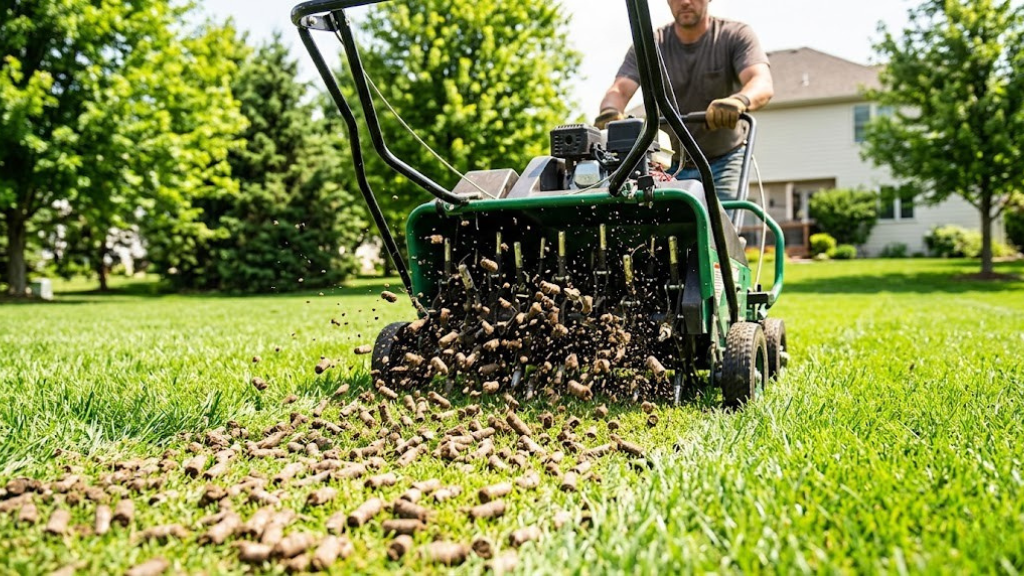
A walk-behind power core aerator is the most practical choice for most homeowners with medium to large lawns.

Supplemental Option · Liquid Aeration
Simple Lawn Solutions Soil Loosener
Concentrated liquid soil conditioner with humic acid. Use as a supplement between mechanical aeration sessions to maintain soil structure through summer.
View on Amazon →Grass-by-Grass Summer Aeration Guide
Different grass species have slightly different needs, recovery rates, and thatch tendencies. This section breaks down summer aeration recommendations by specific grass species so you can fine-tune your approach.
Bermudagrass (Cynodon dactylon)
Bermudagrass is arguably the best candidate for summer aeration of any common turfgrass. It’s the most aggressive warm-season spreader, producing both rhizomes (underground) and stolons (above ground) that fill in aeration holes rapidly — often within 2–3 weeks in peak summer conditions. Bermuda can handle (and benefits from) aeration every 4–6 weeks in summer if compaction is a persistent issue on high-traffic turf.
Bermuda also develops thatch quickly, making core aeration doubly beneficial — the cores help break down the thatch layer as they decompose. Timing: aerate from May through August. Avoid aerating once Bermuda begins to slow in late September.
Zoysiagrass (Zoysia spp.)
Zoysia is another excellent summer aerator candidate, though it spreads more slowly than Bermuda. Its recovery after summer aeration typically takes 3–5 weeks. Zoysia is particularly prone to thatch buildup — its dense, fine-bladed growth creates heavy thatch layers that respond very well to core aeration. Aerating Zoysia in June or early July gives it ample recovery time before fall.
St. Augustinegrass (Stenotaphrum secundatum)
St. Augustine spreads only via stolons (no rhizomes), which means its recovery from aeration is slightly slower than Bermuda or Zoysia. However, it still recovers well during its active summer growing season. Aerate St. Augustine from May through July. Avoid aerating in August in the Deep South, as the stress of late-summer heat combined with aeration recovery can set it back heading into fall. Note that St. Augustine is susceptible to chinch bug damage in summer — check for pest issues before aerating, and consult the guide on lawn pest control methods if needed.
Centipedegrass (Eremochloa ophiuroides)
Centipede is the low-maintenance grass of the South — slow-growing, low-fertility requiring, and sensitive to over-management. Aerate Centipede lawns no more than once per year, ideally in late spring or early summer (May–June). Aerating too aggressively or too late in summer can create thin spots that are slow to fill. A light aeration pass (not a double cross-hatch) is appropriate for this species.
Kentucky Bluegrass (Poa pratensis)
Kentucky Bluegrass is the quintessential cool-season lawn grass — beautiful but requiring careful management. In summer, it goes semi-dormant or fully dormant in most regions. Do not aerate Kentucky Bluegrass in summer unless you’re in a cool northern climate with mild summers. Wait until late August or September when temperatures consistently drop below 85°F and the grass comes out of dormancy. Fall aeration of Kentucky Bluegrass produces outstanding results.
Tall Fescue (Festuca arundinacea)
Tall Fescue is more heat-tolerant than other cool-season grasses and may remain somewhat active in summer. However, it still shouldn’t be aerated in summer in most regions. The exception: in cooler microclimates or at elevations where summer temperatures are moderate (70s°F), a careful early-June aeration followed by aggressive irrigation can work. For most homeowners with Tall Fescue, fall remains the ideal timing.
| Grass Type | Type | Summer Aerate? | Best Window | Recovery Time |
|---|---|---|---|---|
| Bermudagrass | Warm | ✅ Yes | May–August | 2–3 weeks |
| Zoysiagrass | Warm | ✅ Yes | June–July | 3–5 weeks |
| St. Augustinegrass | Warm | ✅ Yes (early–mid summer) | May–July | 3–5 weeks |
| Centipedegrass | Warm | ✅ Light aeration only | May–June | 4–6 weeks |
| Bahiagrass | Warm | ✅ Yes | June–August | 3–4 weeks |
| Kentucky Bluegrass | Cool | ❌ Avoid (except cool climates) | Late Aug–Oct | 3–6 weeks (fall) |
| Tall Fescue | Cool | ⚠️ Only in cool conditions | Sept–Oct ideal | 4–6 weeks |
| Fine Fescue | Cool | ❌ Avoid | Sept–Oct | 4–6 weeks |
| Perennial Ryegrass | Cool | ❌ Avoid | Sept–Oct | 3–5 weeks |
12 Common Summer Aeration Mistakes (And How to Avoid Them)
Even experienced lawn enthusiasts make mistakes with summer aeration. These are the most common errors — and the corrections that prevent them from derailing your lawn care efforts.
- Aerating a cool-season lawn in peak summer: The cardinal mistake. If you have Kentucky Bluegrass, Fescue, or Ryegrass, wait for fall. No exceptions unless you’re in a very cool climate.
- Aerating dry, parched soil: Tines can’t penetrate properly, cores are poor quality, and the lawn is already stressed. Always water deeply 24–48 hours before aerating.
- Using spike aerators on clay soil: Spike aeration on heavy clay doesn’t relieve compaction — it worsens it. Only core aeration is effective on clay-dominant soils.
- Aerating after pre-emergent application: This breaks the chemical weed barrier, allowing weed seeds to germinate. Wait 60 days after pre-emergent before aerating.
- Forgetting to mark sprinkler heads: Aerator tines can destroy irrigation heads in seconds. Flag every head before you start.
- Raking up soil cores immediately: The cores contain beneficial microorganisms and organic matter. Let them decompose naturally on the lawn surface.
- Skipping post-aeration watering: In summer heat, aeration holes dry out within hours without immediate watering. Water within 30 minutes of finishing.
- Mowing too soon after aerating: Wait 48–72 hours minimum. Mowing too soon over fresh, moist cores smears them rather than allowing them to decompose.
- Only making one pass in compacted areas: Severely compacted zones need a cross-hatch double pass. One pass creates holes; two creates a network.
- Aerating a newly seeded or sodded lawn: New lawns need at least 6–8 weeks to establish roots before mechanical aeration is safe. Too early and you pull up young grass.
- Over-aerating cool-season grass in early summer: Even in cooler climates, cool-season grass is on the decline in June. A single light pass might be acceptable; a double cross-hatch is excessive.
- Not following up with fertilizer: Skipping post-aeration fertilization wastes the opportunity. The open channels are perfectly positioned to deliver nutrients directly to the root zone. Take advantage of this window.
If you’re unsure what type of grass you have, take a sample to your local cooperative extension office or use a reputable grass identification app before making any summer aeration decisions. Misidentifying your grass species and aerating at the wrong time can set your lawn back by months.
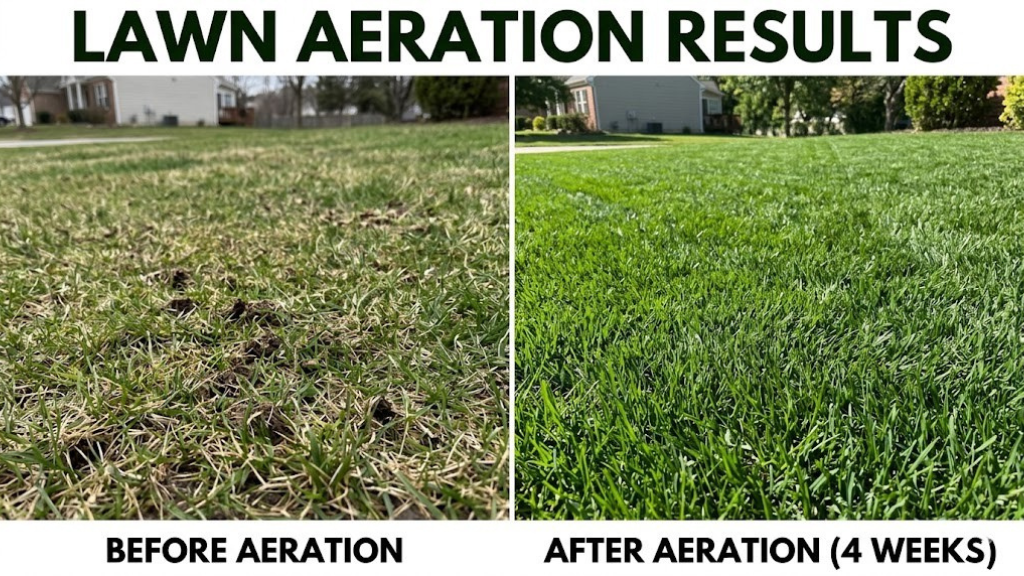
Before and after: a warm-season lawn four weeks after proper summer core aeration and post-care treatment.

Post-Aeration Essential · Summer Fertilizer
Scotts Turf Builder Summer Lawn Food
Specifically formulated for warm-season summer lawns. Feeds and strengthens grass plants while building drought resistance. Apply within 48 hours of aeration for maximum uptake.
View on Amazon →Frequently Asked Questions About Summer Lawn Aeration
Conclusion: Summer Aeration Done Right
The question “Can I aerate my lawn in summer?” doesn’t have a one-size-fits-all answer — but it does have a very clear framework. Understand your grass type, respect the biology, time your aeration correctly, and follow up with proper post-care. Do that, and summer aeration becomes one of the most impactful investments you can make in your lawn’s long-term health.
For warm-season grasses — Bermuda, Zoysia, St. Augustine, Centipede, Bahia — summer is not just acceptable timing for aeration, it’s ideal timing. These grasses are built for heat, they grow aggressively in the warmth, and they recover from aeration with remarkable speed. Core aerate them in June or July, water well, apply a quality slow-release fertilizer, and watch the results unfold over the following weeks.
For cool-season grasses — Kentucky Bluegrass, Tall Fescue, Fine Fescue, Ryegrass — summer is the time for patience, not action. Protect these grasses from additional stress, keep them properly watered (or let them go dormant naturally in dry climates), and save the aeration for fall when they’ll respond beautifully. The wait is worth it.
Whatever your grass type, the fundamentals of aeration success remain constant: moist soil before aerating, core aeration over spike aeration for compacted soils, immediate watering after, and strategic fertilization to capitalize on the open channels. Add in proper mowing height and a calibrated watering schedule, and your lawn will communicate its thanks within weeks — in the form of deeper green color, denser growth, and dramatically improved resilience.
For more on building a year-round lawn care strategy, explore our complete month-by-month lawn care calendar — twelve months of expert guidance covering every season and every key maintenance task.
Ready to Transform Your Lawn This Summer?
Get the right tools, follow the right timing, and apply everything you’ve learned here. A properly aerated lawn is a healthier, more resilient, and more beautiful lawn — whatever the season brings.
Best Lawn Aerators Reviewed → Aeration Benefits Explained →