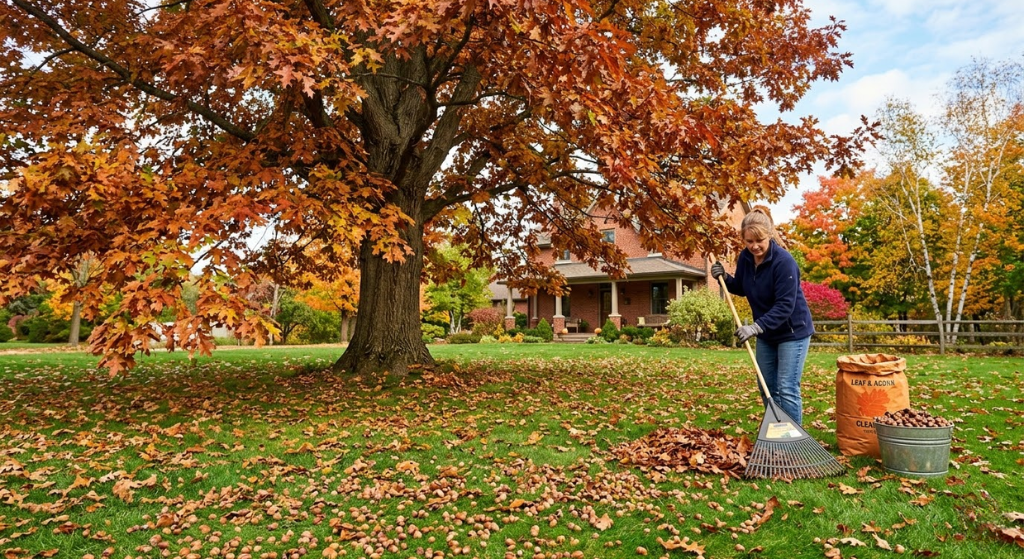
Every autumn, homeowners under mature oak trees face one of the most stubborn lawn maintenance challenges: thousands of acorns covering every inch of grass. They’re too heavy and round for leaf blowers to move well, too numerous to rake by hand, and dangerous to mow over directly. So the question arises — can the lawn sweeper sitting in your garage actually handle these things?
The good news is that lawn sweepers are genuinely well-suited to acorn collection, often more so than any other single tool. The nuance is that acorns behave very differently from leaves: they’re heavy, round, individual objects that sit at the base of the grass rather than resting on top of it, and they require specific brush settings and sweeper designs to collect efficiently. Get those details right and a tow-behind sweeper clears an acre of acorns in under an hour. Get them wrong and you’ll watch the brush roll right over them, leaving every acorn perfectly in place.
This guide covers everything — which sweeper types work, which ones struggle, the best products on the market for acorn collection, exactly how to adjust and operate your sweeper, and what to do when a sweeper isn’t the right tool for your particular situation.
1. The Direct Answer: Can a Lawn Sweeper Pick Up Acorns?
Yes — but with important qualifications. A lawn sweeper collects debris by using rotating brushes to fling material up and over into a trailing hopper. Acorns, being round, smooth, and relatively heavy, are actually well-suited to this mechanism in many respects: the brush can grab and flick them efficiently when the settings are correct, and their weight means they travel cleanly into the hopper without blowing back out.
The challenges are specific and solvable:
- Acorns sit low in the grass — they sink to the soil surface under their own weight, which means a brush set too high simply passes over them. Lowering the brush height to have the bristle tips just touching the lawn surface is essential.
- High-density acorn coverage clogs hoppers fast — acorns are volumetrically dense compared to leaves. A hopper that handles a full bag of leaves may need emptying after every two or three passes in a heavy acorn fall. Frequent emptying is part of the workflow.
- Wet acorns are significantly harder to collect — moisture causes acorns to stick to each other, to grass blades, and to the soil surface. Sweeping dry acorns is markedly more effective than wet ones.
- Very heavy, deep accumulations challenge any sweeper — if acorns are piled several layers deep under the tree’s drip line, a single sweeper pass won’t clear them. Multiple passes or a nut roller works better here.
Get the brush height right, sweep when the acorns are dry, and empty the hopper frequently — and a quality lawn sweeper is a genuinely excellent acorn collection tool. These are manageable conditions, not fundamental limitations.
Leaves are lightweight, irregularly shaped, and tend to mat together — sweepers collect them efficiently with a higher brush setting and softer bristles. Acorns are dense, spherical, and individual — they require the brush to make firm contact at the base of the grass to flick them upward. The same sweeper handles both effectively with the right setting for each task.
2. Why Acorns Need to Be Removed from Lawns
Before diving into equipment, it’s worth understanding why acorn removal matters enough to warrant a dedicated tool and the time investment. Acorns are a genuine lawn problem, not just an aesthetic nuisance.
🌰 What Acorns Do to Your Lawn If Left Uncollected
- They germinate into oak seedlings — acorns are viable seeds. Left through autumn and winter, a proportion will germinate into oak seedlings in spring. Young oak seedlings develop a deep taproot quickly and become increasingly difficult to remove as they mature. An established two-year-old oak seedling in a lawn requires significant effort to fully remove.
- They damage mower blades — running a mower over a dense acorn layer causes blade nicks, dents, and dulling at an accelerated rate. Acorns can also become dangerous projectiles if struck by a fast-spinning mower blade.
- They smother grass — in high densities, acorns block light and trap moisture against the soil surface, causing the grass beneath to thin and yellow over winter.
- They create tripping hazards — a lawn covered in acorns is a slip-and-trip hazard, particularly when wet. For households with elderly residents or young children, this is a genuine safety concern.
- They attract pest animals — while squirrels and deer feeding on acorns may seem benign, the digging activity of squirrels burying acorns creates dozens of small divots across the lawn surface that accumulate over a season.
- Decomposing acorns acidify soil — acorns contain tannins that lower soil pH as they break down. In heavy oak areas with persistent accumulation, the localised soil acidification can affect grass health over time.
The optimal approach is to remove acorns promptly as they fall — every 3–7 days during peak drop season — rather than allowing them to accumulate. This keeps the individual sweeping sessions manageable, prevents germination from getting started, and avoids the compounding problems of large accumulations.
3. Lawn Sweeper Types and Their Acorn Performance
Different sweeper designs handle acorns with varying effectiveness. Understanding the strengths and limitations of each type helps you choose the right tool — or combination of tools — for your specific situation.
Tow-Behind Sweeper
Pulled by riding mower or tractor. Wide brush, large hopper (15–25 bushels). Best for large lawns with heavy acorn coverage.
✓ Excellent for AcornsPush Sweeper
Manually pushed. Narrower brush, smaller hopper (3–7 bushels). Good for small to medium lawns with moderate acorn falls.
~ Good with Correct SettingsLawn Vacuum / Vac
Powered suction-based collection. Very effective on mixed debris including acorns. Higher cost, more maintenance.
✓ Excellent for AcornsNut Roller / Gatherer
Wire cage or plastic finger roller specifically designed to collect round objects. Best pure-acorn tool available.
✓ Best for Acorns SpecificallyPerformance by Acorn Scenario
Tow-Behind Sweeper
Large lawn (½ acre+) with moderate-to-heavy acorn coverage. Most efficient overall.
Nut Roller
Any size lawn with pure acorn coverage and minimal leaf mixing. Fastest per-pass pickup rate.
Push Sweeper
Small to medium lawn with moderate acorn fall. Set brush low for best results.
Lawn Vacuum
Mixed leaves and acorns. Dense accumulations under trees. Good collection rate.
Leaf Blower Alone
Heavy acorns don’t move well under air blast. Use only to corral before collecting.
Lawn Mower (bagging)
Light coverage only. Dense acorns damage blades and clog decks. Risky approach.
4. Tow-Behind Sweepers: The Best Choice for Large Lawns with Heavy Acorn Falls
If you have a riding mower or lawn tractor and a large lawn under oak trees, a tow-behind sweeper is the most efficient acorn collection solution available. These sweepers attach to the hitch of any standard riding mower and are pulled across the lawn as you drive, with the rotating brushes picking up acorns and depositing them into a large trailing hopper.
What Makes Tow-Behind Sweepers Good for Acorns
- Wide brush width (42–52 inches) — covers large areas quickly, often completing a full acre in under 30–45 minutes
- Large hopper capacity (15–25 bushels) — accommodates the significant volume of acorns without constant emptying stops
- Adjustable brush height — most models offer multiple height settings that allow precise calibration for acorn contact
- Brush density and stiffness — tow-behind brushes are typically stiffer and more densely packed than push sweeper brushes, giving them better flicking action on heavy, smooth acorns
- Consistent speed — the mower sets a steady walking pace that maintains consistent brush contact across the whole lawn
Setting Up a Tow-Behind for Acorns
The most critical adjustment is brush height. Most tow-behind sweepers have a lever or adjustment dial that raises and lowers the brush relative to the ground. For leaf collection, a mid-to-high setting works well. For acorns, you need to lower the brush by 1–2 positions from the leaf setting so the bristle tips are actively contacting the lawn surface at the base of the grass blades where acorns sit.
Test your setting by making one pass and checking behind: if acorns remain in the swept path, lower the brush further. If the sweeper drags or scalps the lawn surface, raise it slightly. Once dialled in, a tow-behind sweeper will collect 85–95% of acorns in a single pass on a flat, well-maintained lawn.
For very heavy acorn falls, make your first pass in one direction across the lawn, then make a second pass perpendicular to the first. The first pass collects the majority; the second catches acorns that were pushed aside or missed between the first passes. This two-directional approach achieves near-complete collection without needing to lower the brush to a level that risks scalping.
5. Push Sweepers for Acorns: What to Expect
Push sweepers — the manually-operated models with a rotating brush that sweeps debris into a hopper as you walk — are capable acorn collectors for small to medium lawns. Their limitations versus tow-behind models are practical rather than fundamental: smaller hoppers require more emptying, and pushing on small acorns is more tiring than driving. But the collection mechanism is entirely suitable.
Push Sweeper Tips for Acorn Collection
- Lower the brush aggressively — push sweepers benefit from the lowest effective brush setting even more than tow-behinds, because the brush contact is directly under the operator’s effort and can be monitored in real-time
- Slow down your walking pace — a slower pace gives the brush more contact time per inch of travel, improving pickup on dense acorn coverage
- Empty the hopper often — push sweeper hoppers typically hold 3–5 bushels. With heavy acorn coverage, you may need to empty every 10–15 minutes. A partially filled hopper with acorns can start to back up and reduce collection efficiency
- Use overlapping passes — overlap each pass by 3–4 inches to ensure you don’t miss the narrow strip between passes where acorns can sit undisturbed
A push sweeper is a perfectly adequate acorn tool for a small suburban lawn with one or two oak trees. For large properties or very heavy acorn falls, the time and effort investment makes a tow-behind sweeper worth considering — especially since the same machine handles leaves, pine cones, and general debris cleanup throughout the year.
6. Lawn Vacuums: The Premium Option for Mixed Leaf-and-Acorn Debris
Lawn vacuums (powered machines that use suction rather than brush action to collect debris) are highly effective on acorns and particularly good when acorns are mixed with leaves — a very common autumn scenario. The suction mechanism handles mixed debris sizes better than a brush, which can sometimes push lighter leaves aside while collecting heavier acorns, or vice versa.
Tow-behind lawn vacuums like the Agri-Fab Lawn Vacuum series use an impeller fan to create suction through a wide intake nozzle, collecting acorns, leaves, pine needles, and other debris simultaneously. They are more expensive than sweep-action models but produce the cleanest results in mixed-debris conditions. For homeowners dealing with both heavy leaf fall and significant acorn drop from multiple oaks, a lawn vacuum’s ability to handle both in one pass makes it worth the premium.
The main consideration with vacuums for acorns: the impeller that creates suction can be damaged by very dense, concentrated acorn loads. Make multiple passes rather than trying to collect piled-up acorns in a single slow pass to avoid overloading the impeller.
7. Nut Rollers: The Specialist Tool That Outperforms Sweepers for Pure Acorn Collection
If your primary lawn problem is specifically acorns — with minimal leaf mixing — a nut roller (also called a nut gatherer or lawn nut picker) may actually outperform a conventional sweeper for that specific task. Nut rollers deserve a section of their own because many homeowners aren’t aware they exist, yet they are among the most practical acorn tools available.
How Nut Rollers Work
A nut roller consists of a cylindrical wire cage or a flexible plastic-fingered drum mounted on a handle or frame. As the roller is pushed or pulled across the lawn, the cage or fingers deform slightly as they pass over acorns, allowing the acorns to enter the interior of the drum. Once inside, the acorns can’t exit because the cage springs back to its original shape. The drum fills progressively and is emptied by opening a release mechanism or bending the cage open over a collection bag.
The simplest versions are handheld push models (effective for small areas) and more capable tow-behind versions exist for large areas. The key advantage over a sweeper is geometric: the roller mechanism is specifically engineered for round objects like acorns and walnuts, whereas a sweeper is a more general-purpose tool adapted to work on acorns.
Nut Roller Limitations
- Most effective only when acorns are the primary debris — performs poorly on mixed leaves and acorns because leaves clog the cage
- Works best on flat, relatively short grass — long or rough grass impedes the rolling action
- Small collection capacity requires frequent emptying on large properties
- Not useful year-round for general lawn cleanup (a sweeper is more versatile)
The verdict: for homeowners with multiple large oaks and a primary annual cleanup challenge of acorns specifically, a nut roller used after a leaf blower pass (to clear loose leaves from the acorns) is the fastest and most complete acorn collection method available. For general yard cleanup including leaves and other debris, a good tow-behind sweeper is the more versatile and better overall investment.
8. Top Products for Acorn Collection: Reviews
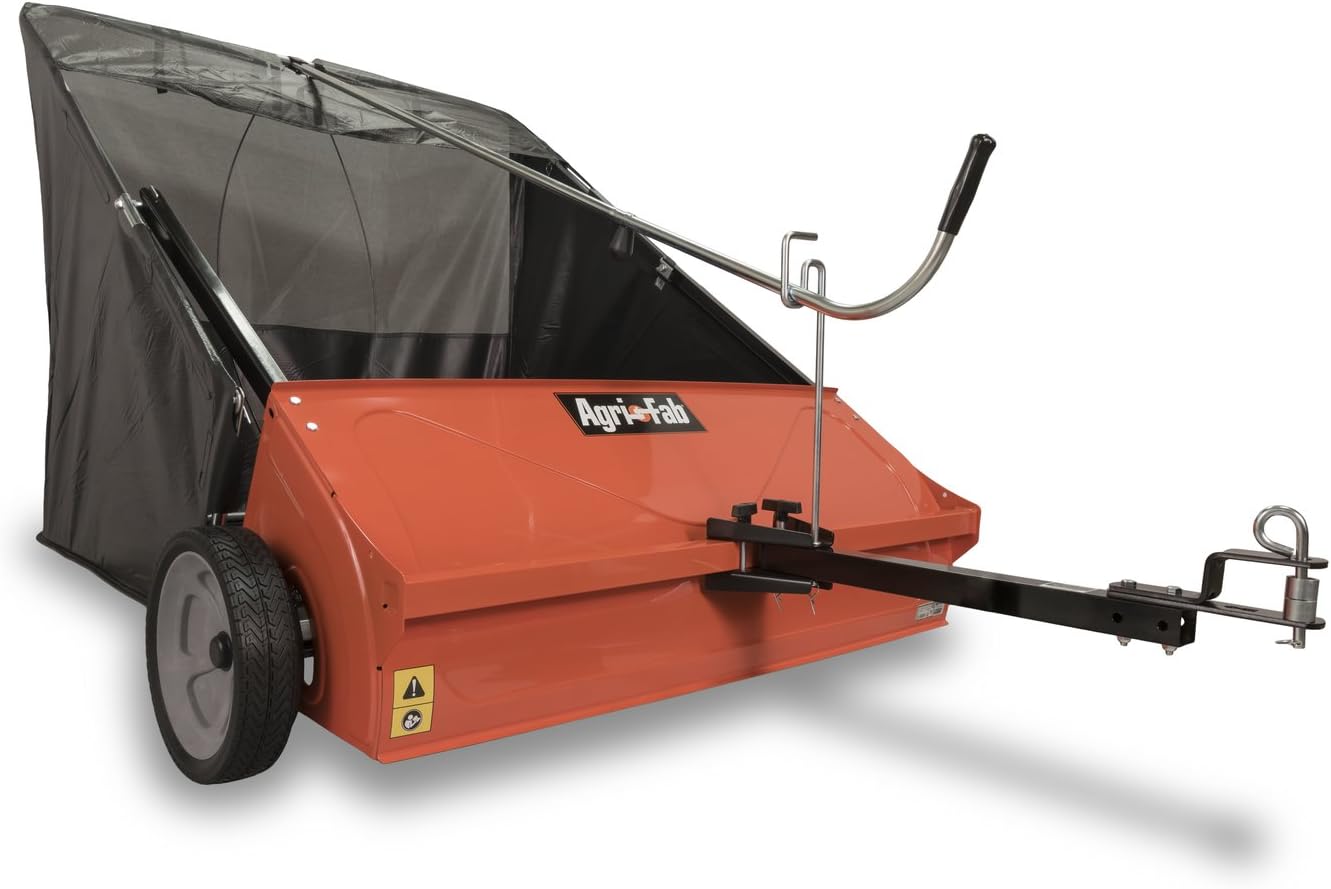
The Agri-Fab 45-0492 is the best-selling tow-behind lawn sweeper in the US and earns its reputation on acorn collection in particular. The 44-inch brush width covers serious ground quickly, and the 25-bushel hopper handles substantial acorn volumes before requiring emptying. The adjustable brush height — five settings — allows precise calibration for acorn contact without scalping the lawn, and the spring-loaded hopper release makes emptying simple and fast.
The brush system uses a set of stiff nylon bristles on a rotating drum, and acorns respond well to the firm flicking action. On a flat lawn with moderate acorn coverage, expect to collect 85–90% of acorns in a single pass. A second perpendicular pass brings that figure close to complete coverage. Assembly takes 30–45 minutes from the box and the hitch attachment is universal for all standard riding mowers with a rear hitch pin.
✅ Pros
- Best-in-class hopper capacity for acorn volume
- 5-position brush height adjustment
- Wide 44″ coverage cuts session time significantly
- Robust all-season build
❌ Cons
- Requires a riding mower or tractor to operate
- Assembly can be time-consuming out of the box
- Large footprint for storage

The Brinly BS-36BH is the standout push sweeper for acorn collection, primarily because of its stiffer-than-average brush bristles and the 4-position height adjustment that allows you to get the brush down close enough to the lawn surface to engage acorns reliably. The 7-bushel hopper is generous for a push model, and the folding design makes storage practical in smaller sheds and garages.
On a lawn of up to 6,000–8,000 square feet with moderate acorn coverage, this sweeper completes a thorough cleanup in one session. Above that size or with very heavy acorn falls, the hopper capacity becomes a limiting factor — plan on multiple emptying stops. The lightweight design is appreciated on slopes and irregular terrain where a heavy tow-behind would be less practical.
✅ Pros
- No riding mower required
- Stiffer brush than most push competitors
- Compact fold-flat storage
- Excellent value per dollar
❌ Cons
- 7-bushel hopper fills quickly in heavy acorn falls
- Manual effort on large areas gets tiring
- Less efficient than tow-behind on large flat lawns
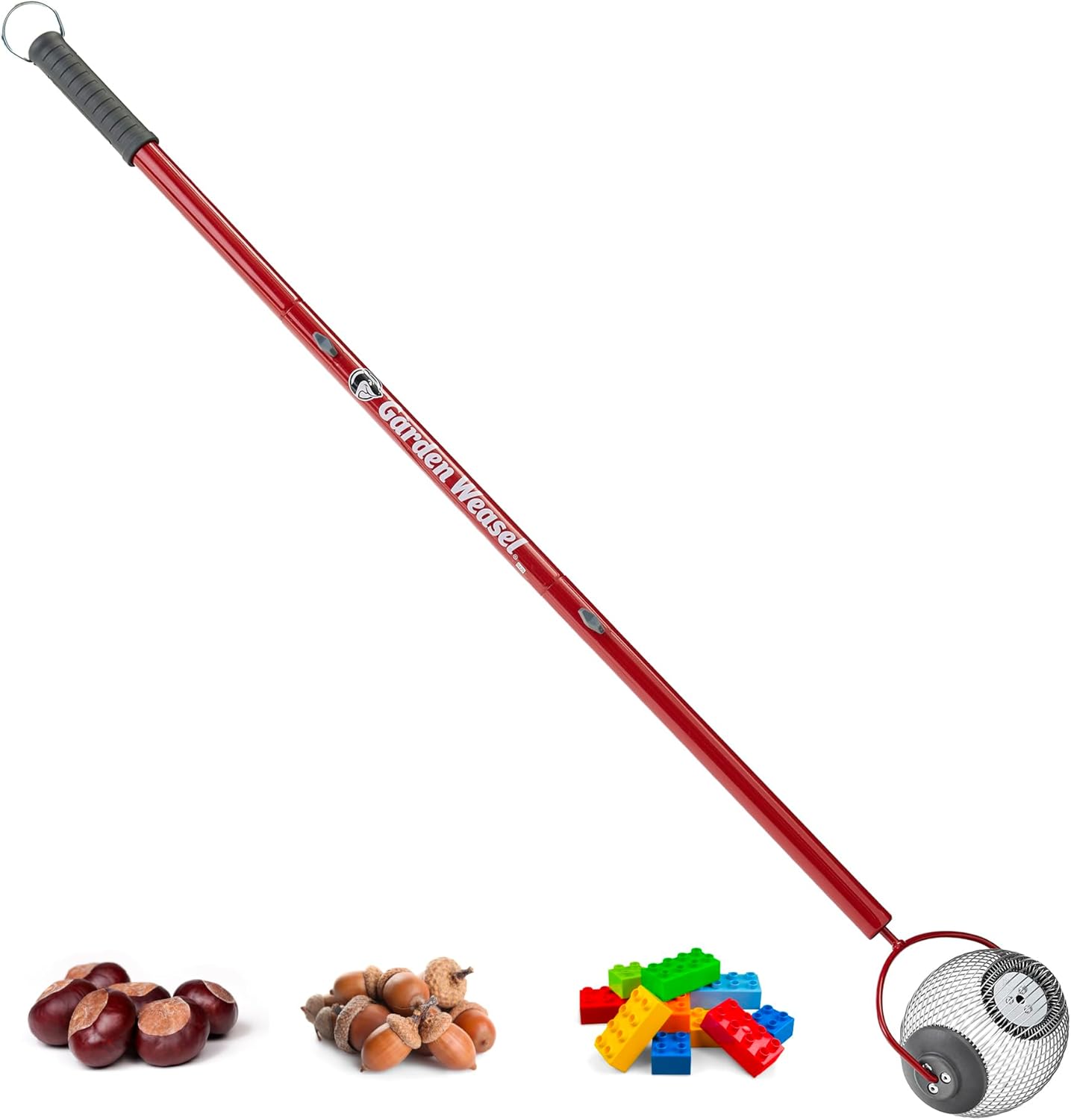
The Garden Weasel Nut Gatherer is the most widely available nut roller on Amazon and one of the top-reviewed options in the category. It uses flexible wire tines that form a rolling cage to trap acorns as it’s pushed across the lawn — no bending, no kneeling, and no motor required. Simply push forward, the tines flex to admit acorns, then spring back to trap them inside. Emptying is done by rolling over a bucket or bag.
The practical limitation is the same as all nut rollers: it performs at its best when the lawn is relatively clear of leaves and other debris, because leaves clog the tines and reduce acorn pickup. The ideal workflow is to use a leaf blower first to clear loose leaves from the acorn-covered area, then follow with the nut roller for near-complete acorn collection. For pure acorn work under cleared conditions, no other tool comes close to its efficiency per minute of operation.
✅ Pros
- Very high acorn pickup rate on cleared surfaces
- No power required, virtually zero maintenance
- Standing operation — no bending or kneeling
- Affordable; widely available on Amazon
❌ Cons
- Best on acorns only — leaves clog the tines
- Small capacity; needs frequent emptying on large areas
- Less effective on rough or very uneven terrain
9. Full Acorn Cleanup Tool Comparison
| Tool | Acorn Pickup Rate | Best Lawn Size | Mixed Debris? | Power Required? | Approx. Cost | Overall Rating |
|---|---|---|---|---|---|---|
| Tow-Behind Sweeper (44″) | 85–92% | ½ acre+ | ✓ Yes | Riding mower needed | $150–$350 | 9.1 |
| Nut Roller (Garden Weasel) | 90–95% | Any (small-med best) | ✗ Acorns only | ✓ None | $35–$60 | 8.8 |
| Push Sweeper (36″) | 78–86% | Up to ¼ acre | ✓ Yes | ✓ None | $70–$150 | 8.2 |
| Lawn Vacuum (tow) | 88–95% | ¼ acre+ | ✓ Excellent | Riding mower needed | $300–$600 | 8.6 |
| Mower with Bag | 40–60% | Any | ✓ Yes | Mower needed | Already owned | 5.0 (blade risk) |
| Leaf Blower (corral only) | 30–50% | Any (assist only) | ~ Assist only | Battery/electric/gas | Already owned | 6.0 (assist tool) |
| Hand Raking | 90–95% | Up to ~2,000 sq ft | ✓ Yes | ✓ None | $15–$30 | 6.5 (labor-intensive) |
10. How to Use a Lawn Sweeper for Acorns: Step-by-Step
A correctly-operated lawn sweeper handles acorns far more efficiently than one used with the default settings for leaf collection. Follow this sequence for best results.
- Wait for dry conditions — sweep acorns when the lawn surface is dry. Wet acorns stick to grass, to each other, and to the hopper, reducing pickup efficiency and causing clogs. If dew is present, wait until mid-morning for it to clear.
- Pre-mow the lawn if grass is long — mowing before sweeping reduces the grass height so the sweeper brush can reach acorns at the base of the grass without being impeded by long blades. Mow at your normal height — this is not about scalping, just ensuring the grass isn’t longer than normal.
- Lower the brush height 1–2 settings from your normal leaf position — the most critical adjustment. For tow-behind sweepers, this typically means setting 2 or 3 on a 5-position scale. The brush tips should just lightly contact the lawn surface. Test on a small patch and confirm acorns are being collected before proceeding.
- Make your first pass slowly and in straight overlapping lines — overlap each pass by 3–4 inches. Move at a walking pace for tow-behinds; too fast reduces brush engagement time per square foot.
- Empty the hopper before it becomes overfull — an overfull hopper creates backpressure that reduces the brush’s ability to fling material in. For acorn-dense conditions, empty when the hopper is about two-thirds full rather than waiting for it to overflow.
- Make a second perpendicular pass for thorough coverage — rotate your pass direction 90 degrees for a second pass. This catches acorns that were pushed aside or oriented in ways that the first directional pass missed.
- Use a leaf blower or nut roller under the tree — the area directly under the oak’s canopy often has the densest concentration. Use a leaf blower to corral these into a windrow first, then sweep or collect manually from the concentrated pile.
- Clear the bag and clean the brush after each session — acorns that lodge in the brush or hopper screen can cause mould or jamming before the next use. A quick rinse of the hopper and brush check after each session keeps the sweeper performing optimally throughout the season.
11. Brush Height: The Single Most Critical Setting for Acorn Pickup
If there is one reason why a homeowner’s lawn sweeper “doesn’t work” for acorns, it is almost always the brush height setting. This deserves its own dedicated section because it is so consistently the deciding factor between effective and ineffective acorn collection.
Why Brush Height Matters More for Acorns Than Leaves
Leaves are lightweight and sit on top of the grass. A brush that contacts the upper two-thirds of the grass blade will catch and fling leaves effectively because the leaves rest at the level where the brush engages. Acorns are heavy and round. They sink through the grass to the soil surface, resting at the very base of the grass blade. A brush set for leaf collection passes over the acorns entirely because the bristle contact zone never reaches the base level where the acorns sit.
Visualise it this way: leaves float at the top of the grass canopy; acorns sink to the floor of it. The brush must reach the floor.
Setting the brush too low causes the bristles to actively drag on the soil surface, which scalps the lawn, wears out brush bristles prematurely, and puts excessive strain on the sweeper’s brush drive mechanism on tow-behind models. The correct position is bristle tips just lightly contacting the grass surface — not gouging into it. If you hear a heavy dragging sound or see soil being picked up, raise the brush one setting.
How to Find the Optimal Setting
The best way to calibrate brush height for acorns is the following test: scatter a handful of acorns on a test area of lawn, make one sweeper pass, and check how many acorns were collected. If most remain, lower the brush one position and repeat. Once you’re collecting 85%+ of test acorns in a single pass, you’ve found the right setting. Record or photograph the position so you don’t have to re-calibrate on future sessions.
Note that the optimal setting may vary slightly across your lawn if the terrain is uneven or if grass height varies between areas. On sloped sections or areas where grass is longer, you may need to adjust mid-session.
Garden Weasel Nut Gatherer — 93% Acorn Pickup, No Bending Required
The specialist nut roller for pure acorn collection. Pair with a leaf blower to pre-clear leaves, then roll across the exposed acorn layer for near-complete collection in minutes. Widely available on Amazon with fast shipping.
🛒 View on Amazon12. Using a Leaf Blower with a Sweeper for Maximum Acorn Efficiency
The most effective acorn cleanup system combines a leaf blower with a lawn sweeper or nut roller — using each tool’s strengths and avoiding their weaknesses. This combination approach is significantly more effective than either tool used alone, especially when leaves and acorns are mixed.
The Blower-First, Sweeper-Second Method
Leaf blowers are poor at moving acorns directly — their round, heavy nature means they don’t blow cleanly and tend to roll erratically rather than forming neat windrows. However, leaf blowers excel at clearing the lightweight leaf layer that covers the acorns. By blowing leaves aside first, you expose the acorns sitting at the grass base, then follow immediately with the sweeper or nut roller.
- Use the leaf blower to clear loose leaves from the target lawn area, blowing them into windrows along the edges or into a corner. Use moderate blower speed — high speed just scatters acorns further.
- Follow immediately with the sweeper or nut roller across the now-exposed acorn layer. Collection efficiency increases dramatically when the sweeper isn’t simultaneously trying to handle mixed debris sizes.
- After sweeping the open lawn area, use the blower to corral the windrows of leaves into piles for separate collection (tarp haul, mow-mulch, or bag).
This approach is particularly effective under dense oak canopy where the deepest accumulations occur and the direct sweeper-only approach struggles most. The blower removes the leaf buffer that buries acorns; the sweeper then collects the exposed acorns at maximum efficiency.
For choosing the right blower for this task, our detailed guide on choosing a lawn blower by yard size and debris type covers the exact specifications — airspeed, CFM, and nozzle type — that matter for acorn corralling versus leaf blowing. A high-CFM nozzle rather than a high-MPH concentrating nozzle works better for moving heavy acorns, for example.
13. Best Time to Sweep Acorns: Frequency and Seasonal Timing
During the Acorn Drop Season
In most of the US, acorn drop season runs from September through November, with peak drop typically occurring in October. The exact timing varies by oak species: red oaks drop their acorns in the second year after flowering (meaning the drop is delayed), while white oaks drop in the same year. Understanding which species you have helps predict your cleanup window.
During peak drop, sweep every 3–7 days. This frequency prevents accumulations from becoming difficult to manage and — critically — prevents the earliest-dropped acorns from beginning to germinate. An acorn that has been on the ground for three weeks in moist conditions may already have its radicle (root tip) emerging, making it significantly harder to collect cleanly as it begins to anchor to the soil.
Time of Day
Sweep in late morning or afternoon when dew has dried. Dry acorns roll freely into the hopper and don’t cause clumping or clogging. Avoid sweeping on rain days or within a few hours of heavy dew. The dryness of the acorn surface is as important as the dryness of the grass around it.
Before a Hard Frost
Complete your acorn removal before the first hard frost if possible. Frozen ground makes collection harder — acorns can freeze slightly to the soil surface — and the freeze-thaw cycle begins the decomposition process that makes acorns harder to roll and sweep cleanly.
Integrating acorn sweeping into your overall fall lawn maintenance calendar is part of a comprehensive autumn programme. Our guide to preparing your lawn for winter covers the full fall maintenance sequence from final fertilisation through winter prep, with acorn clearance as an important component of overall lawn health going into dormancy.
14. When a Sweeper Isn’t the Right Tool: Alternatives and Their Uses
A lawn sweeper is an excellent acorn tool in most situations, but there are specific scenarios where other approaches work better or should complement sweeping.
When Acorns Are Too Dense for a Single Pass
Under the canopy of a very productive oak tree, acorns can pile up 3–4 deep in late October. Running a sweeper through these dense concentrations results in the brush essentially riding on top of the acorn layer rather than engaging with the lawn surface. In this scenario: use a stiff garden rake to loosen and spread the concentrated pile, reducing depth to a single layer, then sweep. Alternatively, shovel the heaviest concentrations directly into buckets or onto a tarp before sweeping the perimeter.
When Terrain is Steep or Irregular
Tow-behind sweepers work best on relatively flat terrain. On steep slopes, the sweeper may not maintain consistent brush contact with the lawn surface, reducing collection efficiency and creating safety concerns when maneuvering. A push sweeper or nut roller is more practical on moderate slopes; for steep terrain, hand raking or a handheld nut gatherer is the safest and most controllable approach.
When You Also Need Leaf Removal
The most common autumn scenario is mixed leaves and acorns together. Here a sweeper handles both simultaneously, but consider the blower-first approach described above for maximum efficiency. For large properties with significant leaf fall alongside heavy acorn drop, a tow-behind leaf vacuum rather than a sweep-action model may provide the cleanest and most complete result on mixed debris.
Mowing Over Acorns: The Risk Assessment
Using a mower to collect acorns (particularly with a bagging attachment) is tempting because it requires no additional equipment. The risks are real: acorns are hard enough to nick and dull mower blades rapidly when struck, and at mower blade tip speeds, acorns can become projectiles if they exit the discharge chute. For light, scattered acorn coverage with no accumulation, a bagging mower handles the task adequately. For moderate to heavy coverage, use a dedicated sweeper or nut roller first, then mow normally afterward. Our guidance on keeping mower blades in good condition — including the signs that blades need attention after hard-object contact — is covered in our guide to sharpening lawn mower blades.
15. What to Do With Collected Acorns
Once you’ve swept up a hopper-load of acorns, what do you do with them? The answer isn’t always just “bag them and bin them” — collected acorns have a surprising number of practical uses and can be diverted from the waste stream productively.
Composting
Acorns can be composted but they decompose slowly due to their tannin content and hard hull. Add them to a compost heap in layers mixed with high-carbon materials (dry leaves, straw, cardboard) and allow 12–18 months for complete breakdown. Avoid adding large quantities to a small domestic compost bin as they slow the overall decomposition cycle significantly. A hot-compost system accelerates acorn breakdown considerably.
Wildlife Feed
Deer, wild turkeys, squirrels, blue jays, and wood ducks all rely on acorns as a significant food source, particularly through autumn and winter. Collected acorns can be scattered in woodland edges, nature reserves, or wildlife garden areas. Contact local wildlife rehabilitation centres, deer management organisations, or hunting clubs — many actively seek acorn donations in autumn as supplemental feed for wildlife.
Crafts and Decoration
Dried, clean acorns are popular in autumn wreath making, table centrepieces, seasonal decorations, and children’s craft projects. Spread collected acorns on a tray in a warm, dry space for 2–3 weeks to dry thoroughly before use in crafts, which prevents mould growth and cap separation.
Acorn Flour
Several oak species produce acorns that, after leaching of tannins through prolonged soaking and water changes, can be ground into an earthy, nutrient-dense flour used in baking. White oak acorns are lower in tannins and easiest to process. While not a mainstream culinary practice, acorn flour has genuine nutritional value and is historically significant as a food source in many cultures.
Seed for Oak Propagation
If you want to grow oak trees — for a future planting project, donation to a woodland trust, or just to see the process — fresh acorns collected in autumn and stratified (kept moist at refrigerator temperature through winter) will germinate readily in spring. Container-grown oak seedlings raised from your own collected acorns make meaningful contributions to woodland creation and habitat projects.
Brinly-Hardy BS-36BH Push Sweeper — Best for Small Lawns
The most capable push sweeper for acorn collection on small to medium properties. No riding mower needed. 36-inch width, 7-bushel hopper, 4 brush height positions. Folds flat for compact storage.
🛒 View on AmazonFrequently Asked Questions: Lawn Sweepers and Acorns
Yes — most lawn sweepers can pick up acorns, but how well depends on the sweeper type and brush height setting. Tow-behind sweepers with wide brushes and large hoppers handle heavy acorn falls best, collecting 85–92% of acorns per pass when correctly set up. Push sweepers work adequately for moderate acorn quantities. The single most important factor is lowering the brush height so bristle tips just contact the lawn surface at the base of the grass where acorns sit — without this adjustment, the brush passes over most acorns.
The Agri-Fab 45-0492 44-inch tow-behind sweeper is the top overall choice for heavy acorn collection on large lawns — its 25-bushel hopper, 5-position brush height adjustment, and wide brush width make it the most efficient single option. For push sweepers, the Brinly-Hardy BS-36BH is the best available. For pure acorn collection specifically, the Garden Weasel Nut Gatherer roller actually achieves the highest pickup rate (90–95%) when acorns are not mixed with heavy leaf coverage.
For any lawn larger than a few hundred square feet, yes — significantly better. A tow-behind sweeper clears an acre of moderate acorn coverage in 30–45 minutes; the same area would take several hours of raking. Even a push sweeper outpaces hand raking on any lawn over about 1,500–2,000 square feet. Hand raking achieves thorough collection but is only practical for very small areas or for spot cleanup after a sweeper pass. The advantage compounds when you consider that acorn season requires multiple sweepings over several weeks.
Most sweeper-acorn failures trace back to brush height being set too high — the brush passes over acorns sitting at the base of the grass rather than engaging them. Other causes include hopper mesh too coarse for acorns to be retained (uncommon in modern designs), brush bristles too soft or too widely spaced to grip round acorns, and very deep accumulations where multiple layers of acorns prevent the bottom layer from being reached. Lower the brush, sweep in dry conditions, empty the hopper frequently, and use a blower-first approach on deep accumulations to resolve most issues.
Wet acorns are significantly harder to sweep than dry ones. Moisture causes acorns to stick to grass, to each other, and to the soil surface, reducing pickup efficiency and increasing hopper clogging. For best results, sweep when the lawn surface is dry — wait for dew to clear (usually by mid-morning) and avoid sweeping within 24 hours of significant rainfall. If you must sweep wet acorns, lower the brush further than usual, move more slowly, and expect to need more passes than you would under dry conditions.
During peak acorn drop in autumn, aim for every 3–7 days depending on how many oaks you have and how productive they are. Letting acorns accumulate for longer than a week in warm autumn conditions increases the risk of germination beginning — once a radicle emerges, the acorn becomes anchored to the soil and harder to sweep. Very heavy oak producers may need sweeping every 2–3 days during the peak October drop period. Outside of peak season, monthly checks are adequate.
Yes, in several ways. Left through autumn and winter, acorns germinate into oak seedlings with deep taproots that are increasingly difficult to remove over time. Dense accumulations smother grass by blocking light. Decomposing acorns acidify soil locally through their tannin content. Acorns create trip hazards (particularly when wet) and attract digging squirrels. They also damage mower blades when struck at speed. Regular removal during the fall season is strongly recommended for all of these reasons.
A mower with a bagging attachment handles light, scattered acorn coverage, but dense acorn layers cause real problems: acorns are hard enough to nick and dull mower blades rapidly, can clog the mowing deck, and at mower blade speeds can exit the discharge chute as dangerous projectiles. For any more than very light scattered coverage, use a dedicated sweeper or nut roller first to remove the acorns, then mow normally afterward. The mower isn’t designed for hard-object collection at the volume that an oak tree produces.
A nut roller uses a flexible wire tine cage or plastic finger drum that rolls across the ground, trapping acorns inside the cage as it rotates. In pure-acorn conditions (no significant leaf mixing), a nut roller achieves higher pickup rates (90–95%) than a conventional sweeper because it’s specifically engineered for round objects. It works less well on mixed debris. The Garden Weasel Nut Gatherer is the most widely available nut roller on Amazon. The ideal approach for many properties is to use a leaf blower to clear loose leaves first, then use the nut roller to collect the exposed acorns — a combination that beats a sweeper alone for speed and completeness on acorn-specific cleanup.
A leaf blower is most effective for clearing the leaf layer that buries acorns rather than moving the acorns themselves. Use it on a medium power setting to blow leaves aside and expose the acorn layer underneath, then follow with the sweeper or nut roller. High blower speed just scatters acorns further across the lawn in unpredictable directions. On hard surfaces like driveways and paths, blowers do corral acorns into piles adequately. On grass, the blower-first, sweeper-second sequence is more effective than trying to move acorns directly with air.
Yes — collected acorns can be composted (mixed with high-carbon material; takes 12–18 months), used as wildlife feed for deer, turkeys, squirrels, and blue jays, donated to wildlife rehabilitation centres, used in autumn crafts and decorations (dry thoroughly first), processed into acorn flour after tannin leaching, or stratified in the refrigerator through winter and germinated as oak seedlings for planting projects. White oak acorns are easiest to use for food purposes; any oak species works for wildlife feed and composting.
Brush height is the most critical single setting for acorn sweeper performance. Acorns are heavy and sink to the soil surface at the base of the grass — a brush set at the normal leaf-collection height passes over them entirely. Lower the brush 1–2 positions from the leaf setting so bristle tips just contact the lawn surface lightly. Calibrate by testing on a small section: if acorns remain after the first pass, lower the brush one more position. Once you’re collecting 85%+ per pass, you’ve found the right setting. Record this setting for use throughout acorn season.
Conclusion: Yes, a Lawn Sweeper Can Pick Up Acorns — Here’s How to Make It Work
The answer to the core question is a clear yes — lawn sweepers are effective acorn collection tools when properly set up. The critical success factors are straightforward: lower the brush height so bristles contact the lawn surface where acorns sit, sweep in dry conditions, empty the hopper frequently, and use a second perpendicular pass for thorough coverage.
For large properties with heavy oak canopy, a tow-behind sweeper like the Agri-Fab 45-0492 is the most efficient investment — it clears acorns, leaves, and general debris across a full season with minimal physical effort. For small to medium lawns, the Brinly-Hardy push sweeper handles the job adequately without requiring a riding mower. And for households where acorns are the primary challenge with minimal leaf mixing, the Garden Weasel Nut Gatherer roller delivers the highest pure-acorn pickup rate of any tool available at a fraction of the cost of a full sweeper.
The combination that outperforms all others: leaf blower to clear the leaf surface layer, followed immediately by a nut roller or sweeper on the exposed acorn layer. In 45 minutes on most suburban lawns, you can achieve near-complete acorn removal and move on with your day. Repeat every 3–7 days through October, and your lawn enters winter clean, germination-free, and ready for spring without any oak seedling surprises waiting to emerge.
🍂 Read the Full Agri-Fab 44″ Sweeper Review →