Quick Reference: All 14 Answers at a Glance
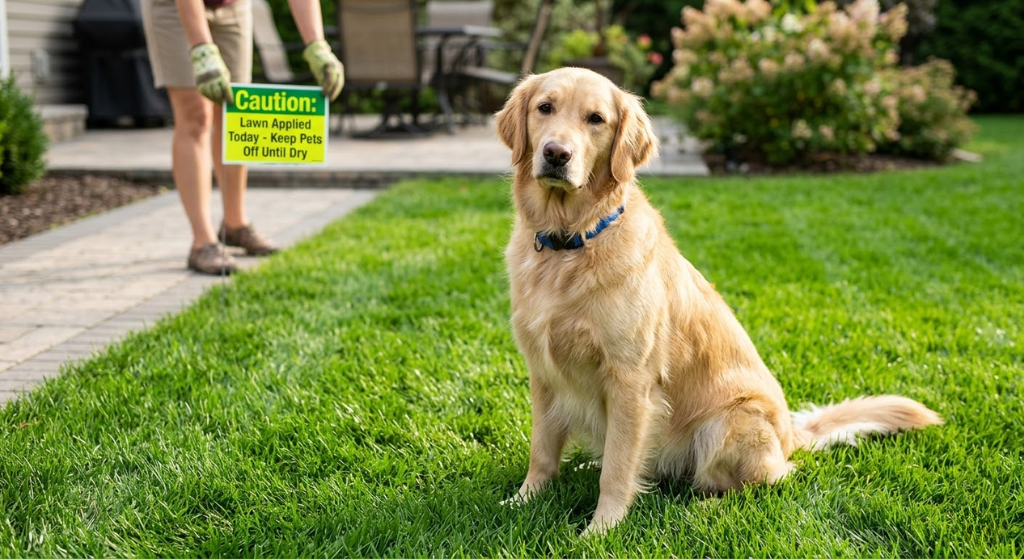
How Long After Fertilizing Lawn Is It Safe for Dogs? (How Long to Keep Dogs Off Lawn After Fertilizing / How Long Before Dogs Can Go on Treated Lawn)
Dog owners asking this question deserve a clear, honest answer — not just the blanket “call your vet if concerned” non-answer that many sites offer. Here’s the practical breakdown by product type.
Granular Fertilizers
Granular fertilizers pose their primary risk to dogs in two ways: through skin contact (granules sticking to paws and being licked off) and through ingestion (dogs eating granules directly from the lawn, which some dogs do given the sometimes-attractive smell). Once granules are fully dissolved and watered into the soil, both risks are significantly reduced.
The standard guidance: keep dogs off a granular-fertilized lawn for 24–48 hours, during which time you should apply at least ½ inch of irrigation to dissolve and carry the granules into the soil. Once the lawn surface is dry and no visible granules remain, the risk from routine walking on the lawn is low for most products.
Liquid Fertilizers
Liquid fertilizers absorb directly into the grass leaf tissue and dry on the surface. Once completely dry — typically 2–4 hours in normal conditions — contact exposure to pets walking on the lawn is minimal. The re-entry interval is shorter than for granular products but drying time must be complete. In humid conditions, this can take longer than 4 hours.
🐕 Pet Re-Entry Timing by Product Type
| Product Type | Keep Pets Off Until… | Why | Risk Level |
|---|---|---|---|
| Granular synthetic fertilizer | 24–48 hrs after watering in | Granules must dissolve & absorb | ⚠️ Moderate |
| Milorganite / organic granular | Once granules dissolve (12–24 hrs) | Lower toxicity; attractive smell to dogs | ⚠️ Low-Moderate |
| Liquid fertilizer | Once fully dry (2–4 hrs) | Leaf absorption complete when dry | ⚠️ Low once dry |
| Granular herbicide (weed & feed) | 24–48 hrs + watered in | Herbicide component adds risk | ⚠️ Higher — check label |
| Liquid herbicide (weed killer) | Once dry + 24–48 hrs ideally | Herbicide residue on leaf surface | ⚠️ Higher — check label |
| Granular insecticide | 24–48 hrs after watering in | Insecticide compounds need time to absorb | ⚠️ Higher — check label |
Organic Fertilizers and Dogs: The Milorganite Problem
Milorganite and similar organic fertilizers have very low toxicity profiles — but they have a specific issue with dogs: dogs are often attracted to eating organic fertilizers directly from the lawn because they are made from organic materials with a distinctly animal-like scent. A dog consuming large amounts of Milorganite can experience gastrointestinal distress (vomiting, diarrhea) not from toxicity but from the volume of unusual organic material. Keep dogs off Milorganite-treated lawns until the granules have fully dissolved and been worked into the soil by watering and rain.
Weed and feed products containing synthetic herbicides (2,4-D, MCPP, dicamba) and insecticides have the longest re-entry intervals and the highest risk profiles. For these, the minimum is 24–48 hours after application and watering in, with the label re-entry interval taking absolute precedence. Metaldehyde slug pellets are the most dangerous lawn product for dogs — even small amounts can be fatal. Never use these on any lawn with dog access. Our guide on safe weed killer for pets covers the safest options for dog-friendly lawns.
Signs of Fertilizer Ingestion in Dogs
If your dog has been on a recently treated lawn and shows any of these symptoms, contact a veterinarian promptly:
- Excessive drooling or foaming at the mouth
- Vomiting or diarrhea
- Lethargy or weakness
- Pawing at the face or mouth
- Difficulty breathing (rare — indicates serious exposure)
For non-emergency situations, the ASPCA Animal Poison Control hotline (888-426-4435) provides specific guidance on lawn product exposures.
How Long After Lawn Treatment Is It Safe for Pets? (How Long After Lawn Treatment Is It Safe for Dogs / How Long to Keep Pets Off Lawn After Fertilizing)
“Lawn treatment” is a broad term that encompasses fertilizers, herbicides, fungicides, insecticides, and combined products — and each has its own re-entry timeline. The answer for any specific treatment depends entirely on what product was used and in what form. Here’s the comprehensive breakdown by product category.
Re-Entry Intervals by Treatment Type
| Treatment Type | Active Ingredient Examples | Minimum Pet Re-Entry | Notes |
|---|---|---|---|
| Granular fertilizer | Urea, ammonium sulfate | 24–48 hrs (after watering in) | Lower risk; water in promptly |
| Organic fertilizer | Milorganite, bone meal | 12–24 hrs (after watering in) | Low toxicity; dogs may eat it |
| Liquid fertilizer | Various soluble nutrients | Once dry (2–4 hrs) | Short window; check dryness |
| Broadleaf herbicide | 2,4-D, MCPP, dicamba | 24–48 hrs dry; check label | Cats especially sensitive to 2,4-D |
| Pre-emergent herbicide | Pendimethalin, prodiamine | Once dry + 24 hrs | Relatively low mammalian toxicity |
| Granular insecticide | Imidacloprid, bifenthrin | 24–48 hrs after watering in | Higher concern; check label |
| Fungicide | Azoxystrobin, propiconazole | Once dry (2–4 hrs) | Relatively low pet risk |
| Slug bait (iron phosphate) | Iron phosphate | Once absorbed | Low risk; safe organic option |
| Slug bait (metaldehyde) | Metaldehyde | NEVER safe for pets | Highly toxic — avoid entirely |
The universal rule that overrides all specific guidance: the product label’s re-entry interval (REI) is the legally binding standard. It is tested and established by the manufacturer’s toxicology studies. Where we give general guidance here, the label takes precedence.
Cats are uniquely sensitive to certain herbicides, particularly 2,4-D (found in most standard broadleaf weed killers and weed-and-feed products). Cats groom their paws extensively after outdoor contact and can ingest significant herbicide residue this way. For households with outdoor cats, extended re-entry intervals (48–72 hours) are advisable after any 2,4-D application, or consider switching to iron-based or organic weed control products. Our resource on pet-safe weed killer options covers every alternative.

Espoma Organic Lawn Food — Pet-Safe Fertilizer
All-organic slow-release fertilizer with virtually no pet re-entry concerns after watering in. No synthetic herbicides or insecticides. Safe for dogs, cats, children, and wildlife. OMRI listed.
🛒 View on AmazonHow Long After Lawn Treatment Can I Mow?
Mowing timing after lawn treatment is one of the most overlooked factors in getting full value from the products you apply. The waiting periods aren’t arbitrary — they’re based on the biological process the treatment needs to complete.
After Fertilizer Application
The primary reason to wait 24–48 hours before mowing after fertilizing is practical rather than chemical: granular fertilizer that hasn’t been watered in yet can be redistributed by the mower’s air movement and discharge, resulting in uneven coverage and potential clumping in the collection bag or discharge path. Once granules are watered in and dissolved, mowing is safe and normal. For liquid fertilizer, wait until the product has fully dried (2–4 hours) before mowing.
After Herbicide / Weed Killer Application
This is where the mowing timing matters most and where most people get it wrong. Post-emergent herbicides (2,4-D, dicamba, triclopyr) work by being absorbed through the weed’s leaf tissue and translocating through the plant’s vascular system to the roots — killing the entire plant, not just the part above the soil. This translocation process takes time: typically 3–7 days for complete movement to the roots.
Mowing within 24–48 hours of herbicide application removes the treated leaf tissue before the herbicide has fully translocated. The result: the roots survive, the weed regrows, and you’ve wasted the product. Wait a minimum of 3–5 days (ideally 5–7 days for stubborn weeds like wild violet or ground ivy) before mowing treated areas.
| Treatment Type | Minimum Wait Before Mowing | Ideal Wait | Reason |
|---|---|---|---|
| Granular fertilizer | 24 hrs (after watering in) | 48 hrs | Allow granules to dissolve and absorb |
| Liquid fertilizer | 2–4 hrs (once dry) | Same day OK after drying | Leaf absorption completes when dry |
| Post-emergent herbicide | 3 days | 5–7 days | Allow full translocation to roots |
| Pre-emergent herbicide | 24 hrs | 48 hrs | Allow soil barrier to set |
| Weed & feed granular | 3 days | 5 days | Herbicide component needs translocation time |
| Fungicide | 24 hrs (once dry) | 48 hrs | Avoid mechanical disruption of treated tissue |
| Insecticide (surface) | 48 hrs | 48 hrs | Maintain residual insecticide on leaf surface |
Mowing Before Applying Treatment
One often-overlooked strategy: mow before applying treatment rather than waiting to mow after. For weed killers, mowing 2–3 days before application ensures weeds have regenerated fresh leaf surface for maximum herbicide contact. For fertilizer applications, mowing beforehand provides cleaner spreader contact with the soil surface. Planning treatment after mowing rather than before eliminates the post-treatment waiting problem entirely.
After overseeding, don’t mow until the new grass has germinated and been mowed at least 2–3 times. The first mow on new seedlings should be at a high blade setting — never remove more than one-third of the new grass blade height. Mowing too early or too aggressively on new seedlings pulls them out of the soil before roots have anchored properly.
How Long Does It Take for Lawn Fertilizer to Work?
The timeline from fertilizer application to visible results varies enormously based on what type of fertilizer you’re using — and understanding this helps you interpret whether what you’re seeing (or not seeing) is normal or a sign that something went wrong.
The Three Fertilizer Categories and Their Timelines
Nitrogen is immediately soluble and available to grass roots within hours of watering in. Visible greening begins within 3–5 days and peaks around day 7–10. This rapid response is the appeal — but the spike fades within 4–6 weeks and requires reapplication.
The polymer or sulfur coating releases nitrogen gradually over weeks. Visible greening begins in 1–2 weeks and continues steadily for 6–12 weeks. The delayed response is sometimes misread as “not working” — be patient. Results are more even and sustained than quick-release products.
Nitrogen is released only as soil microbes break down the organic material — a temperature and moisture-dependent biological process. Initial greening typically begins in 2–3 weeks. Full response takes 3–6 weeks. The results last longer and build soil health over time, but the wait tests patience.
Surface greening is the first visible sign of fertilizer response, but the root deepening, crown strengthening, and density improvements that represent the real value of fertilization take 4–8 weeks to fully manifest regardless of fertilizer type.
Why Fertilizer “Isn’t Working”: Common Causes
- Not watered in — granular fertilizer that hasn’t been dissolved and moved into the soil cannot be absorbed by roots regardless of nitrogen content
- Applied to drought-stressed grass — stressed grass cannot metabolize fertilizer normally; roots in drought-hardened soil have impaired uptake capacity
- Wrong time of year — fertilizing cool-season grass in peak summer heat or warm-season grass in winter produces little response because the plants aren’t in active growth mode
- Soil pH out of range — if soil pH is below 5.5 or above 7.5, nutrient uptake is impaired regardless of fertilizer quantity
- Compacted soil — nutrients sit above the compacted layer rather than reaching the root zone
For a complete breakdown of how different fertilizer types compare in nutrient release timing, our slow-release vs. quick-release fertilizer comparison covers everything in depth.
How Long Does Lawn Grass Live?
This question gets at something important about how lawns work. A lawn isn’t a single organism — it’s a dense community of millions of individual grass plants, each with its own lifespan, growing within a few centimetres of its neighbours. The lawn’s apparent continuity over decades is maintained by a constant cycle of older plants dying and being replaced by seedlings and tillers from surrounding plants.
Individual Grass Plant Lifespans
| Grass Species | Individual Plant Lifespan | Spread Method | Self-Renewal? |
|---|---|---|---|
| Kentucky Bluegrass | 3–7 years per plant | Rhizomes (underground runners) | ✓ Strong — spreads laterally |
| Tall Fescue | 3–5 years per plant | Bunch-type — no lateral spread | ✗ Needs overseeding to maintain density |
| Perennial Ryegrass | 2–3 years per plant | Bunch-type — tillers only | ~ Needs regular overseeding |
| Fine Fescue (creeping red) | 3–5 years | Rhizomes | ✓ Moderate self-renewal |
| Bermudagrass | Practically indefinite | Stolons + rhizomes | ✓ Very aggressive spread |
| Zoysiagrass | Practically indefinite | Stolons + rhizomes | ✓ Slow but persistent spread |
| St. Augustine | Practically indefinite | Stolons | ✓ Strong stolon spread |
| Centipedegrass | Practically indefinite | Stolons | ✓ Moderate spread rate |
What This Means for Your Lawn Care Programme
The practical implication of grass plant lifespan depends on species:
Cool-season bunch-type grasses (tall fescue, perennial ryegrass) don’t spread — each plant stays exactly where it germinated. As individual plants age and die, bare patches form. This is why tall fescue lawns need annual or biennial overseeding to maintain density. Without overseeding, a tall fescue lawn progressively thins over 4–6 years.
Cool-season spreading grasses (Kentucky bluegrass) fill gaps by sending rhizomes horizontally through the soil. A healthy bluegrass lawn can largely maintain its own density without overseeding if soil conditions and nutrition are adequate — though overseeding still improves density speed.
Warm-season spreading grasses (bermuda, zoysia, St. Augustine) are the most self-sustaining. Their aggressive stolon and rhizome spread means they will fill any gap in the lawn given time and appropriate conditions. The lawn’s longevity is essentially unlimited with normal seasonal care.
Without overseeding, fertilizing, or weed control, a cool-season bunch-type lawn like tall fescue typically degrades noticeably within 3–5 years — thinning, weed invasion, and bare patch expansion accelerate. A Kentucky bluegrass or warm-season lawn can persist much longer without active maintenance, though weeds gradually reduce grass density. With basic maintenance, any lawn type lasts indefinitely.
How Long Do Lawn Tractors Last?
A riding lawn tractor or zero-turn mower is one of the most significant lawn care investments a homeowner makes — typically $1,500–$5,000 or more — so understanding realistic lifespan and the maintenance that determines it is genuinely important.
Engine Hours: The True Lifespan Metric
Like a car’s odometer, engine hours are the most meaningful measure of a lawn tractor’s wear. Residential-grade tractors are generally engineered for 500–1,000 engine hours before major engine work becomes necessary. Premium commercial-grade tractors (John Deere, Kubota, Husqvarna professional series) may reach 1,500–2,000+ hours with proper care.
For the average homeowner mowing once per week for 1–2 hours during a 20–25 week mowing season, annual engine hours accumulate at roughly 25–50 hours per year. At this rate:
| Annual Use | 500 Hours Reached In | 1,000 Hours Reached In |
|---|---|---|
| 25 hrs/year (small lawn, infrequent) | 20 years | 40 years |
| 40 hrs/year (average homeowner) | 12–13 years | 25 years |
| 75 hrs/year (large property) | 7 years | 13 years |
| 150 hrs/year (commercial light use) | 3–4 years | 7 years |
Maintenance: The Lifespan Multiplier
The difference between a tractor that lasts 10 years and one that lasts 25 years is almost entirely maintenance. The key annual maintenance tasks that extend tractor lifespan:
- Oil and filter change — every 50 hours or annually, whichever comes first. The single most important maintenance task for engine longevity.
- Air filter replacement — annually or more frequently in dusty conditions. A clogged air filter causes the engine to run rich, accelerating wear.
- Blade sharpening — dull blades create vibration that stresses the deck spindles and bearings. Sharpen every 20–25 mowing hours.
- Belt inspection and replacement — deck drive belts crack and stretch; replace at first signs of wear rather than waiting for failure.
- Fuel system maintenance — use fresh fuel each season; add fuel stabilizer at end of season or drain completely for winter storage.
- Deck cleaning — accumulated grass buildup under the deck causes corrosion and imbalance. Clean after every 3–4 uses.
- Tire pressure check — correct tire pressure maintains even cutting height and reduces stress on the frame.
Brand Longevity: What the Data Shows
Brands known for above-average tractor longevity with proper maintenance include John Deere (particularly the 100 and 300 series), Husqvarna, Cub Cadet, and Kubota. Consumer-grade entry-level tractors (some big-box store brands) are engineered to lower standards and may show significant wear before reaching 500 hours. For a large property investment, purchasing a mid-tier or higher residential tractor from a reputable brand with a strong local dealer network for parts and service is typically the better long-term value.
The general rule: if annual repair costs exceed 20–25% of the current replacement value, consider replacing rather than repairing. An engine rebuild on a 15-year-old tractor that would cost $800–$1,200 may not make economic sense if the equivalent replacement tractor costs $2,500. Track engine hours and keep a maintenance log — it also adds resale value if you eventually sell.

Scotts Turf Builder Lawn Food
One of the most-tested granular fertilizers available. Quick-release nitrogen for visible results in 3–5 days. Apply with a spreader, water in, and keep pets off for 24–48 hours. Covers 5,000 sq ft.
🛒 View on AmazonHow Long for Lawn Aeration to Work?
The timeline for aeration results is one of the most misunderstood aspects of this lawn care practice. Many homeowners aerate, see a lawn covered in muddy plugs and open holes, and wonder if they’ve done something wrong. The plugs and holes are the point — and the results unfold over a specific timeline that’s worth understanding.
Aeration Results Timeline
The first result you’ll notice is that irrigation or rain absorbs into the lawn more readily — less surface ponding, less runoff. The open channels created by core aeration allow water to bypass the compacted surface layer and reach the root zone directly.
The soil cores pulled from the lawn begin to break down on the surface, returning organic material and soil organisms to the surface layer. The channels remain open in the soil, allowing air exchange and root exploration.
Grass plants begin sending roots into the aeration channels, and in the case of fall aeration with overseeding, germinating seeds in the channels produce dense new growth. The lawn starts looking visibly thicker and more uniform.
Aeration holes close naturally as roots and grass growth fill them. Fertilizer applied after aeration has penetrated to root depth. Improved nutrient efficiency becomes visible as more even, deeper greening and improved drought resistance.
The most dramatic aeration results typically appear the season after aeration — particularly in spring after fall aeration. The deeper root systems developed over fall and winter produce noticeably denser, greener, more resilient turf when growth resumes.
The dramatic density improvement that follows fall aeration with overseeding happens because the aeration holes provide perfect seed-to-soil contact for new grass seed. New seedlings establishing in the channels have immediate access to the deeper root zone, establishing faster and more robustly than seed broadcast onto an un-aerated surface. For the full aeration benefit breakdown, our lawn aeration benefits guide covers the science and practical results in depth.
How Long to Water Lawn After Fertilizing?
The watering step after fertilizing is not optional — it’s essential for the fertilizer to work. Granular fertilizer left sitting dry on the lawn surface without irrigation does several things, none of them good: it sits exposed to UV degradation (which breaks down urea-based nitrogen rapidly), it concentrates at the leaf surface in dry conditions (increasing burn risk), and it doesn’t reach the root zone where grass plants can absorb it.
How Much Water Is Needed
The goal is to dissolve the fertilizer granules and carry them through the thatch layer into the top 2–3 inches of soil where the root zone is most active. This takes approximately ¼ to ½ inch of water — not a deep soaking, just enough to get the granules dissolved and moving.
To measure irrigation output from your sprinkler system, place several empty tuna cans or straight-sided cups in different areas of the lawn and run the system until you have ¼ inch collected in each container. Record the time — this is your calibration for future applications.
Watering Timing by Fertilizer Type
| Fertilizer Type | Water Immediately? | How Much | When to Water |
|---|---|---|---|
| Granular synthetic | ✓ Yes — within 24 hrs | ¼–½ inch | Within 24–48 hrs of application |
| Slow-release granular | ✓ Yes — within 24 hrs | ¼–½ inch | Within 24–48 hrs; natural rain is fine |
| Milorganite / organic granular | ✓ Yes — helps activation | ¼–½ inch | Within 24 hrs; rain acceptable |
| Liquid foliar fertilizer | ✗ Wait 2–4 hrs first | Normal watering after | Allow drying before watering |
| Weed & feed granular | ~ Wait 24 hrs | ¼ inch after 24 hrs | Herbicide needs 24 hrs before watering |
What Happens If You Don’t Water After Fertilizing
Skipping the post-fertilizer watering is one of the most common reasons homeowners feel “the fertilizer didn’t work.” Without irrigation, granular fertilizer:
- Sits on the surface where it can be redistributed by wind, mower, foot traffic, and birds
- Degrades from UV exposure — urea-based products lose significant nitrogen content within days if left dry on the surface
- Cannot be absorbed by roots until it dissolves and moves to the root zone
- Creates burn risk if concentrated on the leaf surface in hot, dry conditions
Our guide on how to fertilize your lawn for optimal growth and root health covers the complete fertilization process from product selection through application and watering in full detail.
How Long to Water Lawn After Overseeding?
Post-overseeding watering is the single most critical factor in whether new grass seed germinates successfully. The stakes are high: miss a watering session in the first two weeks and surface seeds can desiccate and die before their root system is established. Over-water and seeds wash away or rot. The window is narrow, but the protocol is straightforward once you understand what the seed actually needs.
The Overseeding Watering Protocol by Stage
Water 2–3 times per day in short sessions (5–10 minutes per zone) to maintain consistent moisture in the top inch of soil. The goal is moist, not wet. Early morning, midday, and early afternoon are the best timing windows — this allows surface drying before evening, which reduces disease risk. Avoid evening watering during this period.
As germination begins (timing varies by species: ryegrass germinates in 7–10 days; bluegrass takes 14–21 days), continue the frequent light watering programme. Visible sprouts are more vulnerable to drying out than ungerminated seed. Do not reduce frequency at this stage — wait until germination is complete and seedlings are 1–1.5 inches tall.
Once all seeded areas have germinated and seedlings are 1–2 inches tall, begin transitioning to less frequent but deeper watering: once daily or every other day with ¼ inch per session. This encourages roots to grow deeper rather than staying in the top inch of soil.
Once the new grass has been mowed 2–3 times at a high setting, the root system is established enough to tolerate the standard once or twice weekly deep watering that serves the mature lawn. Transition fully at this point — continued shallow watering keeps roots shallow and creates a lawn that’s more susceptible to drought stress.
Germination Times by Grass Species
| Grass Species | Typical Germination Time | Germination Temp (Soil) |
|---|---|---|
| Perennial Ryegrass | 5–10 days | 50–65°F |
| Tall Fescue | 7–12 days | 50–65°F |
| Fine Fescue | 7–14 days | 45–60°F |
| Kentucky Bluegrass | 14–30 days | 50–65°F |
| Bermudagrass | 10–30 days | 65–70°F minimum |
| Zoysiagrass | 14–21 days | 65–70°F minimum |
| Centipedegrass | 14–21 days | 65–70°F minimum |
Kentucky bluegrass is famously slow to germinate — 14–30 days is normal, and in cooler fall temperatures it can push toward the 30-day end of that range. Many homeowners give up on bluegrass overseeding after 2 weeks assuming it failed, then start seeing germination in week 3 or 4. Maintain the watering programme for the full 30 days before concluding germination has failed.
For the complete overseeding guide including seed selection, application rates, and the best timing by region, our comprehensive resource on what to do with your lawn in spring and our fall lawn preparation guide both include full overseeding protocols with watering schedules.

Orbit 6-Zone Smart Sprinkler Timer
The easiest way to nail post-overseeding watering schedules. Set it to run 3x daily at the precise intervals your new seed needs — then let the timer handle it while your schedule stays free. Works with any sprinkler system.
🛒 View on AmazonFrequently Asked Questions
For granular fertilizers, keep dogs off the lawn for 24–48 hours after the granules have been watered in. For liquid fertilizers, the lawn is generally safe once the product has fully dried — typically 2–4 hours. Always check the specific product label for the re-entry interval. Weed and feed products with herbicide components require the full 24–48 hour window. If your dog shows any symptoms after lawn contact (excessive drooling, vomiting, lethargy), contact your veterinarian.
Re-entry intervals depend on the product type: granular fertilizer (24–48 hours after watering in), liquid fertilizer (once dry, 2–4 hours), broadleaf herbicides (24–48 hours after drying — cats are particularly sensitive to 2,4-D), insecticides (24–48 hours after watering in), and organic products (generally shorter intervals, but wait until granules dissolve). Metaldehyde slug pellets are the one product to never use in any household with pets — the toxicity risk is too high. The product label’s re-entry interval is always the binding guidance.
After fertilizer application: wait 24–48 hours (or until granules are fully watered in and the lawn is dry). After herbicide or weed killer application: wait a minimum of 3–5 days, ideally 5–7 days, to allow the herbicide to fully translocate through the weed to the root system. Mowing too soon after herbicide removes treated leaf tissue before the chemical has killed the roots, resulting in weed regrowth. After overseeding: wait until new grass has been mowed 2–3 times before resuming normal mowing frequency and height.
Quick-release synthetic fertilizers (urea, ammonium nitrate) show visible greening within 3–5 days of being watered in. Slow-release products take 1–3 weeks to show results as the coatings gradually release nitrogen. Organic fertilizers like Milorganite take 2–4 weeks as soil microbes break down the organic material. The full root and density benefits of fertilization take 4–8 weeks regardless of product type. If you see no results after 2–3 weeks, check that the product was watered in adequately and that the lawn isn’t drought-stressed or pH-imbalanced.
Individual grass plants live 2–7 years depending on species. Perennial ryegrass lasts 2–3 years per plant; tall fescue 3–5 years; Kentucky bluegrass 3–7 years. Warm-season grasses like bermuda and zoysia spread vegetatively and can persist almost indefinitely. A lawn as a whole doesn’t have a fixed lifespan — with proper maintenance including periodic overseeding (essential for bunch-type grasses like tall fescue), any lawn can be sustained and improved indefinitely. Without overseeding, tall fescue and ryegrass lawns thin noticeably within 3–5 years.
A well-maintained riding lawn tractor lasts 500–1,000 engine hours, which translates to 15–25 years for an average homeowner mowing once a week for 1–2 hours. Premium brands (John Deere, Husqvarna, Cub Cadet) with regular annual servicing — oil changes, air filter replacement, belt inspection, blade sharpening — regularly exceed 1,000 hours. The single biggest factor in tractor longevity is consistent annual maintenance. Neglected oil changes cause more premature tractor death than any other factor.
You’ll notice better water absorption almost immediately after core aeration. Visible grass density improvements begin in 2–4 weeks. Full root deepening and density benefits take 4–8 weeks. The plugs break down and the holes close naturally within 3–4 weeks. The greatest visible improvement from fall aeration typically appears in the following spring growing season, when the deeper root systems developed over fall produce noticeably denser, more resilient turf. Aeration combined with overseeding and fertilization delivers the fastest and most dramatic results.
Apply approximately ¼ to ½ inch of irrigation — which takes about 15–30 minutes with a standard lawn sprinkler. The goal is to dissolve the granules and carry the nutrients through the thatch and into the top 2–3 inches of soil where roots are most active. For granular products, water within 24–48 hours of application. For liquid fertilizers, wait for the product to dry first (2–4 hours), then water normally. For weed and feed products, the herbicide component typically needs 24 hours before watering in — check the label.
After overseeding, water lightly 2–3 times per day for the first 14–21 days to keep the top inch of soil consistently moist during germination. Each session should apply approximately ⅛ inch. After germination is complete and seedlings reach 1–2 inches tall, transition to once-daily or every-other-day watering. After the first 2–3 mowing cycles, transition to the standard once or twice weekly deep watering schedule. Kentucky bluegrass takes the longest to germinate (up to 30 days) — maintain the frequent watering programme for the full period before concluding germination has failed.
The standard guidance is 24–48 hours after the fertilizer granules have been watered in and the lawn surface is dry. For organic fertilizers like Milorganite, 12–24 hours is generally sufficient for safety — though dogs may still be attracted to the smell and try to eat the material, so monitor closely. For weed and feed products containing herbicide, the full 24–48 hour interval is important. Always follow the specific product label’s re-entry interval if it differs from these general guidelines. When in doubt, waiting an extra 24 hours costs nothing and adds a safety buffer.
For a treated lawn: granular fertilizer — 24–48 hours after watering in; liquid fertilizer — once fully dry (2–4 hours); herbicides — minimum 24–48 hours after the surface is dry; insecticides — 24–48 hours after watering in; fungicides — once dry (2–4 hours). The universal rule is always to read and follow the specific product label’s re-entry interval. If the label says 72 hours, that takes precedence over any general guideline. Choosing organic fertilizer products reduces re-entry intervals and overall risk significantly.
Conclusion: The Right Timing Protects Your Pets and Maximises Your Lawn Investment
Lawn timing questions come up because the stakes are real on both ends. Get the pet re-entry timing wrong and you risk your dog or cat’s health from avoidable exposure. Get the mowing or watering timing wrong after treatment and you waste the product’s effectiveness. Understand how long different fertilizers take to work and you stop second-guessing whether something is failing or just slow.
The clearest patterns from all 14 questions: granular products need time to be watered in before they’re safe and effective; herbicides need time to translocate before mowing; organic products are safer but slower; and almost everything in lawn care benefits from patience of at least 24–48 hours between application and the next intervention. Knowing your grass species helps with fertilizer timing; knowing your product type determines pet safety. Neither requires expert knowledge — just a minute reading the label and a willingness to wait the recommended interval.
For a complete annual lawn care programme that integrates all these timing decisions into a coherent seasonal schedule, our complete month-by-month lawn care calendar lays it all out from January through December.
🌿 Start with the Lawn Care 101 Foundation →