Walk into any garden center in spring and you’ll find an entire wall of weed and feed products — different formulas, different NPK ratios, different herbicide active ingredients, and wildly different price points. Making the wrong choice can mean either wasted money on a product that doesn’t control your specific weeds, or worse, damage to your grass if you apply a formula that’s incompatible with your turf type.
We’ve researched and evaluated every major weed and feed product available in 2026, looking at weed control efficacy, fertilizer quality, grass type compatibility, application ease, and value per square foot. Whether you’re battling dandelions and clover in a Kentucky bluegrass lawn, managing crabgrass in a tall fescue turf, or looking for a pet-safer option, this guide has a specific recommendation for you.
1. Quick Picks: Best Weed and Feed at a Glance
Scotts Turf Builder Weed & Feed 3
Cool-season grasses · 5,000–15,000 sq ft
Spectracide Weed Stop for Lawns
Broadleaf control · Most grass types
Scotts Southern Turf Builder
Bermuda, zoysia, St. Augustine · Southern US
Espoma Organic Weed Preventer
Corn gluten · Pet-friendly · Pre-emergent
Scotts Turf Builder with Halts
Pre-emergent crabgrass + feed · Spring
BioAdvanced 3-in-1 Weed & Feed
Hose-end spray · Fast-acting · Easy apply
2. What Is Weed and Feed — and How Does It Work?
Weed and feed is a two-in-one lawn care product that combines a selective herbicide (to kill weeds) with a granular or liquid fertilizer (to feed the grass) in a single application. The appeal is obvious: tackle two major lawn care tasks — weed control and nutrition — simultaneously, saving time, money, and effort compared to buying and applying two separate products.
The Two Components Explained
The fertilizer side works exactly like any standard lawn fertilizer: nitrogen (N) drives green, leafy top growth; phosphorus (P) supports root development; and potassium (K) improves overall stress resistance and winter hardiness. Weed and feed NPK ratios vary widely — from heavily nitrogen-focused products like 28-0-3 to more balanced options — so matching the formula to your lawn’s needs matters.
The herbicide side is where the real complexity lies. Most weed and feed products use one of two categories of herbicide:
- Post-emergent herbicides — kill weeds that are already actively growing. Common active ingredients include 2,4-D, MCPP (mecoprop), dicamba, and triclopyr. These target broadleaf weeds like dandelions, clover, plantain, and chickweed.
- Pre-emergent herbicides — create a chemical barrier in the soil that prevents weed seeds from germinating. Pendimethalin, prodiamine, and dithiopyr are common active ingredients. These prevent crabgrass, annual bluegrass, and other grassy weeds from taking hold.
Some products combine both — a pre-emergent for crabgrass prevention plus a post-emergent for existing broadleaf weeds — making them the most versatile (and typically most expensive) option.
All major weed and feed products use selective herbicides — formulated to kill certain plant types (broadleaf weeds) while leaving grass plants unharmed. Non-selective herbicides like glyphosate kill everything, including grass, and are never found in weed and feed products intended for lawn use.
Pre-Emergent vs. Post-Emergent: Choosing the Right Mode
| Type | Kills Weeds | Prevents Weeds | Apply When | Best For |
|---|---|---|---|---|
| Post-Emergent + Feed | ✓ Yes | ✗ No | Weeds actively growing, 60–90°F | Spring/fall broadleaf weed control |
| Pre-Emergent + Feed | ✗ No | ✓ Yes | Before germination (soil 50–55°F) | Crabgrass and annual weed prevention |
| Combo (Pre + Post + Feed) | ✓ Yes | ✓ Yes | Early spring, weeds emerging | Maximum weed control in one product |
3. How We Evaluated These Products
Each product was assessed across six criteria with individual weightings reflecting what homeowners care about most:
- Weed control efficacy (30%) — breadth of weeds targeted, speed of action, and completeness of kill based on manufacturer data and verified user reports
- Fertilizer quality (20%) — NPK balance, nitrogen form (quick-release vs. slow-release), and whether the ratio suits typical seasonal needs
- Grass type safety (20%) — confirmed compatibility with major grass species; products that damage sensitive grasses are penalized heavily
- Ease of application (15%) — product form (granular vs. liquid), coverage per package, and whether application requires special equipment
- Value per square foot (10%) — cost per 1,000 sq ft of coverage at MSRP
- Environmental profile (5%) — pet safety interval, waterway proximity restrictions, and organic/synthetic classification
4. Best Overall: Scotts Turf Builder Weed & Feed 3

Scotts Turf Builder Weed & Feed 3 is the best-selling weed and feed in the US for good reason — it delivers reliable, consistent results on the widest range of cool-season lawns with minimal fuss. The formula uses a combination of 2,4-D, MCPP, and dicamba to target over 50 common broadleaf weeds including dandelions, clover, plantain, oxalis, chickweed, and wild violet. The fertilizer component provides 28% nitrogen in a blend of quick-release and controlled-release forms, delivering an immediate green-up followed by extended feeding.
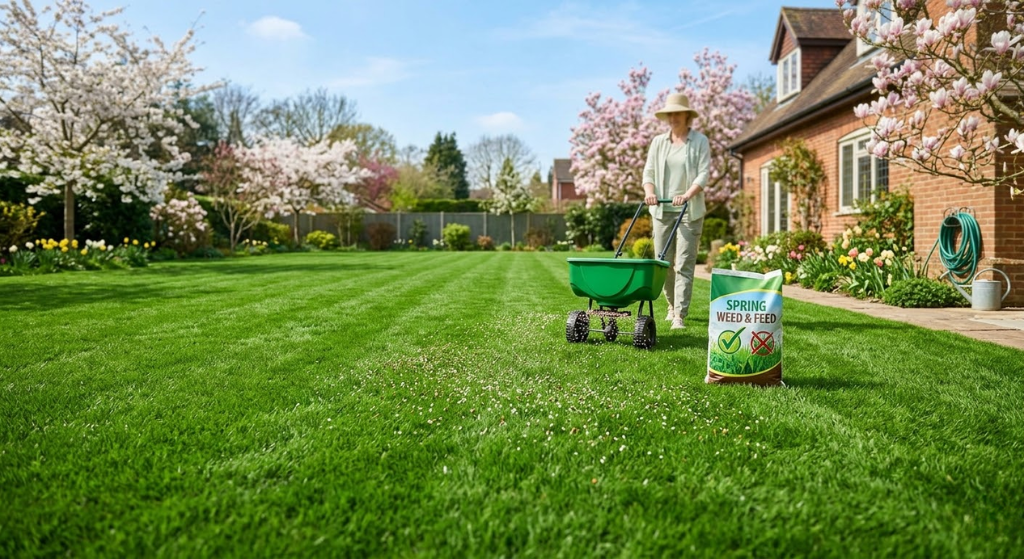
Application is straightforward: apply the granules with a Scotts spreader (or any broadcast spreader calibrated to the label settings) to a slightly damp lawn, then wait 24 hours before watering. Weeds begin to yellow and curl within 7–10 days and are typically fully dead within 3–4 weeks. The grass visibly greens up within 3–5 days of application.
The main limitation is grass type compatibility: this formula should not be applied to St. Augustine, dichondra, or carpet grass. For bermudagrass and zoysia in warmer climates, the “Southern” version (reviewed below) is a better fit. For lawns that are primarily Kentucky bluegrass, tall fescue, or perennial ryegrass, this is the definitive first choice.
✅ Pros
- Kills 50+ broadleaf weed species
- Works on all major cool-season grasses
- Fast visible results (7–10 days)
- Widely available at every major retailer
- Excellent spreader calibration data on label
❌ Cons
- Not safe for St. Augustine or dichondra
- Herbicide requires damp grass to adhere
- 24–48 hr rain-free window needed
- Not a pre-emergent; won’t prevent crabgrass
5. Best Budget: Spectracide Weed Stop for Lawns Plus Crabgrass Killer

If your primary concern is weed control on a tight budget, Spectracide Weed Stop delivers impressive breadth — the formula claims efficacy against over 460 weed types including crabgrass, which is unusual at this price point. It’s a concentrate that attaches to a garden hose for spray application, which means no spreader required and very even coverage across the lawn.
The trade-off versus Scotts is fertilizer quality: Spectracide’s feeding component is lighter, and the nitrogen form is less sophisticated. For lawns primarily in need of weed control with a modest fertility boost, it’s excellent value. For lawns that are genuinely undernourished and need significant feeding, pair this with a separate dedicated fertilizer application 3–4 weeks apart.
✅ Pros
- Lowest cost per 1,000 sq ft of any reviewed product
- Targets 460+ weed types including crabgrass
- Hose-end spray — no spreader needed
- Fast-acting on actively growing weeds
❌ Cons
- Fertilizer component less robust than premium products
- Coverage consistency depends on hose pressure
- Not safe for St. Augustine, bentgrass
6. Best for Warm-Season Grass: Scotts Southern Turf Builder Weed & Feed

This is the product of choice for homeowners in the Southern US managing St. Augustine, centipede, zoysia, or bermudagrass lawns — grass types that are damaged or killed by the 2,4-D formulas used in standard (non-Southern) weed and feed products. The Southern formulation uses atrazine as its primary herbicide, which is both effective on Southern broadleaf weeds and safe across all major warm-season grass species.
The NPK of 29-0-10 is well-suited for warm-season grasses that benefit from higher potassium alongside nitrogen feeding. Weeds targeted include dollarweed, clover, dandelion, spurge, and chickweed — the most prevalent problem weeds in Southern lawns. For St. Augustine in particular, where weed options are severely limited by the grass’s herbicide sensitivity, this product is practically the only granular weed-and-feed choice on the market.
The atrazine in this Southern formula will damage or kill cool-season grasses like Kentucky bluegrass, tall fescue, and perennial ryegrass. This product is exclusively for warm-season turf. Check your grass type before purchasing.
✅ Pros
- The only major granular weed & feed safe for St. Augustine
- High-potassium formula suits warm-season grass nutrition
- Targets dollarweed — a major Southern lawn pest
- Well-tested, reliable Scotts formulation
❌ Cons
- Not for cool-season grasses (can cause damage)
- Atrazine has groundwater contamination restrictions in some states
- Higher price per sq ft than budget alternatives
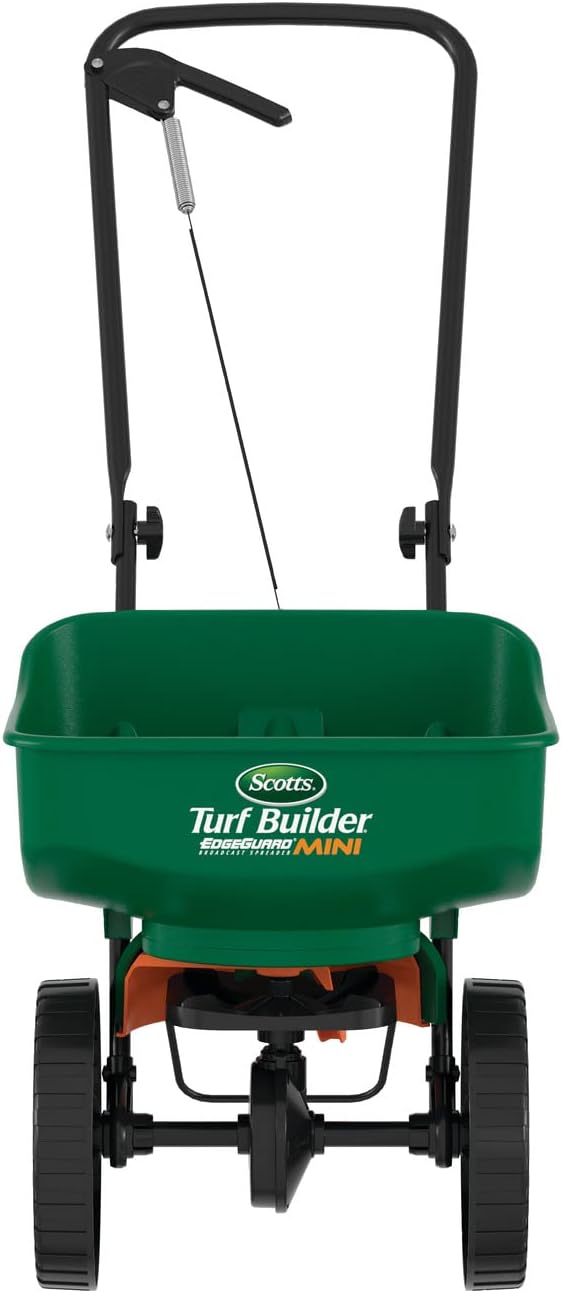
Scotts Turf Builder EdgeGuard Mini Broadcast Spreader
Calibrated specifically for Scotts weed & feed products. EdgeGuard technology keeps granules off driveways and beds. Covers up to 5,000 sq ft per fill. The ideal partner for granular weed and feed application.
🛒 View on Amazon7. Best Organic: Espoma Organic Weed Preventer Plus Lawn Food

Espoma’s corn gluten-based weed preventer is the leading organic option in the weed and feed category. Corn gluten meal acts as a natural pre-emergent: it inhibits root formation in germinating seeds, preventing annual weeds like crabgrass, annual bluegrass, and chickweed from establishing. It also provides slow-release nitrogen as it breaks down, improving soil biology over time.
The important caveat with any organic pre-emergent is that it does not kill established weeds. If your lawn already has a weed problem, you’ll need to address existing weeds first with a targeted spot treatment or hand weeding, then use Espoma to prevent the next generation from establishing. Applied consistently over 2–3 seasons, corn gluten meal becomes increasingly effective as weed seed banks in the soil are depleted.
For households with children and pets where synthetic herbicide exposure is a concern, this product is the top choice. It’s safe for all grass types, OMRI (Organic Materials Review Institute) listed, and carries none of the waterway contamination restrictions that apply to atrazine or synthetic broadleaf herbicides. The fertilizer component is modest (9-0-0) but genuinely improves soil health through organic matter contribution. Our full resource on safe weed killer options for pet owners covers additional pet-friendly alternatives in detail.
✅ Pros
- Safe for all grass types, children, and pets
- OMRI listed — certified organic
- Improves soil biology over time
- No waterway contamination restrictions
- Effective when used consistently
❌ Cons
- Pre-emergent only — won’t kill existing weeds
- Less immediately effective than synthetic options
- Higher cost per sq ft than synthetic products
- Efficacy builds over multiple seasons
8. Best for Crabgrass Prevention: Scotts Turf Builder Halts Crabgrass Preventer with Lawn Food

Crabgrass is one of the most persistent and visually disruptive annual grassy weeds in American lawns. Unlike broadleaf weeds, it cannot be killed by the 2,4-D formulas in standard weed and feed — it requires a completely different approach. Scotts Halts uses pendimethalin as its pre-emergent active ingredient, creating a soil barrier that prevents crabgrass seeds from germinating when soil temperatures reach the 50–55°F threshold in spring.
Timing is everything with this product: apply it too late (after crabgrass has already germinated and is visible as a tiny seedling) and it’s ineffective. The traditional timing cue is when forsythia blooms in your region — this correlates with the soil temperature window where the pre-emergent barrier is most effective. The fertilizer component (30-0-4) delivers excellent early-season nitrogen alongside the preventive barrier.
The critical limitation: pendimethalin prevents ALL seed germination, including grass seed. Do not apply this product if you plan to overseed within 4 months. Plan your fall overseeding schedule around this — apply Halts in spring, skip fall pre-emergent if overseeding, and return to Halts the following spring.
✅ Pros
- Highly effective crabgrass prevention
- High nitrogen content for strong spring green-up
- Single application covers the season
- Prevents several other grassy weeds alongside crabgrass
❌ Cons
- Pre-emergent only — won’t kill established weeds
- 4-month seeding restriction after application
- Timing-sensitive — must apply before germination
- Not for use on bentgrass or newly seeded lawns
9. Best Liquid Formula: BioAdvanced 3-in-1 Weed & Feed for Southern Lawns

For homeowners who don’t own a spreader or want the simplest possible application experience, BioAdvanced’s hose-end liquid format is hard to beat. Attach the bottle to your garden hose, set the dial, and spray — coverage is even, there’s no granule cleanup, and the liquid formula makes excellent contact with weed leaves. The 3-in-1 formula combines post-emergent broadleaf herbicide, pre-emergent weed prevention, and lawn food in a single product, making it the most comprehensive all-in-one option reviewed here.
The liquid format has specific advantages for irregular or landscaped lawns: you can easily navigate around garden beds, trees, and obstacles without scattering granules where you don’t want them. It’s also ideal for spot-treating specific problem areas rather than treating the entire lawn.
✅ Pros
- Easiest application of any product reviewed
- Combines post + pre-emergent + fertilizer
- Great for irregular, landscaped lawn areas
- No spreader purchase required
❌ Cons
- Smaller coverage per unit than granular products
- Coverage evenness depends on walking pace
- Higher cost per sq ft than granular
10. Full Weed and Feed Comparison Table
| Product | Type | NPK | Weeds Targeted | St. Augustine Safe? | Coverage | Overall Score |
|---|---|---|---|---|---|---|
| Scotts Weed & Feed 3 | Granular, Post | 28-0-3 | 50+ broadleaf | ✗ No | 5,000–15,000 sq ft | 9.1 |
| Spectracide Weed Stop | Liquid, Post | Low N | 460+ incl. crabgrass | ✗ No | Up to 16,000 sq ft | 7.9 |
| Scotts Southern Weed & Feed | Granular, Post | 29-0-10 | 30+ Southern weeds | ✓ Yes | 5,000–10,000 sq ft | 8.8 |
| Espoma Organic Preventer | Granular, Pre | 9-0-0 | Annual seeds (pre only) | ✓ Yes | Varies by weight | 7.3 |
| Scotts Halts + Lawn Food | Granular, Pre | 30-0-4 | Crabgrass + grassy weeds | ~ Limited | 5,000–15,000 sq ft | 8.7 |
| BioAdvanced 3-in-1 | Liquid, Pre+Post | Moderate N | Broadleaf + grassy | ~ Check label | Up to 5,000 sq ft | 8.3 |
Our Top Pick: Scotts Turf Builder Weed & Feed 3
The best overall weed and feed for cool-season lawns. Kills 50+ broadleaf weeds and feeds your lawn simultaneously. Available in 5,000 and 15,000 sq ft coverage sizes.
🛒 View on Amazon11. Weed and Feed Buying Guide: How to Choose the Right Product
Step 1: Identify Your Grass Type
This is the most critical first step and the most common mistake homeowners skip. The herbicide in weed and feed products is selective — it targets certain plant types while sparing others — but that selectivity is tuned to specific grass families. St. Augustine, centipede, and dichondra are particularly vulnerable to 2,4-D, the active ingredient in most standard cool-season weed and feed products. Always confirm your grass species matches the product’s compatibility list before purchasing. Our guide to types of grass for lawns will help you identify your turf if you’re unsure.
Step 2: Identify Your Target Weeds
Are your weeds broadleaf (dandelions, clover, plantain, chickweed, oxalis) or grassy (crabgrass, annual bluegrass, nutsedge)? Or both? Standard weed and feed products target broadleaf weeds. Crabgrass requires a pre-emergent specifically. Nutsedge requires yet another category of herbicide (sulfentrazone or halosulfuron). Matching product to weed type determines whether you’ll see results or waste your money.
Step 3: Choose Pre-Emergent or Post-Emergent
If weeds are already growing and visible, you need a post-emergent formula. If you want to prevent annual weeds from germinating in the coming season, choose a pre-emergent formula. For spring applications, timing determines the correct choice: apply pre-emergent before weeds germinate (when soil temperature is rising toward 55°F), or post-emergent once weeds are actively growing.
Step 4: Match NPK to Season and Lawn Needs
Spring weed and feed products typically carry higher nitrogen ratios (28-0-3, 30-0-4) to support the flush of spring growth. Fall products designed to be used alongside winterization often carry more potassium. Knowing your soil’s current nutrient profile — from a simple soil test — helps you choose a product that supplements what’s missing rather than adding more of what’s already sufficient. Our step-by-step guide to soil pH testing covers how to get a basic soil profile before making fertilizer decisions.
Step 5: Consider Grass Coverage Area
Calculate your lawn’s square footage before buying. Underapplication wastes money and delivers suboptimal results; overapplication risks fertilizer burn and excessive herbicide concentration. Most homeowners underestimate their lawn area — a rough calculation is: pace off the length and width of each distinct section of lawn, multiply, and add the sections together. For irregular shapes, break the lawn into rectangles and triangles.
| Situation | Recommended Product Type | Timing |
|---|---|---|
| Dandelions, clover, plantain in cool-season lawn | Post-emergent broadleaf + feed (granular) | Spring or early fall when weeds active |
| Crabgrass prevention in spring | Pre-emergent (pendimethalin) + feed | Early spring, before soil hits 55°F |
| St. Augustine with weeds | Scotts Southern (atrazine-based) | Spring, weeds actively growing |
| Pet/child-safe lawn care | Organic pre-emergent (corn gluten) | Early spring, annually |
| No spreader, want easy application | Liquid hose-end weed & feed | Spring or fall, weeds active |
| Comprehensive spring program | Combo pre+post emergent + feed | Early spring |
12. How to Apply Weed and Feed: Step-by-Step for Best Results
Even the best weed and feed product will underperform — or cause damage — if applied incorrectly. Follow this sequence for optimal results with granular products (the most common form).
- Check the weather forecast — you need at least 24 hours without rain after application for herbicide absorption, and temperatures between 60–90°F. Avoid application during heat waves (above 90°F) which stress grass and increase burn risk.
- Mow the lawn 2–3 days before — this removes tall weed growth and lets weeds regenerate enough fresh leaf surface for maximum herbicide contact. Don’t apply immediately after mowing.
- Lightly water or apply to dew-covered lawn — granules need moisture to adhere to weed leaves. Apply in the morning when dew is present, or water lightly (just enough to dampen) 1–2 hours before application. Do NOT apply to soaking wet grass.
- Calibrate your spreader — set the spreader to the setting specified on the product label for your spreader brand and model. Incorrect settings are the primary cause of both under- and over-application.
- Apply in an overlapping pattern — walk in straight lines with 2–3 inch overlaps at the edges of each pass. Start and stop at the edges of the lawn, not in the middle.
- Keep off treated area for 24 hours — allow the herbicide to remain on weed leaves undisturbed. Keep children and pets off the lawn until the granules have fully dissolved and the lawn is dry (or until the waiting period specified on the label).
- Water after 24–48 hours — watering after the herbicide absorption period activates the fertilizer component and carries nutrients into the soil. Apply about 0.5 inch of water.
- Monitor results over 2–4 weeks — broadleaf weeds will curl, yellow, and die progressively. Grass should show visible greening within 3–5 days. Do not reapply within the minimum interval stated on the label (typically 30 days).
Using the wrong spreader setting is the #1 cause of both patchy weed control and fertilizer burn. Always look up the setting on Scotts’ online spreader calibration tool (or the brand’s equivalent) for your exact spreader model and product combination. Never guess the setting.
What to Expect: Timeline After Application
| Timeframe | What You’ll See |
|---|---|
| Days 1–3 | Grass begins to respond to fertilizer; slight greening |
| Days 3–7 | Weed leaves begin to curl, yellow, or distort (first visible signs) |
| Days 7–14 | Weeds showing significant yellowing, wilting, or browning |
| Days 14–28 | Most weed species fully dead or nearly so; grass noticeably greener |
| Weeks 4–8 | Dead weed material breaks down; lawn fills in naturally |
After the lawn is treated and weeds die back, you may notice bare patches where dense weed colonies previously existed. These areas benefit from overseeding to prevent new weeds from colonizing the exposed soil. Wait 3–4 weeks after the weed and feed application before seeding to ensure the herbicide has fully broken down.
For a full picture of lawn nutrition and how weed and feed fits into an annual fertilization program, our comprehensive guide on how to fertilize your lawn for optimal growth and root health covers the complete annual schedule.
Espoma Organic Weed Preventer — Pet-Safe Choice
OMRI listed, corn gluten-based pre-emergent that’s safe for all grass types, children, and pets. Builds long-term weed resistance while improving soil biology. The clean-conscience option.
🛒 View on Amazon13. Common Weed and Feed Mistakes That Ruin Results
Applying to the Wrong Grass Type
The most costly mistake. Applying a product containing 2,4-D or MCPP to St. Augustine grass causes rapid browning, crown damage, and can kill the lawn. The atrazine in Southern formulas kills cool-season grasses. Always check the product label’s grass type compatibility — it’s listed clearly on the front of every product — before purchasing and applying.
Applying in the Wrong Conditions
Heat stress (above 90°F), drought stress, or application immediately before rain are the most common environmental mistakes. High temperatures increase the risk of fertilizer burn and can cause herbicide drift that damages nearby plants. Rain within 24 hours washes granules off weed leaves before the herbicide absorbs, dramatically reducing efficacy. Check the 48-hour forecast before every application.
Applying to Newly Seeded Lawns
Never apply any herbicide to a newly seeded lawn or to areas where you plan to seed within 6–8 weeks. The herbicide component kills germinating grass seed with the same mechanism it kills germinating weed seeds. Wait until new grass has established through at least 3–4 mowing cycles.
Over-Applying for “Better Results”
More product does not mean more dead weeds or greener grass — it means fertilizer burn, herbicide accumulation in the soil, and potential damage to the grass itself. Follow the label rate precisely. The label rate is calculated for efficacy; deviating above it creates problems without any benefit.
Applying Before Weeds Are Actively Growing
Post-emergent herbicides require actively growing, metabolizing weeds to work. Applying to dormant or very young weeds in very early spring (before sustained warmth), or to drought-stressed weeds in midsummer, produces poor results because the plants aren’t taking up and translocating the herbicide effectively. Wait for confirmed active growth conditions.
Not Watering After Application
The fertilizer component of weed and feed needs moisture to dissolve granules and carry nutrients into the soil. If you don’t water after the 24–48 hour herbicide absorption window, the nitrogen stays on the grass surface, can volatilize (escape as gas), and may cause surface burn in dry conditions. Water in the fertilizer once the herbicide has had time to absorb.
For more on weed identification and targeted control strategies beyond weed-and-feed products, our deep-dive on the best lawn weed killers, active ingredients, and effectiveness covers the full spectrum of selective herbicide options for specific weed problems.
Frequently Asked Questions About Weed and Feed
Scotts Turf Builder Weed & Feed 3 is the best overall option for cool-season grasses, killing 50+ broadleaf weeds while feeding simultaneously. For warm-season lawns including St. Augustine, Scotts Southern Turf Builder Weed & Feed is the top choice. For organic households with pets, Espoma Organic Weed Preventer is the leading safe option. The best product depends entirely on your grass type, target weeds, and whether you need pre-emergent or post-emergent control.
For spring application, apply when daytime temperatures are consistently 60–90°F and weeds are actively growing — typically April through June in most of the US. For fall application targeting broadleaf weeds, apply in September or October when weeds are still actively growing. Avoid application during extreme heat (above 90°F), drought, or when rain is expected within 24 hours. Check soil and air temperature, not just the calendar.
Never apply weed and feed to a newly seeded lawn. The herbicide component kills germinating grass seed. Wait until the new lawn has been mowed at least 3–4 times — typically 6–8 weeks after germination when the grass is well established — before applying any herbicide. If weeds emerge in new seed areas, hand-weeding or tolerating them until establishment is the only safe option.
Most synthetic weed and feed products should be treated as unsafe for pets until the product has been watered in and the lawn is completely dry — typically 24–48 hours after application. Check the specific product label for the re-entry interval. Organic options using corn gluten meal (like Espoma) pose significantly lower risks. If you have dogs that frequently eat grass, an organic pre-emergent is the more prudent choice regardless of label claims on synthetic products.
With post-emergent broadleaf formulas, weeds begin to show curling, yellowing, or distortion within 7–10 days. Complete weed death and decomposition takes 3–4 weeks. The fertilizer component begins feeding the grass within 1–5 days depending on whether it uses quick-release or slow-release nitrogen forms. Pre-emergent products show no visible weed-killing activity since they prevent germination rather than killing existing plants — their efficacy is measured by the absence of weeds rather than visible die-off.
No — this is the most critical point in weed and feed selection. St. Augustine, centipede, dichondra, and bentgrass are particularly sensitive to 2,4-D and MCPP found in most standard cool-season weed and feed products. Cool-season grasses (Kentucky bluegrass, tall fescue, perennial ryegrass) are damaged by the atrazine in Southern formulas. Always verify your grass species and match it to the product’s compatibility list on the label before applying.
Most weed and feed products should not be applied more than twice per year — typically once in spring and once in early fall if needed. Many products specify a minimum interval of 30 days between applications. Overapplication causes fertilizer burn, herbicide accumulation in the soil, and increased environmental impact. Follow the label instructions precisely — they are legally binding and based on safety testing.
For granular weed and feed, the lawn should be slightly damp — either from morning dew or a light pre-watering — so that granules adhere to weed leaves for herbicide contact. The grass and weeds should not be soaking wet (granules wash off) or bone dry. For liquid hose-end products, apply to dry grass for even coverage, then allow the liquid to dry on the leaves before any rain or irrigation. After 24–48 hours, water in to activate the fertilizer component.
Most standard weed and feed products target broadleaf weeds and do not control grassy weeds like crabgrass, annual bluegrass, or nutsedge. Products with pre-emergent herbicides can prevent crabgrass germination but won’t kill established grassy weeds. Nutsedge requires specialized herbicides (sulfentrazone or halosulfuron) not found in standard weed and feed products. Wild violet and ground ivy are notoriously difficult to control with standard formulas and may require products specifically formulated for these tough-to-kill weeds.
Pre-emergent weed and feed contains an herbicide that prevents weed seeds from germinating — it creates a soil barrier that stops germinating seedlings at the root emergence stage. Apply before weed germination (spring: when soil temps reach 50°F; fall: before winter annual germination in September). Post-emergent weed and feed contains herbicides that kill actively growing weeds — apply when weeds are visible and growing vigorously. Some products combine both, making them effective at both killing current weeds and preventing new ones.
Use caution near trees, shrubs, and garden beds. The herbicide in weed and feed can be absorbed through shallow surface roots of landscape plants and cause damage, especially with dicamba-containing products that move readily through soil. Maintain a buffer zone of at least 3–6 feet from sensitive plants and avoid application near edging where granules can migrate into beds. For lawns surrounded by extensive garden areas, a liquid spot-spray approach allows greater precision than broadcast granular application.
Organic options are generally less immediately effective than synthetic formulas. Corn gluten meal is the best organic pre-emergent but requires consistent multi-year application to deplete weed seed banks. Iron-based products can cause rapid browning on weeds but rarely achieve complete systemic kill. The trade-off is safety: organic products are far safer for children, pets, beneficial insects, and waterways. For lawns with serious established weed problems, a hybrid approach — one targeted synthetic application to knock back existing weeds, followed by organic maintenance — often delivers the best balance of results and safety.
Conclusion: Choosing the Right Weed and Feed for Your Lawn
The best weed and feed for your lawn is the one that matches your grass type, targets your specific weeds, and is applied at the right time of year. For most homeowners with cool-season lawns, Scotts Turf Builder Weed & Feed 3 is the clear benchmark — reliable, widely available, and effective across a broad spectrum of broadleaf weeds. For Southern lawns with St. Augustine or bermudagrass, Scotts Southern Turf Builder Weed & Feed is essentially the only safe granular option. If crabgrass is your primary battle, go with Scotts Halts + Lawn Food applied in early spring before germination begins.
Whatever product you choose, success comes down to three things: confirming grass type compatibility before you buy, applying in the right conditions (active weed growth, 60–90°F, no rain forecast), and following the label rate precisely. Weed and feed is one of the highest-value tools in lawn care — a single well-timed application can transform a weedy, patchy lawn into a dense, clean turf that makes the entire property look better.
Ready to round out your full lawn care program? Our beginner-friendly lawn care 101 guide covers every aspect of turf management from soil health to seasonal maintenance — the perfect companion to your new weed control program.
🌿 Start Your Complete Lawn Care Plan →