Scotts Turf Builder EdgeGuard Mini Spreader Review: Big Results for Small Lawns
We put the internet’s most popular lawn spreader to the ultimate test. Discover if its signature EdgeGuard technology and compact design are the right fit for your turf care routine.
1. Introduction: The Importance of Precision Feeding
A lush, emerald-green lawn doesn’t happen by accident; it requires a calculated diet of macronutrients delivered at specific times of the year. However, finding the right fertilizer is only half the battle. If you attempt to spread granular fertilizer by hand, or use a cheap, uncalibrated spreader, you are playing Russian roulette with your grass. Dumping too much nitrogen in one spot will violently burn your turf, leaving hideous yellow patches that take months to recover. Conversely, spreading it too thin leaves your grass starving and susceptible to weed invasions.
To master how to fertilize a lawn for optimal growth and root health, you need a tool that guarantees even, precise distribution. For millions of homeowners, the default choice is the Scotts Turf Builder EdgeGuard Mini Spreader.
As the smaller sibling to the ubiquitous Scotts DLX, the EdgeGuard Mini is designed specifically for tight, residential properties. But does a smaller hopper mean compromised performance? In this comprehensive 2026 review, we analyze its build quality, test its namesake “EdgeGuard” mechanism, and reveal a hidden flaw that every buyer needs to know about before hitting the lawn.
2. What is the Scotts Turf Builder EdgeGuard Mini?
The Scotts Turf Builder EdgeGuard Mini is a walk-behind broadcast spreader. In the world of lawn care, broadcast spreaders (also known as rotary spreaders) work by dropping granular product from a hopper onto a rapidly spinning impeller disc below. As you push the spreader forward, the gears turn the disc, which violently flings the fertilizer or grass seed outward in a wide, overlapping 180-degree arc.
Capacity Profile: The “Mini” designation refers to its hopper size. It holds enough Scotts granular lawn care product to cover up to 5,000 square feet. To put that in perspective, 5,000 square feet is roughly the size of an average suburban front and back yard combined. It perfectly accommodates one standard-sized bag of Scotts Turf Builder fertilizer without requiring you to carry the bag with you for a mid-yard refill.
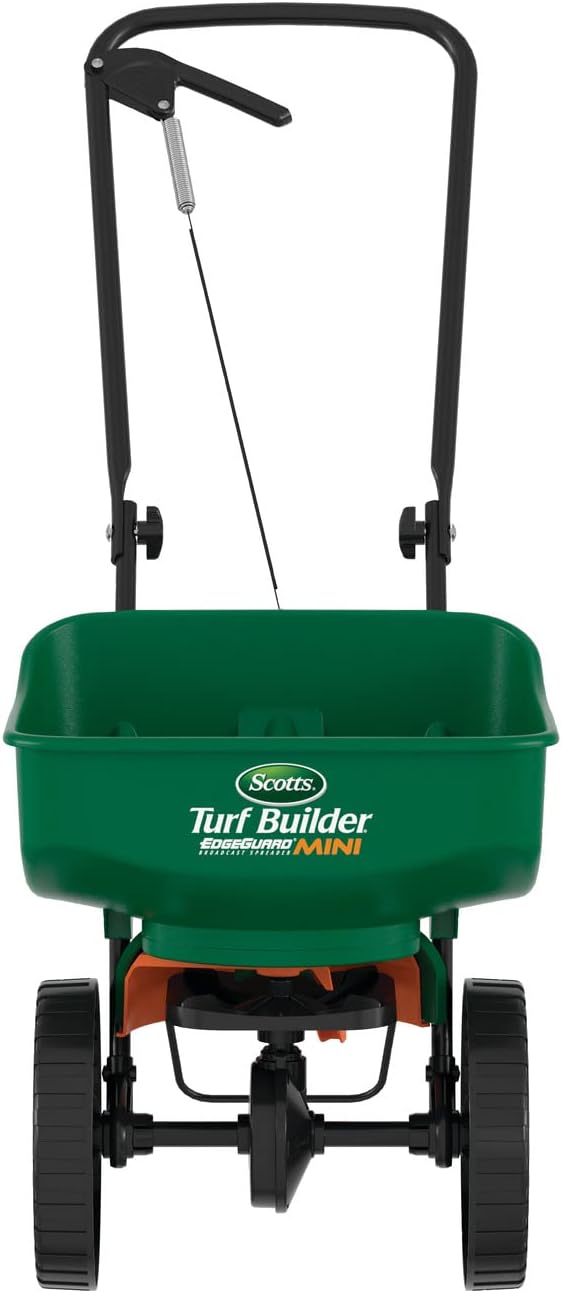
Scotts Turf Builder EdgeGuard Mini Spreader
Achieve a golf-course green lawn with precision. Hold up to 5,000 sq. ft. of product and keep fertilizer off your driveway with patented EdgeGuard technology.
Check Price on Amazon3. Unboxing & Zero-Tool Assembly
One of the most frustrating aspects of buying outdoor power equipment is the inevitable hour spent deciphering poorly translated manuals and hunting for obscure wrench sizes. Scotts bypasses this headache entirely.
The EdgeGuard Mini comes 100% fully assembled right out of the box. The handle is simply folded in half to fit inside the packaging. To set it up, you just swing the upper half of the handle upward until it aligns with the lower half, and tighten the two large plastic wing knobs. That is it. You can literally take it from the delivery box to your driveway and be spreading fertilizer in under 60 seconds.
4. The Genius of EdgeGuard Technology
The standout feature that gives this product its name is the EdgeGuard mechanism. When you are using a broadcast spreader along the perimeter of your lawn—next to a sidewalk, a driveway, or a delicate flower bed—the spinning disc naturally throws fertilizer everywhere.
Fertilizer thrown onto concrete is a massive waste of money. Worse, when it rains, that nitrogen-heavy fertilizer washes down the driveway, into the storm drains, and eventually pollutes local waterways, causing toxic algae blooms. Furthermore, throwing broadleaf weed control into your flower beds will actively kill your ornamental plants.
How EdgeGuard Works
Located on the back of the hopper is an orange toggle switch. When engaged, a curved plastic shield drops down to block the right side of the spinning impeller disc. The product is physically blocked from being thrown to the right, bouncing off the shield and dropping straight down onto the grass. You simply walk the perimeter of your yard with the right side facing the driveway, and 100% of your product stays on the turf.
5. Key Features: Precision Dial, Hopper, & The Hollow Wheel Flaw
The PrecisionRate™ Control Panel
Located conveniently on the handle is the PrecisionRate dial. This dictates how wide the hole at the bottom of the hopper opens, determining how much product drops onto the spinner. The beauty of the Scotts ecosystem is that every bag of Scotts fertilizer, grass seed, or weed control tells you exactly what number to set this dial to. There is no mathematical guesswork required. You just turn the dial to “3.5”, squeeze the trigger, and walk.
The Hollow Wheel Design Flaw (And The Easy Fix)
We must address the elephant in the room regarding the Scotts Mini. The wheels are made of hard plastic, but more importantly, the *inside* of the wheels are hollow with structural plastic ribs.
Because the spinning disc sits relatively low, some fertilizer granules inevitably get thrown directly into the hollow cavities of the wheels. As the wheels turn, those captured granules drop out in a concentrated line directly beneath the tires. A week later, users often report seeing “dark green stripes” tracking across their lawn where the tires rolled, because those specific lines received double the fertilizer.
The DIY Fix: Lawn care veterans solve this instantly by running a strip of duct tape around the inside rim of the wheels, or filling the hollow cavities with expanding foam. Once the wheels are “solid,” the fertilizer bounces off them cleanly, and the striping issue is completely eliminated.
6. Real-World Application Test
We tested the EdgeGuard Mini using three different materials to gauge its versatility.
- Grass Seed (Overseeding): It performed flawlessly. The lightweight fescue seeds were broadcast in a beautiful, even 5-foot arc. The EdgeGuard shield kept the seeds perfectly out of the mulch beds.
- Granular Fertilizer: When analyzing liquid vs. granular fertilizer nutrient release, granular is preferred for slow, sustained feeding. The Scotts Mini handled thick, heavy granules with ease. The trigger mechanism was responsive and snapped shut instantly when released, preventing accidental fertilizer dumps when turning around.
- Ice Melt / Rock Salt: During winter, it serves as a highly effective salt spreader for large driveways. *Crucial warning: Salt is highly corrosive. You must hose the spreader down thoroughly after winter use, or the metal axle and springs will rust solid by spring.*
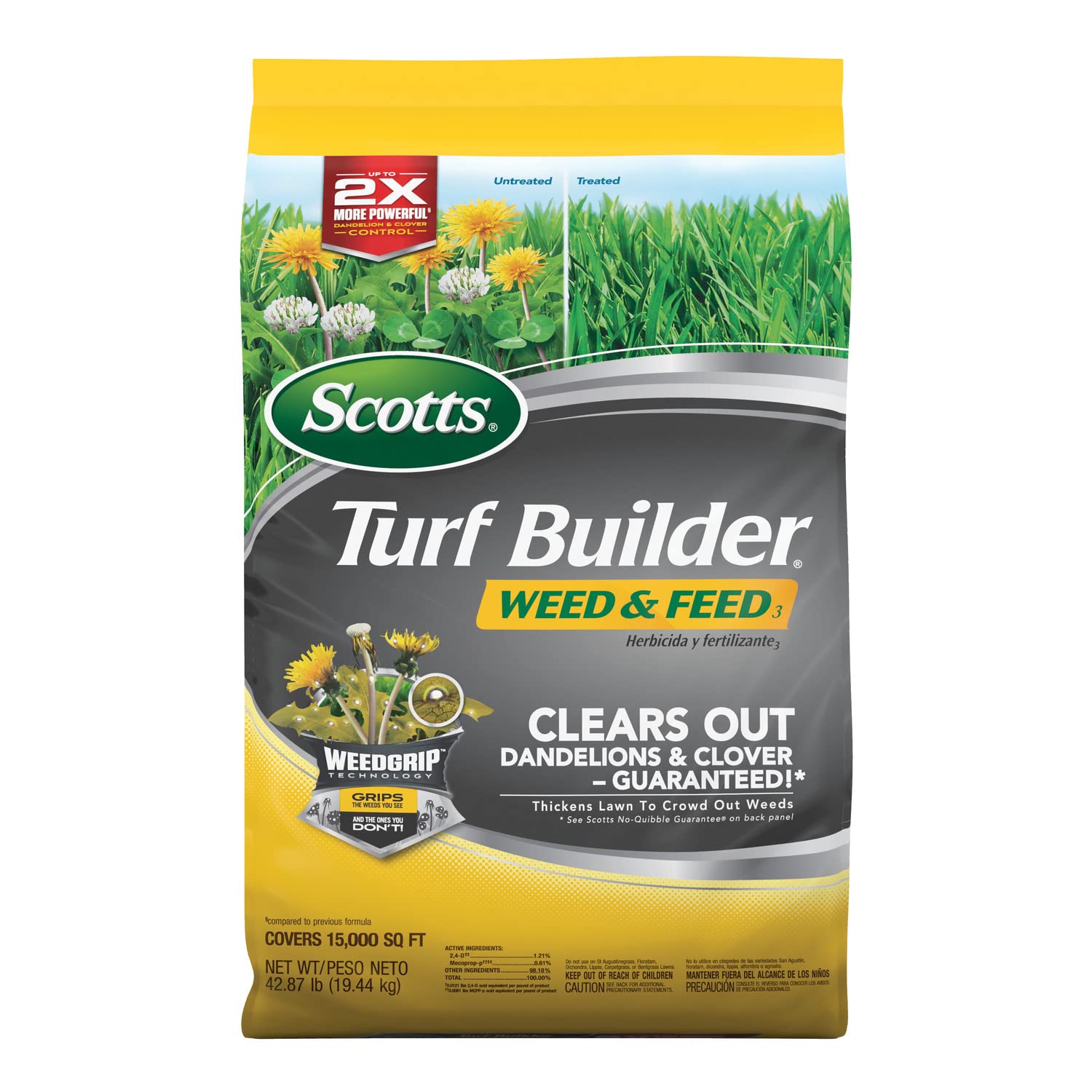
Pair it with Scotts Weed & Feed
Maximize your spreader’s potential. Scotts Weed & Feed is specifically calibrated to work seamlessly with the EdgeGuard Mini, killing dandelions while feeding your turf to thicken the root system.
Buy Fertilizer on Amazon7. Drop vs. Broadcast Spreaders: Which is Better?
If you are confused about which type of spreader you need, you are not alone. When comparing drop vs. broadcast spreaders, the decision comes down to yard size and shape.
Drop Spreaders: These drop fertilizer straight down between the wheels, exactly the width of the machine (usually 22 inches). They are incredibly precise and excellent for tiny yards or navigating around complex garden mazes. However, because the path is so narrow, it takes forever to cover a large yard, and overlapping lines can be difficult to gauge.
Broadcast Spreaders (Like the Scotts Mini): These throw the product in a massive arc (usually 5 feet wide). They cover ground significantly faster. Because the edges of the throw pattern naturally feather out, overlapping passes blend seamlessly, drastically reducing the risk of accidental fertilizer striping. For 90% of homeowners, a broadcast spreader is the superior choice.
8. Pros and Cons: The Final Summary
The Pros
- No Assembly: Ready to use straight out of the box.
- EdgeGuard Tech: Brilliant for keeping product off concrete and out of gardens.
- Perfect Capacity: Holds exactly 5,000 sq. ft. of product; ideal for suburban lawns.
- Compact Storage: The fold-down handle allows it to fit on tight garage shelves.
- Calibrated Dial: Takes the guesswork out of applying Scotts brand products.
The Cons
- Hollow Wheels: Fertilizer can get trapped in the wheels and drop in lines (requires a DIY tape fix).
- Plastic Tires: The hard plastic wheels don’t roll as smoothly over bumpy terrain as pneumatic rubber tires.
- Not for Estates: If your yard is over 10,000 sq. ft., refilling the tiny hopper will become annoying.
9. Competitor Comparison: Scotts Mini vs. Scotts DLX vs. Earthway
How does the EdgeGuard Mini hold up against its big brother and premium competitors?
| Feature | Scotts EdgeGuard Mini | Scotts EdgeGuard DLX | Earthway 2150 Commercial |
|---|---|---|---|
| Capacity | 5,000 sq. ft. | 15,000 sq. ft. | 50 lbs (Heavy Duty) |
| Edge Control | EdgeGuard Shield | EdgeGuard Shield | Ev-N-Spred (Adjustable Drop) |
| Tires | Hard Plastic | Hard Plastic | 13-inch Pneumatic Rubber |
| Best For | Small to Medium Suburbs | Large Yards (1/4 to 1/2 Acre) | Uneven Terrain / Professionals |
| Price Tier | Budget / Entry Level | Mid-Range | Premium ($$$) |
If you have a massive yard, you should upgrade to the DLX model simply to avoid constant refilling. If you have incredibly bumpy terrain, the pneumatic tires of an Earthway are worth the high cost. But for standard suburban lots, the Mini provides the best bang for your buck.
10. Maintenance & Storage: Preventing Rust
A spreader is a simple machine, but it will fail rapidly if neglected. Granular fertilizers are primarily composed of salts (nitrogen, phosphorus, potassium). If you leave fertilizer dust sitting inside the hopper mechanism, it will absorb moisture from the air and cause the metal axle, the spinning disc spring, and the trigger wire to rust solid.
The Cleaning Protocol: After every single use, pour any remaining fertilizer back into its original bag. Take a garden hose and aggressively wash out the inside of the hopper, the spinning disc, and the wheels. Leave the spreader in the sun to dry completely. Once dry, fold the handle down and store it in your garage or shed.
11. Final Verdict: Is the Scotts EdgeGuard Mini Worth It?
The Scotts Turf Builder EdgeGuard Mini is the quintessential homeowner’s tool. It doesn’t pretend to be a heavy-duty commercial unit; instead, it offers exactly what a weekend warrior needs: simplicity, compact storage, and foolproof calibration for standard lawn products.
While the hollow plastic wheels are a slightly annoying design oversight, applying a quick piece of duct tape solves the issue instantly. If your lawn is under 5,000 square feet and you want a reliable, easy-to-use spreader that ensures you never accidentally burn your grass or fertilize your driveway, the EdgeGuard Mini is an unbeatable value.
Buy the Scotts EdgeGuard Mini Today