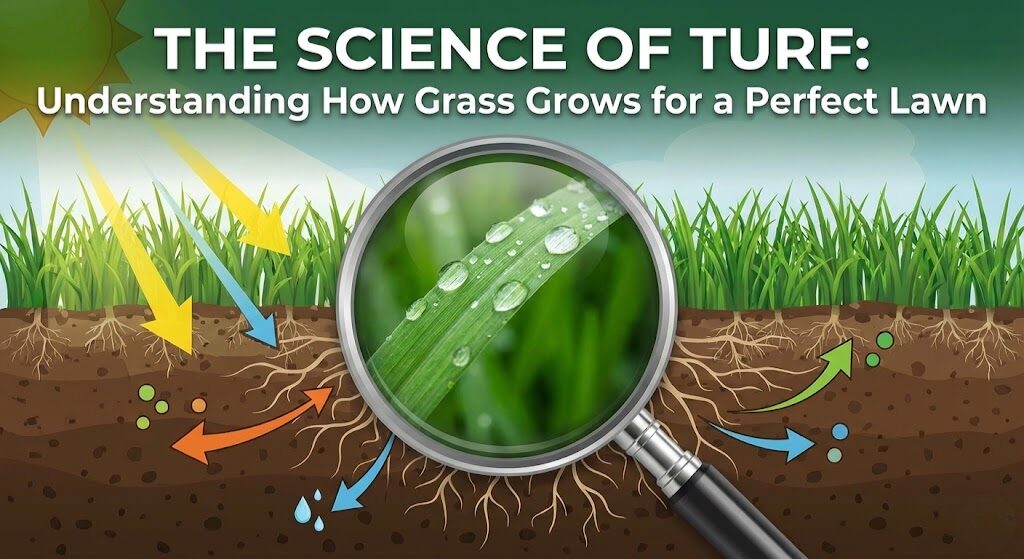
The Science of Turf: Understanding How Grass Grows for a Perfect Lawn
To the untrained eye, a lawn is simply a green carpet that needs occasional trimming. But to the horticulturist—and the serious homeowner—a lawn is a complex ecosystem of millions of individual plants fighting for resources. Understanding how grass grows is the single most important step in transitioning from a “yard owner” to a “turf manager.”
Grass is resilient, adaptable, and biologically fascinating. Unlike trees that grow from the tips of their branches, grass grows from the crown, situated near the soil line. This unique evolutionary trait allows it to be grazed by animals (or cut by your mower) without dying. In this comprehensive guide, we will dissect the biology of turfgrass, exploring everything from cellular respiration to root architecture, ensuring you have the knowledge to cultivate the best lawn on the block.
1. The Anatomy of a Grass Plant
To understand growth, we must first understand the machine. A grass plant is not just a blade; it is a system composed of several critical parts.
The Crown: The Heart of the Plant
The most vital part of the grass plant is the crown. Sitting just at the soil surface, the crown is the growth center where new leaves and roots originate. If the crown is alive, the grass can regenerate even if the roots are severed or the blades are scorched. If the crown dies, the plant dies.
The Blade (Leaf)
The blade is the solar panel of the plant. It captures sunlight to drive photosynthesis. The blade consists of the sheath (which wraps around the stem) and the lamina (the flat upper part).
Roots, Rhizomes, and Stolons
While roots anchor the plant and absorb water, many grasses also have lateral stems:
- Rhizomes: Underground stems that pop up new shoots (e.g., Kentucky Bluegrass).
- Stolons: Above-ground runners that root at nodes (e.g., St. Augustine, Centipede).

Inspect Your Turf Up Close
Use a simple macro lens to inspect grass blades for disease, dull mower cuts, or pest damage.
Check Price on Amazon2. Photosynthesis: The Energy Engine
Grass does not “eat” fertilizer; it eats sunlight. Fertilizer merely provides the raw materials (minerals) to build the machinery that processes sunlight. Through photosynthesis, chlorophyll in the grass blades absorbs light energy and converts carbon dioxide and water into carbohydrates (sugars).
These sugars are then:
- Burned immediately for energy (respiration).
- Used to build new cell walls (growth).
- Stored in the roots and crown for recovery from stress (dormancy/winter).
When you mow your lawn too short, you are effectively removing the plant’s solar panels, forcing it to dip into its root reserves to regrow leaves, which weakens the root system.
3. The Lifecycle: Germination to Maturity
Every blade of grass starts as a seed (or a vegetative node). The journey from seed to established turf involves three key stages:
1. Germination
Triggered by temperature and moisture, the seed absorbs water (imbibition) and swells. The first root (radicle) pushes down, and the first shoot (coleoptile) pushes up. This stage is critical and fragile; if the seed dries out now, it dies.
2. Vegetative Growth
Once the first true leaf unfurls, photosynthesis begins. The plant focuses entirely on producing leaves to capture energy. Tillering begins, where new shoots sprout from the base of the initial plant, thickening the turf.
3. Reproductive Stage
If left unmowed, grass will eventually produce a seed head (inflorescence). For a lawn owner, this is usually undesirable as it diverts energy away from root and leaf growth toward seed production.
4. Cool-Season vs. Warm-Season Growth Cycles
Not all grass grows the same way. The metabolic pathways differ based on the climate origin of the species.
| Feature | Cool-Season (C3) | Warm-Season (C4) |
|---|---|---|
| Examples | Fescue, Bluegrass, Ryegrass | Bermuda, Zoysia, St. Augustine |
| Peak Growth | Spring & Fall (60-75°F) | Summer (80-95°F) |
| Summer Behavior | Slows down, may go dormant | Explosive growth |
| Winter Behavior | Stays green longer, semi-dormant | Goes fully brown (dormant) |
5. The Foundation: Soil Health
You cannot grow great grass on poor soil. The soil provides physical support, water retention, and the nutrient bank. The most critical factor often overlooked is pH balance.
If your soil is too acidic or too alkaline, chemical “locks” occur, preventing the grass roots from absorbing nutrients even if you fertilize heavily. Before trying to stimulate growth, you must ensure the soil chemistry allows for it. For a detailed guide on this, read our article on step-by-step soil pH testing methods.

Stop Guessing, Start Testing
A digital soil meter gives you instant feedback on moisture and pH levels.
View on Amazon6. Turgor Pressure & Water
Grass consists of about 75-85% water. Water isn’t just for hydration; it provides turgor pressure. This is the internal pressure of water pushing against cell walls, which keeps grass blades standing upright.
When water is scarce, turgor pressure drops, and the grass wilts (turning a blue-gray color). Water also acts as the transport vehicle, carrying dissolved nutrients from the soil up through the xylem to the leaves. Without adequate water, growth stops immediately as the plant closes its stomata (pores) to preserve moisture, halting photosynthesis. To optimize this process, follow the best watering schedule for your lawn.
7. Nutrient Uptake (N-P-K)
For grass to grow, it requires three macronutrients, often represented as N-P-K on fertilizer bags:
- Nitrogen (N): The engine of growth. It drives the production of chlorophyll and amino acids. High nitrogen creates fast, green top growth.
- Phosphorus (P): Essential for energy transfer (ATP) and crucial for early root development.
- Potassium (K): The “health” nutrient. It regulates water use, strengthens cell walls, and improves stress tolerance against heat and cold.
Choosing the right delivery method matters. Learn the differences in our comparison of liquid vs. granular fertilizer nutrient release.
8. The Physiological Impact of Mowing
Mowing is a traumatic event for grass. When you cut a blade, you create a wound. The plant responds by:
- Sealing the wound: To prevent water loss and pathogen entry.
- Redirecting Hormones: Cutting the tip removes the source of auxins (growth hormones). This changes the hormonal balance, encouraging lateral growth (thickening) rather than vertical growth.
This is why frequent mowing creates a thicker lawn. However, removing more than 1/3 of the blade at once (“scalping”) shocks the plant, stopping root growth for days as it scrambles to replace the lost solar panels.

Consistent Cutting for Better Growth
Robotic mowers cut daily, providing the perfect hormonal balance for lateral spread and thickness.
See Robotic Mowers9. Root Systems & Depth
There is a direct correlation between the height of the cut and the depth of the roots. “Mow high, grow deep.” A lawn maintained at 3-4 inches will generally have a root system that extends 6-10 inches deep, allowing it to access moisture during droughts.
Roots constantly die off and regenerate. In the spring and fall, root growth is aggressive. In the summer heat, root growth in cool-season grasses often stops completely (root dieback), making the plant vulnerable.
10. Dormancy vs. Death
Grass has a built-in survival mechanism called dormancy. When conditions are too harsh (extreme heat or cold), the plant shuts down metabolic activity and turns brown to conserve energy for the crown.
Brown does not mean dead. A dormant lawn can stay alive for 3-4 weeks without water. However, if the crown dehydrates completely, the plant will die. Distinguishing between the two is vital for lawn care.
11. Reproduction & Spreading
Grasses spread in two ways:
- Sexual Reproduction (Seed): The plant produces flower heads. This is great for genetic diversity but bad for lawn aesthetics.
- Vegetative Reproduction (Cloning): This is how sod forms. Rhizomes and stolons extend from the parent plant to create genetically identical daughter plants.
Grasses like Tall Fescue are “bunch-type” and do not spread significantly; they grow in expanding clumps. Grasses like Kentucky Bluegrass and Bermuda are “creeping” grasses that weave a tight net of sod.
12. Managing Growth Stress
Grass wants to grow, but environmental factors constantly fight it. Compaction squeezes the air out of the soil, suffocating roots. Thatch (dead organic matter) builds up and prevents water from reaching the soil. Shade reduces the energy available for photosynthesis.
Successful management involves mitigating these stresses through aeration, dethatching, and overseeding. For a broader overview of managing these daily struggles, refer to our foundational guide on Lawn Care 101.

Breathe Life into Your Soil
Simple tools like aerators can relieve soil compaction and help roots expand.
Shop AeratorsFrequently Asked Questions
How fast does grass grow per day?
In peak growing season, healthy grass can grow between 0.05 to 0.2 inches per day, depending on the species, moisture, and nitrogen levels.
Does grass grow at night?
Yes, grass actually does most of its elongation (growth) at night or in the early morning, utilizing the sugars produced via photosynthesis during the day.
Why does grass stop growing in summer?
Cool-season grasses undergo “summer dormancy” when temperatures exceed 85°F to conserve moisture and energy, effectively pausing growth to survive the heat.
How long does it take for grass seed to germinate?
It varies by species: Ryegrass germinates in 5-7 days, Tall Fescue in 10-14 days, and Kentucky Bluegrass can take 21-30 days.
Does cutting grass make it grow faster?
Cutting grass stimulates the release of growth hormones to repair the damage, often causing a temporary surge in growth, but consistent over-mowing can stunt the root system.
Does grass need sunlight to grow?
Yes, all grass needs sunlight for photosynthesis. While some varieties (like Fine Fescue) are shade-tolerant, no grass can survive in total darkness or dense, deep shade.
What happens if I never mow my grass?
It will grow to its genetic maximum height (often 12-24 inches), produce seed heads, thin out at the base, and eventually resemble a patchy meadow rather than a dense turf.
Does watering at night cause fungus?
Yes, watering at night leaves moisture on the blades for hours, creating the perfect breeding ground for fungal diseases. It is best to water in the early morning.
Why is my grass growing in clumps?
This is likely a “bunch-type” grass like Tall Fescue. Unlike spreading grasses, it grows in isolated tufts. Overseeding is required to fill in the gaps.
Can grass grow in sand?
Yes, but it requires frequent watering and fertilization because sand has poor nutrient and water retention. Golf course greens are often grown on pure sand profiles.
Conclusion
Understanding how grass grows transforms the chore of lawn care into a science. By recognizing the role of the crown, the necessity of deep roots, and the delicate balance of photosynthesis and respiration, you can make informed decisions rather than guessing.
Your lawn is a living, breathing entity. Treat the soil as a living foundation, respect the mowing height, and feed the plant what it needs when it needs it. With this knowledge, you aren’t just cutting grass; you are cultivating a masterpiece.
Ready to take the next step? Ensure your equipment is ready for the season by learning how to sharpen your mower blades for the cleanest, healthiest cut.