Lawn Maintenance Guide
The Ultimate Guide to Lawn Aeration: Mechanical Plugs vs. Solid Spikes
You water, you mow, and you fertilize, yet your lawn still looks thin, patchy, and lackluster. Water seems to pool on the surface rather than soaking in, and the grass roots feel shallow. The culprit likely isn’t a lack of effort on your part, but rather a silent enemy beneath your feet: soil compaction.
Just like humans need oxygen to breathe, your grass roots need air to survive and thrive. When soil becomes dense and compacted from foot traffic, heavy rain, or clay composition, it chokes off the supply of air, water, and nutrients to the root system.
The solution is aeration—poking holes in the ground to facilitate gas exchange. But walk into any garden center, and you are faced with a confusing choice: Core Aeration (removing plugs of soil) vs. Spike Aeration (punching holes in the soil). Are they equally effective? Is one actually harmful?
In this comprehensive guide, we will settle the “Core Aeration vs. Spike Aeration” debate once and for all, helping you decide which method will transform your backyard into the lush oasis you deserve.
Understanding Soil Compaction: Why Your Lawn is Suffocating
Before choosing a tool, you must understand the problem. Healthy soil is composed of solid particles (sand, silt, clay) and pore space. In an ideal lawn, about 50% of the soil volume is pore space filled with air and water. This allows roots to expand deep into the earth and allows beneficial microbes to break down thatch.
Compaction occurs when pressure pushes these soil particles together, eliminating the pore space. The result is a dense, brick-like layer that roots cannot penetrate. If you have ever tried to stick a screwdriver into your lawn and it bent before entering the earth, you have severe compaction.

Before you aerate, know your soil. This simple tool helps you determine if your soil is compacted, dry, or pH unbalanced, ensuring your aeration efforts aren’t wasted.
Check Price on AmazonWhat is Core Aeration? (The Plug Method)
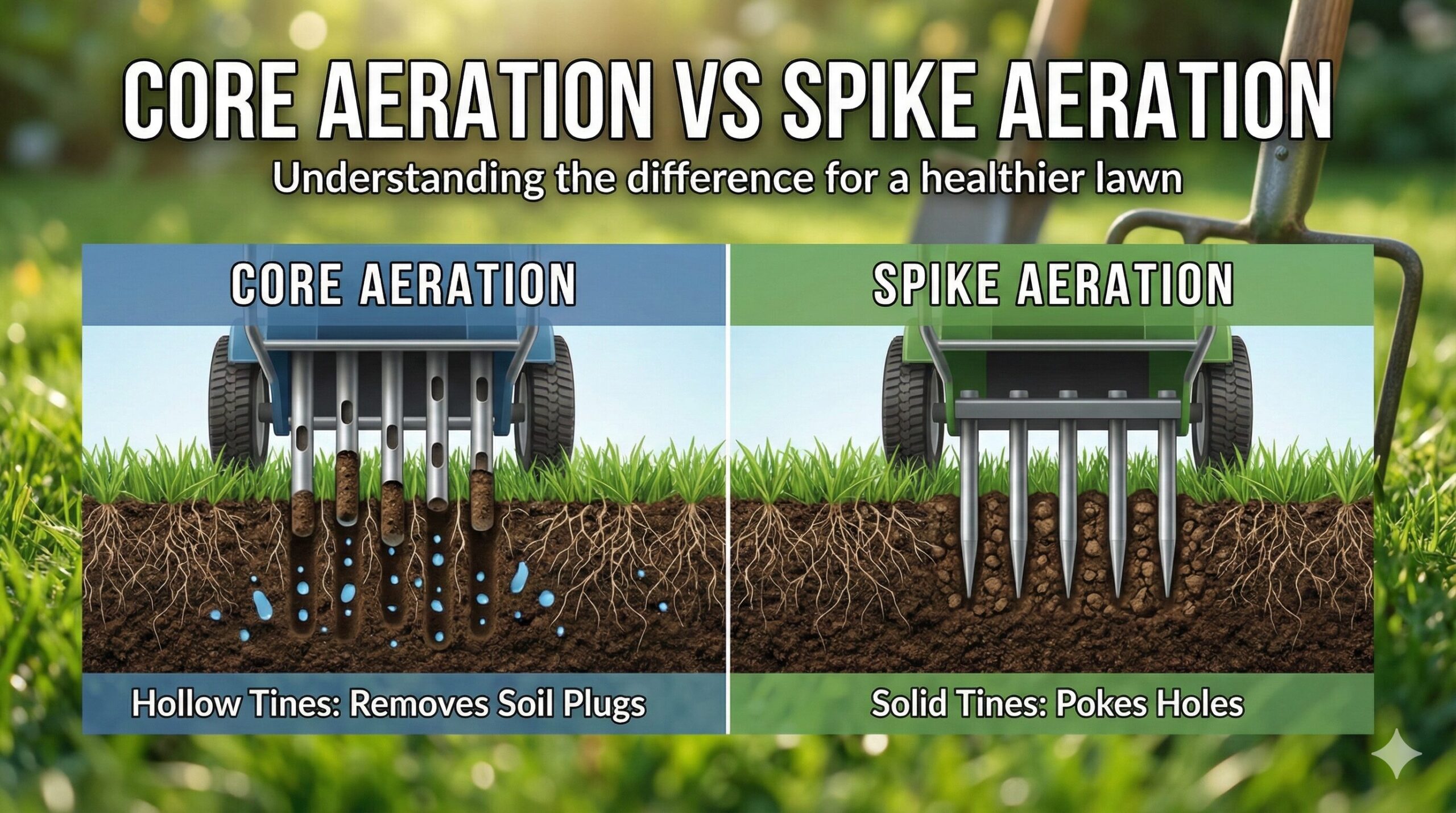
Core aeration, often called plug aeration, involves using a machine equipped with hollow tines. As the machine rolls over the lawn, these hollow tines physically punch into the ground and pull out a cylinder (or “plug”) of soil, thatch, and grass, depositing it on the surface.
The Mechanics of Core Aeration
By physically removing material from the ground, core aeration creates immediate voids in the lawn. This relieves the lateral tension in the soil, allowing the remaining soil to spread out and relax. It effectively reduces the density of the soil profile.
The Benefits
- True De-compaction: It is the only method that actually reduces soil density by removing mass.
- Thatch Management: By pulling up soil microorganisms to the surface, it helps decompose the thatch layer naturally.
- Root Growth: The open holes provide a path of least resistance for roots to grow deeper.
- Topdressing Integration: It creates pockets that catch compost or fertilizer, getting nutrients directly to the root zone.
If you are looking to truly improve soil drainage and reduce puddling, this is generally the superior method.
What is Spike Aeration? (The Solid Tine)
Spike aeration uses solid, wedge-shaped tines or spikes to punch holes in the ground. You often see these sold as “aerator shoes” (sandals with spikes on the bottom) or simple rolling push tools.
The Mechanics of Spike Aeration
When a solid object enters the ground, it does not remove soil. Instead, it displaces the soil sideways. Think of driving a nail into a piece of wood—the wood isn’t removed; it is compressed around the nail.
The Controversy
While spike aeration does create a hole for air and water to enter, it can inadvertently increase compaction in the soil immediately surrounding the hole. For this reason, many lawn care professionals advise against spike aeration for lawns with heavy clay content, as it essentially creates localized hardpan.
When is Spike Aeration Useful?
It isn’t useless. Spike aeration is acceptable for:
- Sandy Soils: Sand does not compact like clay, so the displacement issue is minimal.
- Pre-Seeding: If you are just trying to disturb the surface to ensure seed-to-soil contact, spikes work well.
- Small Areas: For tight corners where a large machine can’t reach.

Ideal for small, sandy lawns or quick surface agitation before seeding. Not recommended for heavy clay compaction relief.
Check Price on AmazonHead-to-Head: Core vs. Spike Aeration
Let’s look at the direct comparison to help you decide which is right for your specific situation.
| Feature | Core Aeration (Plug) | Spike Aeration (Solid) |
|---|---|---|
| Mechanism | Removes soil plugs | Punches holes (displaces soil) |
| Compaction Relief | High | Low (may increase local compaction) |
| Best Soil Type | Clay, Loam, Compacted Soil | Loose, Sandy Soil |
| Effort Level | High (Requires heavy machine) | Low to Medium |
| Thatch Reduction | Excellent | Poor |
| Frequency | Once a year (Fall or Spring) | Can be done more frequently |
Choosing the Right Equipment
If you have decided on core aeration (which we recommend for 90% of homeowners), you have options ranging from manual labor to heavy machinery.
1. Manual Core Aerators
These look like a pogo stick with hollow tubes at the bottom. You step on the bar, driving the tubes into the ground, and pull up.
Pros: Cheap, great for small patches.
Cons: Exhausting for large lawns.
2. Tow-Behind Core Aerators
If you own a riding mower, this is a fantastic investment. It hooks to your hitch and uses weights (like cinder blocks) to press the tines into the ground.
Pros: Fast, covers large acreage.
Cons: Requires a tractor/rider, storage space needed.
3. Gas-Powered Walk-Behind Aerators
These are the machines you rent from Home Depot or Lowe’s. They are heavy, self-propelled, and extremely effective.
Pros: Professional results.
Cons: Heavy to transport, expensive to buy (renting is best).

The ultimate homeowner solution for large lawns. Attaches to your lawn tractor to pull deep cores efficiently across acres of grass.
Check Price on AmazonWhen to Aerate Your Lawn
Timing is critical. You never want to aerate a dormant lawn or one suffering from drought stress. You want the grass to be in its peak growing phase so it can recover quickly from the mechanical stress.
Cool-Season Grasses (Fescue, Bluegrass, Rye)
The best time is Early Fall or Early Spring. Fall is generally preferred because weed pressure is lower, and it pairs perfectly with overseeding.
Warm-Season Grasses (Bermuda, Zoysia, St. Augustine)
The best time is Late Spring through Early Summer. You want to aerate once the grass has fully greened up and is growing vigorously.
Essential Post-Aeration Care
Once you have punched thousands of holes in your lawn, you have created the perfect environment for new growth. Do not waste this opportunity!
- Leave the Plugs: Do not rake up the soil cores. Let them dry out and break down naturally. They will return valuable nutrients and microorganisms to the soil surface. Mowing over them helps break them up.
- Overseed Immediately: The holes provide perfect seed-to-soil contact. This is the best time to thicken your lawn.
- Fertilize: Apply a high-quality fertilizer. It will fall into the holes and get straight to the roots.
Feeding Time: Not sure what to feed your lawn? Check out our guide on Lawn Fertilizing for expert tips.
- Topdress (Optional but Recommended): Spreading a thin layer of compost helps improve soil structure further.
Learn More: See how to boost your soil health in our article How to Topdress Lawn with Compost.
- Water: Keep the lawn moist to help the grass recover and seeds germinate.
Bonus: Is Liquid Aeration a Viable Alternative?
Recently, “liquid aeration” products have flooded the market. These are sprayable solutions containing surfactants (soap-like substances) and humic acids. They claim to break down bonds in the soil to create pore space chemically.
The Verdict: Liquid aeration is a great supplement to mechanical core aeration, but rarely a complete replacement for heavily compacted clay soils. It works well to maintain soil porosity between mechanical aerations.