Can I Use Topsoil to Level My Lawn? The Honest, Complete Answer
🌿 The Quick Answer: Yes, But With Important Caveats
If you’ve ever looked at your lawn and wondered whether that uneven, bumpy, or sunken section could be fixed with a bag of topsoil from the garden center — you’re already on the right track. The short answer is yes, you can use topsoil to level your lawn, but doing it correctly is where most homeowners trip up.
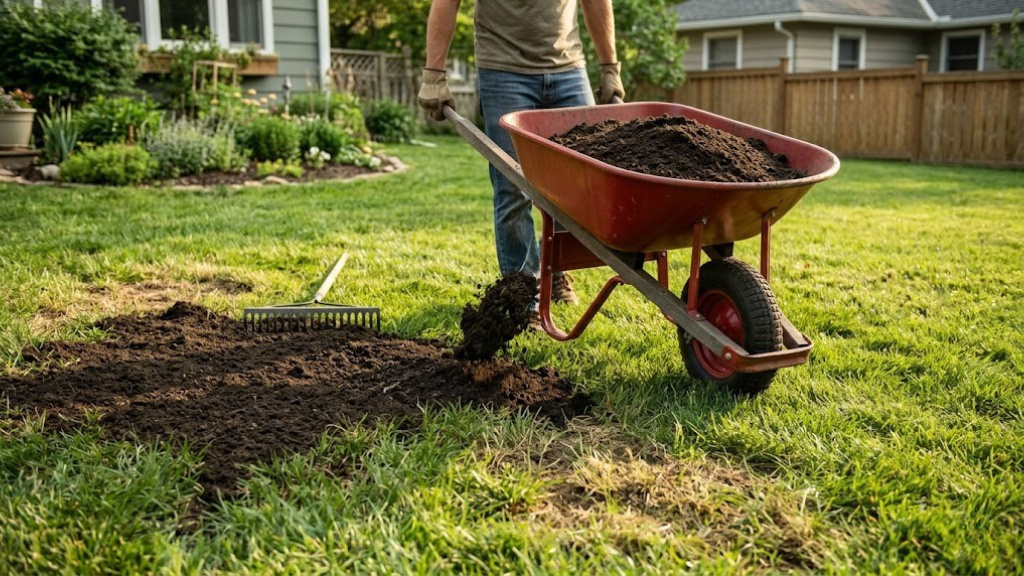
Pure topsoil applied too thickly will smother existing grass, introduce weeds, compact unevenly, and leave you worse off than before. But when used as part of a well-designed topdressing mix — in the right quantity, at the right time of year, spread and watered correctly — topsoil can transform a lumpy, uneven yard into a smooth, lush surface that looks like a golf fairway.
This guide walks you through everything: what type of topsoil to use, the exact mixing ratios, how deep you can apply it, what tools you’ll need, and how to care for your lawn immediately afterward to ensure full recovery and root penetration.
🪱 What Is Topsoil — And Is All Topsoil the Same?
Before you grab the first bag labeled “topsoil” at your local hardware store, it’s critical to understand that topsoil is not a standardized product. The term refers broadly to the uppermost layer of earth — typically the top 2 to 8 inches of ground — but beyond that, quality varies enormously depending on where it’s sourced, how it’s screened, and what it contains.
The Three Categories of Topsoil
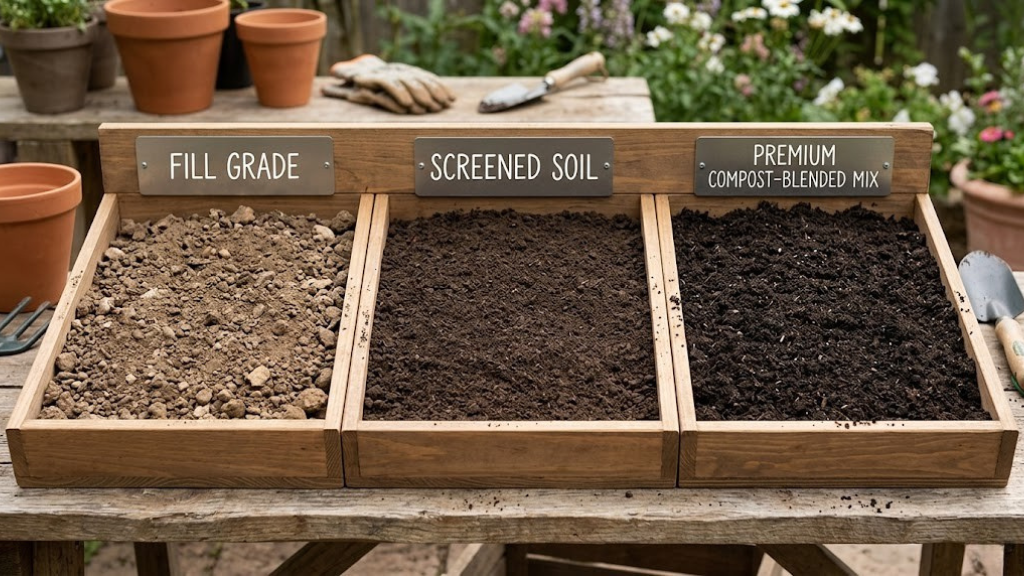
Walk into any garden center or call a bulk soil supplier and you’ll encounter roughly three tiers of topsoil quality:
- Economy/Fill Grade Topsoil: Cheap, minimally screened, often contains clods, rocks, debris, and a high weed seed burden. Suitable for bulk filling of large areas but not ideal for lawn leveling where you need a fine, uniform surface.
- Screened Topsoil: Passed through a sieve to remove large particles. Much more consistent in texture and better suited to lawn applications. Still may contain weed seeds and lack consistent organic matter.
- Premium Blended Topsoil: Often a screened topsoil mixed with compost or sand for improved structure, drainage, and nutrient content. The gold standard for lawn leveling. More expensive but delivers far better results.
What Makes Topsoil Good for Lawn Leveling?
When evaluating topsoil for lawn leveling specifically, you want to look for:
- Fine, uniform texture — so it settles evenly and doesn’t create new bumps
- Low clay content — heavy clay compacts and blocks drainage
- Some organic matter — aids grass root integration and moisture retention
- Low weed seed burden — buying heat-treated or composted mixes reduces weed pressure
- Reasonable drainage characteristics — neither too sandy (won’t hold moisture) nor too dense (waterlogging risk)
If you’re curious about how soil structure affects your turf’s overall health — including drainage issues that often cause low spots in the first place — our deep dive on improving lawn drainage and soil grading is an essential companion read to this article.
Topsoil Quality Ratings at a Glance
Here’s how the three grades of topsoil stack up across the metrics that matter most for lawn leveling:

🛒 Recommended: Premium Blended Topdressing Mix
A 50/50 topsoil-compost blend specifically formulated for lawn leveling — fine-screened, weed-reduced, and ready to spread.
🛒 View on Amazon⚖️ Topsoil vs. Other Lawn Leveling Materials
Topsoil isn’t the only option for leveling a lawn — and in many situations, it’s not even the best single material to use. Understanding how it compares to sand, compost, and blended topdressing mixes will help you make the right decision for your specific soil type and the severity of your lawn’s unevenness.
Lawn Leveling Material Comparison
Full Material Comparison Table
| Material | Best Use Case | Depth Limit | Cost | Weed Risk | DIY-Friendly |
|---|---|---|---|---|---|
| Screened Topsoil | Minor leveling, general fill | ≤ 1 inch | Low–Medium | Medium | ✔ Yes |
| Compost | Soil improvement + light leveling | ≤ 0.5 inch | Medium | Low | ✔ Yes |
| Coarse Sand (alone) | Drainage-heavy areas (professional use) | ≤ 1 inch | Low | Very Low | ✘ Caution |
| Topsoil + Compost Mix | Most lawn leveling scenarios | ≤ 1.5 inches | Medium | Low–Medium | ✔ Yes |
| Sand + Compost Blend | Heavy clay soils, drainage problems | ≤ 1 inch | Medium | Low | ✔ Yes |
| Lawn Topdressing Product | Premium, ready-to-use leveling | ≤ 1 inch | High | Very Low | ✔ Yes |
📅 When Should You Use Topsoil to Level Your Lawn?
Timing is one of the most overlooked aspects of lawn leveling. Apply topsoil at the wrong time of year and your grass won’t be able to grow through it fast enough — leading to smothering, bare patches, and weed invasion. Get the timing right and the grass pushes through the new layer within days, anchoring everything in place.
The Best Seasons for Topdressing and Leveling
The optimal window depends on your grass type. Cool-season grasses (Kentucky bluegrass, fescue, ryegrass) thrive in spring and fall leveling because those are their active growth periods. Warm-season grasses (bermuda, zoysia, St. Augustine, centipede) should be leveled in late spring through early summer when soil temperatures are rising and growth is accelerating.
Growth Activity by Season (Cool-Season vs Warm-Season Grass)
Grass Growth Activity vs. Ideal Leveling Windows
Specific Timing Recommendations
Best timing: Late August through October (fall) is ideal — the soil is still warm, growth is vigorous, and cooler air temperatures reduce stress. Early spring (March–April) is also good but can bring weed competition and moisture challenges. Avoid summer leveling entirely; the combination of heat stress and smothering from topsoil can kill large sections of lawn.
Best timing: Late spring through early summer — typically May through July when grass is in peak growth phase and can push through new material quickly. Avoid leveling in late summer/fall when the grass is heading toward dormancy; topsoil applied at this stage won’t integrate properly before winter. For more on summer lawn care, see our guide on lawn maintenance tips for summer.
Not recommended. While applying soil in winter won’t kill dormant grass, the material won’t integrate at all until spring — meaning it sits on the surface, compacts under rain and freeze/thaw cycles, and often creates new unevenness rather than correcting old problems. The one exception is very light topdressing of overseeded areas, done strategically in early winter in mild climates.
Never apply topsoil to waterlogged ground. Walking on saturated soil compacts it severely. Aim to level when the soil is moist but not wet — about 2–3 days after rain. Apply before a light rain forecast if possible; the rain will help the topdressing settle. Avoid applying before heavy rain, which can wash your carefully spread layer into low spots and undo your work.
🛠️ Step-by-Step: How to Use Topsoil to Level Your Lawn
Here is the complete, proven method for using topsoil or a topdressing mix to level an uneven residential lawn. This approach works for dips up to 1.5 inches deep in a single application. Deeper corrections require multiple applications spaced at least 4–6 weeks apart to avoid smothering the grass.
- Assess and map the uneven areas. Walk the lawn with a long, straight board or aluminum level and mark all low spots with spray paint or flags. Note the depth of each depression. Areas deeper than 3 inches need a different approach (cutting out turf, adding subbase, replacing sod).
- Mow shorter than usual. Cut your grass 1/2 to 1 inch shorter than your normal mowing height. This creates more surface area for the topsoil to make contact with the soil, rather than just sitting on top of the grass blades.
- Dethatch or aerate if needed. If your lawn has a thatch layer thicker than 0.5 inches, dethatch first. If the soil is compacted (as is common in low spots where water pools), aerate before leveling. This dramatically improves how quickly grass grows through the new layer. Learn about lawn aeration benefits to understand why this step matters.
- Prepare your leveling mix. For most lawns, blend 2 parts topsoil : 2 parts coarse sand : 1 part compost by volume. This gives you a workable, well-draining mix that doesn’t compact into a layer that blocks roots.
- Shovel the mix into low areas. Fill depressions generously at first — the material will compact slightly as you work it. Start with the deepest areas and work outward.
- Spread with a leveling rake or drag mat. Use a landscape or leveling rake to distribute the mix evenly across the area. Work the material down into the grass with the back of the rake. A drag mat (a piece of chain-link fence works well) can be pulled across larger areas for a smoother finish.
- Brush grass upright. Use a stiff broom or the back of your rake to brush the grass upright through the topdressing layer. You should still be able to see the grass tips — if the grass is completely buried, you’ve applied too much in one go.
- Check your level. Place your long board across the treated areas to verify you’ve achieved the right grade. Fill any remaining low spots and re-rake.
- Water thoroughly. Apply 0.5–1 inch of water immediately after leveling. This helps the mix settle, fills air pockets, and ensures the new soil makes good contact with existing roots.
- Monitor and follow up. Over the next 4–6 weeks, watch for areas that settle lower than expected. Plan a second application if needed. Avoid heavy foot traffic on leveled areas for at least 3–4 weeks.
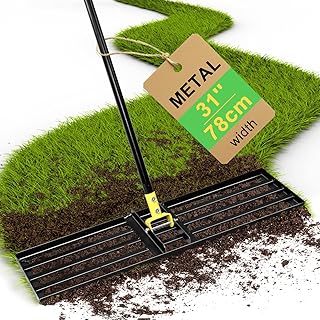
🛒 Lawn Leveling Rake & Drag Mat Set
Purpose-built 6-foot aluminum leveling rake with adjustable angle — designed specifically for topdressing and lawn leveling applications.
🛒 View on Amazon🧪 The Best Topsoil Mix Ratios for Lawn Leveling
One of the most common reasons homeowners get poor results when leveling their lawn is using straight topsoil without adjusting the blend to match their existing soil type. Your topsoil mix needs to match — or be slightly more drainage-friendly than — the soil beneath your lawn. If you apply a dense, clay-heavy topsoil over sandy native soil, you’ll create a perched water table effect where moisture sits at the interface between the two layers rather than draining through.
Recommended Mix Ratios by Soil Type
| Your Existing Soil | Recommended Mix Ratio | Why This Works | What to Avoid |
|---|---|---|---|
| Sandy soil | 60% topsoil : 30% compost : 10% sand | Adds structure and water retention without sealing | Heavy clay topsoil — will separate from sandy base |
| Clay-heavy soil | 40% topsoil : 30% coarse sand : 30% compost | Improves drainage, prevents additional compaction | Pure topsoil — will merge with clay and compact worse |
| Loamy soil | 50% topsoil : 25% compost : 25% sand | Close match to existing soil, easy grass integration | No significant restrictions — most flexible scenario |
| Silty soil | 40% topsoil : 40% coarse sand : 20% compost | Counteracts silt’s tendency to compact and seal | Compost-only mixes — silt + compost = dense layer |
| Unknown/Mixed | 40% topsoil : 40% compost : 20% sand | Balanced, forgiving blend that suits most situations | Gambling on pure topsoil from unknown source |
The Role of Organic Matter in Your Leveling Mix
Compost isn’t just a nice-to-have addition — it’s what bridges the biological gap between your existing lawn ecosystem and the new layer you’re applying. The microbial community in quality compost helps break down thatch, stimulates grass root activity, and creates a more hospitable environment for new growth to push upward through the leveling material.
Aim for a minimum of 20–30% compost in your leveling blend. Garden compost, mushroom compost, or worm castings all work well. If you’re interested in maximizing the organic health benefits of topdressing beyond just leveling, read our comprehensive guides on how to topdress your lawn with compost and how to add organic matter to your lawn.
📏 How Much Topsoil Can You Apply at Once?
This is the question that determines whether your leveling project succeeds or fails. The instinct is always to pour on as much as needed to fix the problem in one go — but that instinct will kill your grass. Understanding the depth limits of topdressing is fundamental to getting lasting results without needing to overseed or resod afterward.
The 1-Inch Rule Explained
The standard guidance from turf agronomists is to never apply more than 1 inch of topdressing material in a single application. The reason is photosynthesis: grass needs light to continue growing, and a layer thicker than roughly an inch effectively blocks enough sunlight that the grass beneath cannot generate the energy to push through it. Anything thicker than an inch in a single pass risks smothering the existing turf.
For shallow dips of half an inch or less, you can often correct the problem in a single application with minimal risk. For dips between 1 and 3 inches, plan for two to three application cycles spaced at least four weeks apart, allowing the grass to fully grow through and anchor each layer before applying the next. For depressions deeper than 3 inches, you’ll need to physically cut out the turf layer, add fill material, regrade, and re-lay or reseed — topdressing alone won’t cut it.
Depth-to-Repair Time Chart
Applications Required vs. Depression Depth
Signs You’ve Applied Too Much
- Grass blades are no longer visible above the topdressing surface
- Yellowing or whitening of grass leaves a day or two after application
- Spongy, uneven surface texture that feels unstable underfoot
- Water pooling on the surface instead of draining in (sealed layer)
- Weed germination in the new material before grass grows through
If you’ve over-applied, don’t panic. Use a leaf rake to thin the layer, redistributing excess material to low spots elsewhere in the yard. Water well and monitor recovery over the next two weeks.

🛒 Topdressing Spreader for Even Application
Calibrated rotary topdress spreader with adjustable gate opening — ensures consistent, controlled application depth every time.
🛒 View on Amazon🚫 8 Common Mistakes When Using Topsoil to Level a Lawn
Even with the best intentions, topsoil leveling projects often go sideways. Here are the eight mistakes we see most often — and exactly how to avoid each one.
What Works vs. What Doesn’t
✅ What Works
- Applying thin layers (≤1 inch) and repeating as needed
- Blending topsoil with compost and sand
- Mowing short before topdressing
- Aerating before application on compacted areas
- Timing to grass’s active growth period
- Watering immediately after spreading
- Using a leveling rake or drag mat for precision
❌ What Doesn’t Work
- Dumping thick layers (2–4+ inches) and hoping for the best
- Using pure clay-heavy topsoil on all soil types
- Leveling on tall grass without mowing first
- Skipping aeration on visibly compacted soil
- Leveling in extreme heat or during dormancy
- Leaving new topdressing dry for days after application
- Using a hand rake on large areas — imprecise and tiring
The 8 Mistakes in Detail
🌾 What to Do After Leveling Your Lawn with Topsoil
The work doesn’t end once you’ve spread and raked the leveling material. The four to eight weeks following application are critical — this is when the grass determines whether it thrives in the new environment or struggles, and your management decisions during this window directly affect the outcome.
Week-by-Week Post-Leveling Care Plan
| Week | Key Tasks | What to Watch For |
|---|---|---|
| Week 1 | Water daily (0.25 inch per day), no mowing, no traffic | Grass tips emerging through topdressing within 5–7 days |
| Week 2 | Light watering (3× per week), first fertilizer application | Grass blade growth visible; check for dry or bare patches |
| Week 3 | First mow when grass reaches normal height; normal watering resumes | Surface firmness improving; topdressing should feel anchored |
| Week 4–6 | Normal mowing and watering; assess need for second application | Fully integrated surface; no visible seams or layering |
| Week 6–8 | Second topdressing pass if needed; overseed bare spots | Consistent level surface; uniform grass density |
Should You Overseed After Leveling?
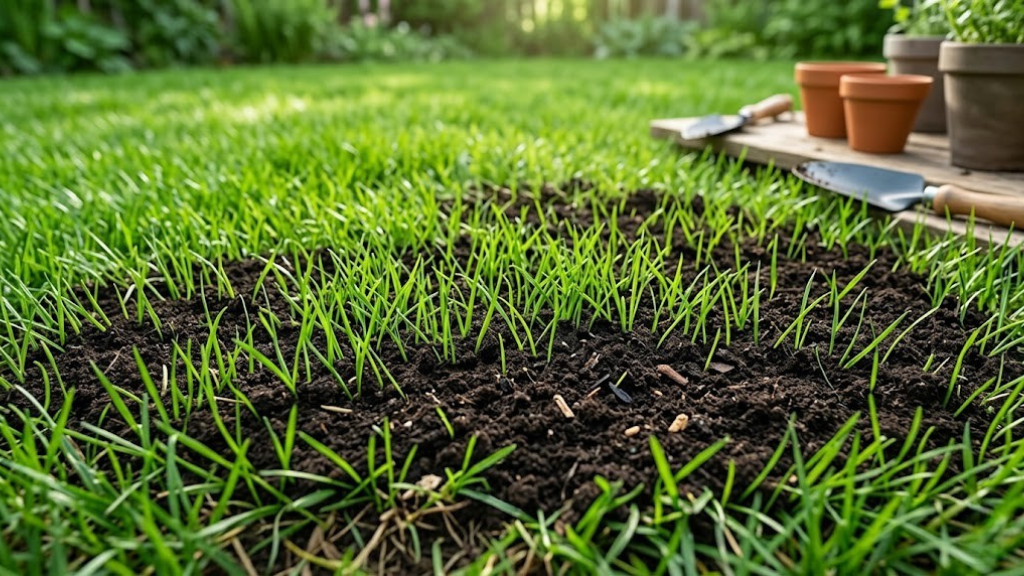
Not always — but often, yes. If your lawn had thin or bare patches before leveling, or if the topdressing process revealed compacted areas with poor coverage, overseeding is a smart move. Apply grass seed immediately after spreading and lightly watering the topdressing layer. The seed will settle into the top layer of the mix and germinate in the same conditions that help the existing grass grow through.
If you’ve had issues with a patchy or weak lawn beyond just leveling concerns — perhaps bare patches from drought, disease, or wear — our guide on how to revive a dead lawn covers the complete soil preparation, watering, and reseeding process from start to finish.
Watering After Topdressing: Getting It Right
The single most important thing you can do after leveling is water correctly. Too little and the topdressing dries out and forms a crust that blocks grass growth. Too much and you wash the material into low spots, undoing your leveling work. Here’s the formula that works:
- Day 1–3: Water thoroughly once per day (0.25–0.5 inch) in the morning
- Day 4–14: Water deeply every other day — deep watering encourages roots to grow downward through the new layer
- Week 3+: Return to your normal watering schedule, typically 1–1.5 inches per week
🧰 Tools You Need to Level a Lawn with Topsoil
The right tools make an enormous difference in both the precision of your work and the effort required. Trying to level a lawn with just a regular garden spade and a basic rake is frustrating and imprecise. Here’s everything you’ll need for a professional-quality result:
| Tool | Purpose | Essential? | Pro Tip |
|---|---|---|---|
| Landscape Leveling Rake | Even distribution and final grading | ✔ Essential | 6-foot+ width for large areas; aluminum for lightweight use |
| Wheelbarrow | Transporting and mixing soil blend | ✔ Essential | Use as mixing vessel — combine topsoil, compost, sand before applying |
| Flat Spade or Shovel | Scooping and placing material | ✔ Essential | Flat-bladed spade gives more control than round-point shovel |
| Drag Mat / Leveling Board | Final surface smoothing over large areas | Recommended | Piece of chain-link fence (3×4 feet) dragged across surface works perfectly |
| Push Lawn Roller | Lightly firming topdressing after spreading | Optional | Do not over-roll — one light pass is enough; more compacts too much |
| Lawn Aerator | Pre-leveling aeration of compacted soil | Recommended | Core aeration beats spike aeration — see our comparison of core vs spike aeration |
| Long Straight Board (8–10 ft) | Checking level across treated areas | ✔ Essential | Used as a visual guide — drag across surface to reveal high and low spots |
| Stiff Broom | Brushing grass blades upright through topdressing | Recommended | Work in circles over the topdressed area before watering |

🛒 Complete Lawn Leveling Starter Kit
Includes a 72-inch landscape leveling rake, drag mat, and leveling board — everything you need for a precision topdressing project.
🛒 View on Amazon❓ Frequently Asked Questions
Here are the most common questions homeowners have about using topsoil to level their lawn — answered with practical, actionable information.
Yes, absolutely — but you must apply it in layers no thicker than 1 inch at a time, use a blend (not pure topsoil alone), time the application to the grass’s active growth period, and water well immediately after. Applying thinner layers over multiple sessions is the safest way to correct significant unevenness without harming established turf.
For most lawns, a 2:2:1 blend of screened topsoil, coarse sand, and compost by volume is the most reliable all-purpose leveling mix. It provides enough structure for leveling, good drainage, and organic matter to support grass root growth through the new layer. Adjust the sand ratio upward for clay soils and the compost ratio upward for sandy soils.
In active growing season, most grass types will show visible growth pushing through a 0.5–1 inch topdressing layer within 5–10 days. Full integration — where the new layer feels anchored and the surface has uniform firmness — takes 3–5 weeks. This timeline shortens with warmer temperatures and appropriate watering.
Yes, though it’s more expensive per unit volume than bulk delivery. Bagged topsoil from reputable brands is typically screened and more consistent than cheap bulk topsoil. Check the label for added compost or perlite — these pre-blended products are often better than buying separate bags and mixing yourself. For small areas (under 200 square feet), bagged is perfectly practical.
The formula is: Area (sq ft) × Depth (inches) ÷ 12 = cubic feet needed. For example, leveling 500 square feet to a depth of 0.5 inch requires about 21 cubic feet, or roughly 0.8 cubic yards of material. Always order 10–15% extra for settling. Online soil calculators can help you estimate quantities based on specific dimensions.
Yes, in most cases — especially if your lawn has visible compaction, pooling water, or poor growth in the low spots you’re trying to level. Core aeration creates pathways for the topdressing mix to work into the root zone, dramatically improving integration. It also loosens the existing soil, making it easier for grass to push upward through the new material. The combination of aerating and topdressing is one of the most effective lawn renovation techniques available.
Yes — this is a real risk with low-quality topsoil sources. Cheap bulk topsoil often contains dormant weed seeds that will germinate enthusiastically when spread across a lawn. Minimize this risk by sourcing topsoil from reputable suppliers, choosing heat-treated products, blending with quality compost (which suppresses some germination), and applying a thin enough layer that the grass grows through it quickly, shading out potential weeds before they establish.
Topdressing refers to the practice of applying a thin, uniform layer of material across an entire lawn surface for soil improvement — not necessarily for grade correction. Lawn leveling specifically targets low spots, depressions, and uneven areas to bring the surface to a consistent grade. They use many of the same materials and techniques, but leveling involves strategic, targeted application to specific problem areas rather than uniform coverage across the whole lawn.
Neither on their own is ideal — a blend of both is optimal. Pure sand offers excellent drainage and leveling precision but provides no nutrients and can dry out rapidly, stressing grass roots. Pure topsoil may be too dense and can compact into a layer that impedes drainage. A blend of 40% topsoil, 40% coarse sand, and 20% compost hits the sweet spot of structure, drainage, and fertility for most leveling applications.
For areas larger than 1,000 square feet, order bulk topsoil delivery rather than bags. Rent a landscape leveling rake (6-foot aluminum) and a drag mat. Work in sections: dump material in heaps across the area, then rake and drag to spread evenly. A rear-mounted lawn tractor topdresser attachment can dramatically speed up large-area applications. For very large or severely uneven properties, professional laser grading may be more cost-effective than DIY correction.
Ready to Level Up Your Lawn?
Using topsoil to level your lawn is entirely achievable as a DIY project — as long as you respect the process. Choose quality screened topsoil blended with compost and sand, apply it in thin layers during your grass’s active growth period, rake it in carefully, keep the grass visible above the surface, water consistently, and exercise the patience to repeat the process over multiple cycles for deeper corrections.
The difference between a beautiful, level lawn and a patchy disaster comes down to preparation, the right materials, and timing. Do it right once and you won’t need to do it again for many years. Start with our full lawn care foundation at Lawn Care 101 if you want to build your knowledge base before tackling this project.
📖 Read the Full Lawn Leveling Guide