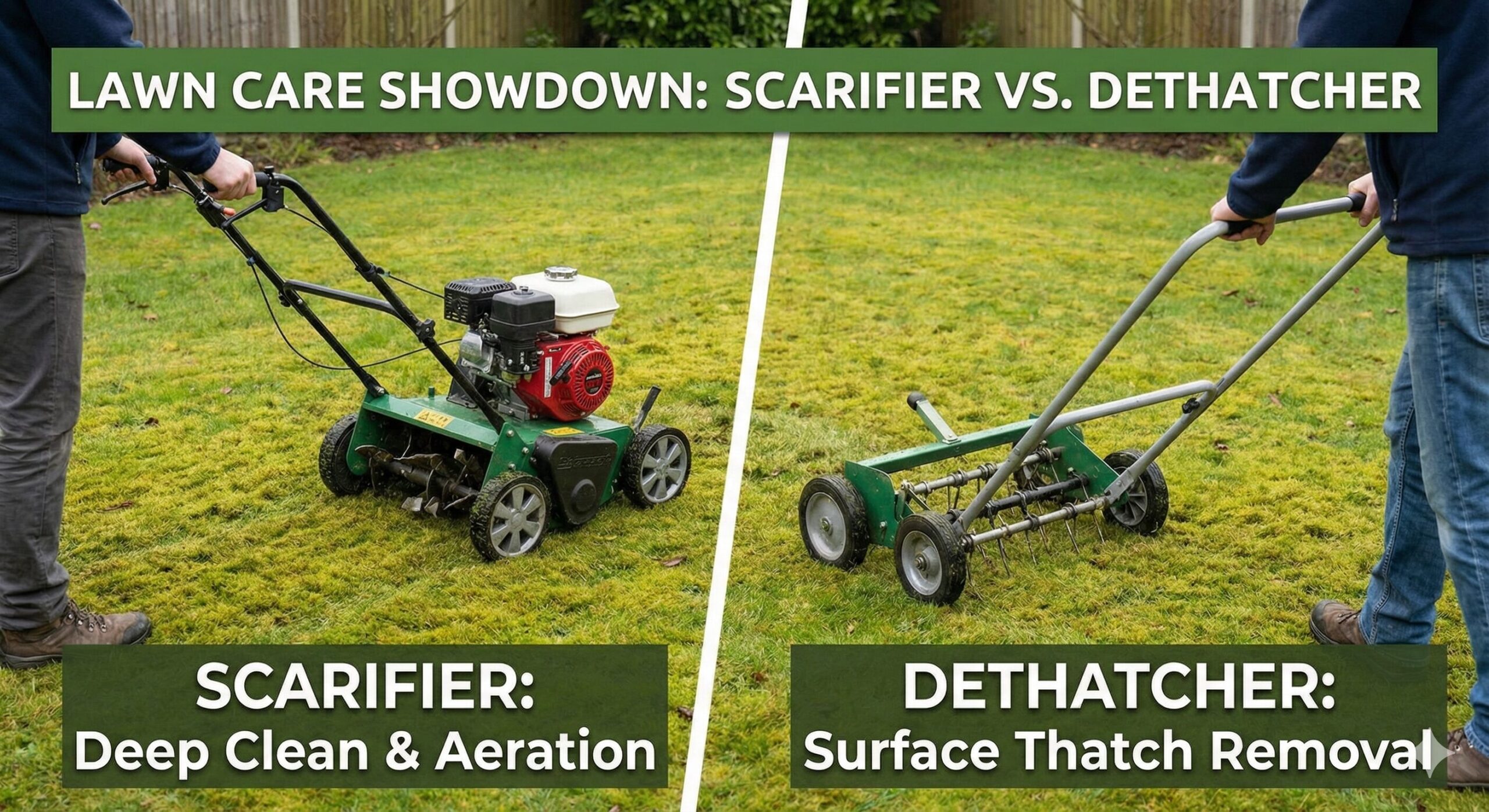
Lawn Renovation Guide
Lawn Scarifier vs. Dethatcher: Which One Saves Your Dying Lawn?
If your lawn feels spongy when you walk on it, or if you see patches of brown, matted material choking out your green grass, you have a debris problem. But when you head to the garden center or search online, you are hit with two terms that seem identical but are radically different: Dethatcher and Scarifier.
Confusing the two can be disastrous. Use a scarifier when you only needed a light dethatching, and you might tear up your lawn unnecessarily. Use a dethatcher when you have a moss infestation, and you won’t solve the root cause.
In this guide, we will break down the mechanics, intensity, and purpose of both tools. We will help you diagnose your lawn’s needs and recommend the best machinery to restore your turf to golf-course quality.
What is a Dethatcher? (The Gentle Groomer)
Think of a dethatcher as a heavy-duty comb for your lawn. Its job is to remove “thatch”—the layer of living and dead organic matter (grass clippings, roots, stems) that sits between the green grass blades and the soil surface.
How it works: Dethatchers use metal tines (like thick wires) or springs that spin rapidly. They skim the surface of the soil, flicking up the dead layer of debris without cutting deeply into the ground. It is a surface-level treatment designed to help air and water reach the soil.
Best for: Routine maintenance on lawns with less than 1/2 inch of thatch. It leaves the existing grass plant largely intact.
What is a Scarifier? (The Surgeon)
A scarifier is the aggressive big brother of the dethatcher. While a dethatcher tickles the surface, a scarifier cuts into it. This process is often called “verticutting.”
How it works: Instead of wire tines, a scarifier uses solid metal blades that rotate and slice vertically into the soil. These blades cut through the thatch, sever lateral grass roots (rhizomes and stolons), and groove the soil itself.
Best for: Removing heavy moss infestations, thick thatch (over 3/4 inch), and preparing a seedbed for overseeding. It will leave your lawn looking ragged and brown temporarily, but it promotes vigorous new growth.
Comparison: Dethatcher vs. Scarifier
Here is the quick breakdown of differences to help you choose.
| Feature | Dethatcher | Scarifier |
|---|---|---|
| Mechanism | Wire Tines / Springs | Solid Metal Knife Blades |
| Action | Teases/Combs surface | Cuts/Slices into soil |
| Intensity | Light to Medium | Heavy / Aggressive |
| Primary Target | Surface Thatch | Moss & Deep Thatch |
| Visual Aftermath | Lawn looks tidy | Lawn looks “ruined” (temporarily) |
| Frequency | 1-2 times per year | Once every 1-3 years |
When to Use Which Tool
Use a Dethatcher IF:
- Your thatch layer is about 1/2 inch thick.
- You want to spruce up the lawn in Spring or early Autumn.
- You don’t want a long recovery time for the grass.
Use a Scarifier IF:
- Your lawn feels like a sponge or carpet when you walk on it.
- You have visible moss growing in the turf.
- You plan to overseed immediately after. The grooves in the soil create the perfect seed-to-soil contact.
Top Tools Reviewed: Dethatchers, Scarifiers, and Hybrids
Many modern electric machines actually offer interchangeable cartridges, giving you both tools in one unit. Here are the best options currently available.

1. Sun Joe AJ801E Dethatcher & Scarifier (Best Hybrid)
The Sun Joe AJ801E is the market leader for a reason: it’s a 2-in-1 machine. It comes with two cylinders—a tined cylinder for dethatching and a bladed cylinder for scarifying—that you can swap out in seconds.
Why We Love It: It solves the debate by giving you both options. Use the spring tines for a light spring clean-up, and switch to the blades for a heavy autumn renovation.
Pros
- Includes both Scarifier and Dethatcher cylinders.
- 5-position depth control (-0.4″ to +0.4″).
- Powerful 12-amp motor handles thick grass.
- Includes a collection bag.
Cons
- Collection bag fills incredibly fast (better to use without).
- Plastic wheels can struggle on bumpy terrain.

2. Greenworks 10-Amp 14-Inch (Best Dedicated Dethatcher)
If you don’t need the aggressive cutting action of a scarifier and just want to maintain a healthy lawn, the Greenworks model is reliable, lightweight, and affordable. It focuses purely on tine-based dethatching.
Pros
- Stainless steel tines are durable and effective.
- 14-inch path makes for quick work.
- Very lightweight and easy to push.
- More affordable than hybrids.
Cons
- Does not scarify (tines only).
- No collection bag included (debris left on lawn).
- Cord management is required.

3. Agri-Fab 40-Inch Tow-Behind (Best for Large Lawns)
For those with riding mowers and large acreage, pushing an electric machine isn’t feasible. This Agri-Fab unit tows behind your tractor. It uses weight (cinder blocks you add) to press tines into the soil.
Pros
- Covers huge areas quickly (40-inch width).
- Heavy-duty steel construction.
- No motor to maintain.
- Rust-proof tines.
Cons
- Strictly a dethatcher (not a scarifier).
- Requires a lawn tractor or ATV.
- You must add your own weights for it to be effective.
Post-Treatment Care: The Most Important Step
Whether you dethatch or scarify, your lawn will look “beaten up” afterward. This is the critical window to help it recover stronger than before.
- Clean Up: Remove all the debris. A lawn sweeper or a mower with a bagger works best.
- Fertilize: Apply a high-quality fertilizer. The soil is open and ready to accept nutrients. See our guide on best lawn fertilizers.
- Water: Deep watering is essential immediately after treatment to help roots recover from the stress.
- Overseed: If you scarified, now is the time to spread grass seed. The grooves in the soil will protect the seeds and ensure germination.