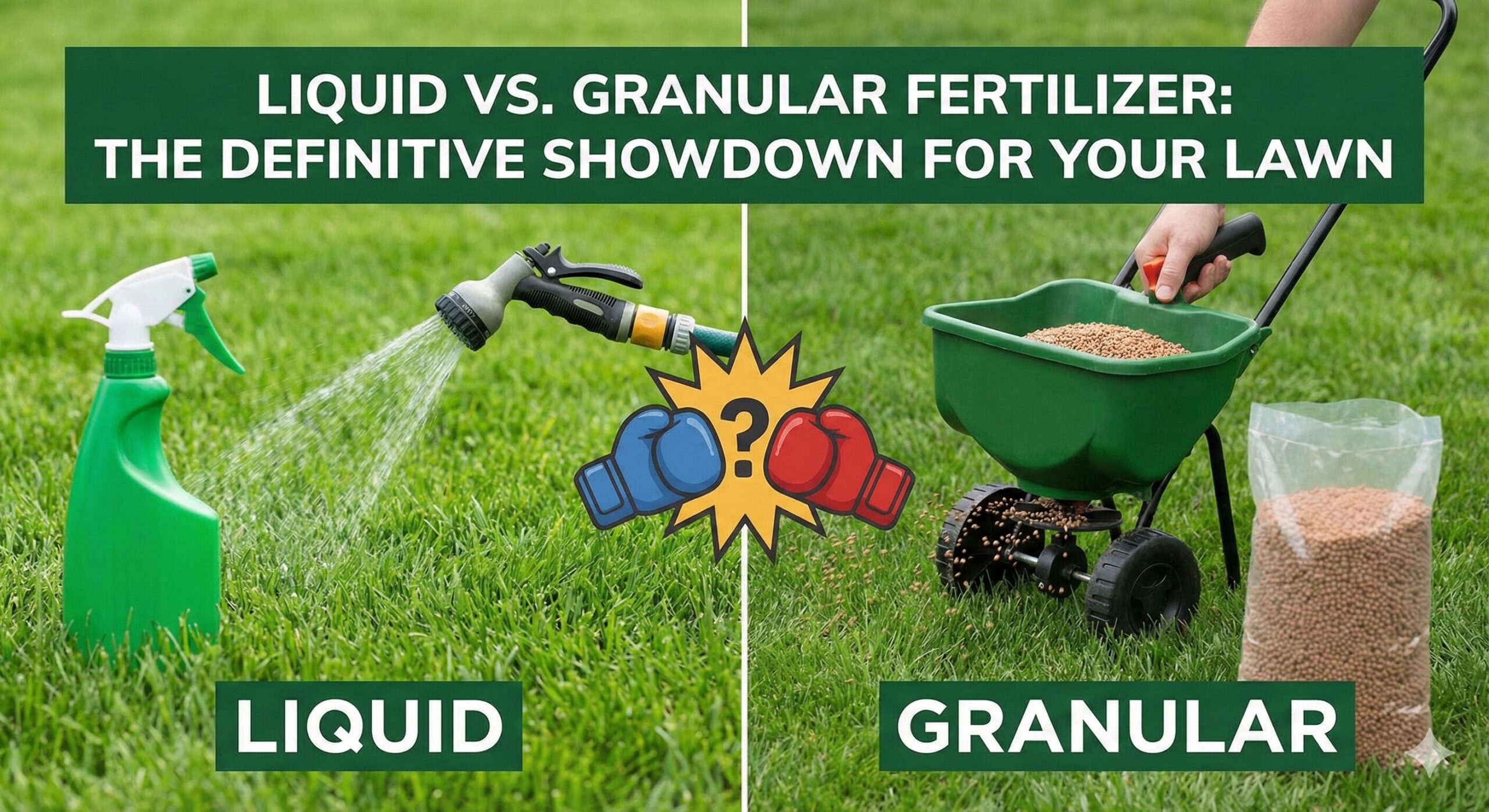
Liquid vs. Granular Fertilizer: The Definitive Showdown for Your Lawn
Every lawn owner eventually faces the choice: haul heavy bags of pellets or walk around with a hose-end sprayer? The debate of Liquid vs. Granular fertilizer isn’t just about convenience—it’s about how your grass eats. Choose the wrong one for your specific situation, and you might see no results—or worse, fertilizer burn.
In this comprehensive guide, we strip away the marketing hype to compare nutrient uptake, cost, ease of use, and equipment requirements so you can pick the perfect food for your turf.
⚡ Quick Decision: Which Should You Buy?
Short on time? Here is the cheat sheet based on your specific lawn goals:
- Choose GRANULAR if: You want a “set it and forget it” solution. You prefer feeding your lawn every 6-8 weeks and want slow, steady growth without a massive spike in mowing frequency.
- Choose LIQUID if: You need to fix a nutrient deficiency fast (yellowing grass) or you want total control over the application. It’s ideal for smaller yards or supplementing a granular program.
- The “Pro” Strategy: Use Granular in the Spring/Fall for the base, and use Liquid in the Summer for spot-treating and iron boosts.
Before applying either, it is critical to ensure your soil can actually absorb the nutrients. If your pH is off, neither method will work efficiently. Check our guide on how to test lawn soil pH before buying your fertilizer.
Granular Fertilizer: The Traditional Heavyweight
Granular fertilizers are dry pellets that you spread across the lawn using a broadcast or drop spreader. They sit on the soil surface and require water (rain or irrigation) to break down and release nutrients into the soil.
How It Works
Granular options are typically “slow-release.” They are coated in polymers or sulfur that break down gradually. This provides a steady drip-feed of Nitrogen (N), Phosphorus (P), and Potassium (K) to the roots over weeks or even months.
✅ Pros
- Long-lasting: Feeds for 4–8 weeks.
- Cheaper in bulk: More cost-effective for large acreage.
- Foolproof storage: Bags have a long shelf life.
- Easy to see: You can see where you’ve spread the pellets.
❌ Cons
- Needs water: Won’t work until watered in.
- Heavy lifting: Bags weigh 20–50 lbs.
- Slow results: Takes 5–7 days to see green-up.
- Runoff risk: Heavy rain can wash pellets into storm drains.
For those interested in organic granular options that improve soil structure over time, take a look at our Milorganite fertilizer review. It’s a biosolid fertilizer that virtually eliminates the risk of burning your lawn.

The Gold Standard for Granular: Scotts Turf Builder feeds and strengthens roots for a thicker lawn.
Check Price on AmazonLiquid Fertilizer: The Instant Energy Shot
Liquid fertilizer comes as a concentrate or a ready-to-spray hose-end bottle. Unlike granular, the nutrients are already dissolved, meaning the plant can absorb them immediately through both the roots and the leaf blades (foliar feeding).
How It Works
Because the grass absorbs the nutrients through its pores instantly, you will see a green-up in as little as 24 hours. However, because it’s processed quickly, the effects don’t last as long, usually requiring re-application every 2–3 weeks.
✅ Pros
- Instant Green: Visible results in 1-2 days.
- Uniformity: Easier to get an even application (no missed strips).
- Customizable: Great for mixing cocktails of Iron, Humic Acid, and Kelp.
- No sweeping: Leaves no pellets on driveways/sidewalks.
❌ Cons
- Frequent application: Doesn’t last long.
- Expensive: High cost per application on large lawns.
- Equipment fuss: Requires calibrating sprayers or carrying heavy tanks.

Instant Green-Up: Simple Lawn Solutions 16-4-8 creates a deep green color in days, not weeks.
Check Price on AmazonHead-to-Head Comparison
Let’s break down the differences side-by-side to see how they stack up in key categories.
| Feature | Granular Fertilizer | Liquid Fertilizer |
|---|---|---|
| Speed of Results | Slow (5-7 days) | Fast (24-48 hours) |
| Duration | Long (4-8 weeks) | Short (2-4 weeks) |
| Cost Efficiency | High (Best for large lawns) | Low (Best for small lawns) |
| Application Ease | Simple (Spreader) | Complex (Sprayer calibration) |
| Salt Content | Higher (Risk of burn) | Lower (Safer on stress) |
| Storage | Keep dry (Clumping risk) | Keep from freezing |
Buyer’s Guide: What Equipment Do You Need?
Your choice of fertilizer dictates your tool shed. Here is what to look for.
If You Choose Granular: Spreaders
- Broadcast Spreader: Fings pellets in a wide arc. Best for large open spaces (5,000+ sq ft). Look for pneumatic tires for a smoother ride over bumps.
- Drop Spreader: Drops pellets directly between the wheels. Essential for precise work near flower beds or sidewalks to avoid staining concrete.
If You Choose Liquid: Sprayers
- Hose-End Sprayer: The cheapest option. You screw the bottle onto your garden hose. It mixes water and concentrate automatically. Great for beginners but less precise.
- Backpack/Pump Sprayer: Gives you total control. You mix the product manually in the tank. Look for a sprayer with a flat-fan nozzle for even coverage.
Regardless of how well you fertilize, your lawn will look ragged if the cut is bad. Ensure you know how to sharpen lawn mower blades to prevent tearing the grass, which invites disease.

The “Cadillac” of Spreaders: The Scotts Elite features dual rotors for 5ft accuracy and holds enough for 20,000 sq ft.
Check Price on AmazonOwnership Costs & Maintenance
Granular Cost: Expect to pay roughly $40–$60 to cover 10,000 sq ft. Since you only apply 4–5 times a year, the annual cost is moderate.
Liquid Cost: A quart bottle might cost $25 but only covers 3,000–5,000 sq ft. Since you apply it twice as often, liquid programs can cost 2x–3x more annually for large properties.
Grass Type Matters: Hungry grasses like Bermuda need frequent nitrogen pushes, which can get expensive with liquids. Slower growers like St. Augustine might do better with slow-release granular. See our Bermuda vs St. Augustine grass guide to identify your lawn’s specific needs.
Troubleshooting Common Issues
Usually caused by user error with a broadcast spreader. Fix: Overlap your wheel tracks by 6 inches on each pass, or apply at half-rate in a criss-cross pattern.
Brown patches after application. Caused by spilling granular piles or applying liquid in high heat. Fix: Water immediately and deeply to flush the salts.
Liquid not coming out? Granular products dissolved in water often leave sediment. Fix: Use a mesh filter when pouring into your backpack sprayer.
Final Verdict
So, who wins the Liquid vs Granular fertilizer battle?
For 80% of homeowners, Granular is the winner. It provides the most “bang for your buck,” improves soil structure over time, and requires less frequent application. It is the backbone of a solid lawn care program.
However, Liquid is the perfect sidekick. Use it when you need a quick green-up before a backyard party, or during summer droughts when granular pellets won’t break down. The best lawns usually get a mix of both.